
The industrial center of gravity is shifting, and it is not moving to a different city, but to a different altitude. For decades, the gold standard of manufacturing has been the terrestrial foundry—massive, capital-intensive complexes like Intel's Leixlip campus in Ireland, where a recent 5.7 billion euro investment aims to scale the Intel 3 node for AI factories. Yet, this massive expenditure highlights a growing tension. We are spending billions to fight Earth's physical constraints, building automated track systems to integrate disparate modules into high-velocity environments, while the most significant breakthroughs in material science are now happening where those constraints vanish entirely.
Why does this matter right now? Because the delta between terrestrial capability and orbital potential has reached a breaking point. Twelve months ago, the conversation focused on the logistics of launch; today, the focus is on the logistics of fabrication. The recent FCC approval on July 9, 2026, for Reflect Orbital to launch the Eärendil-1 mirror satellite marks a regulatory pivot. We are no longer just sending tools into space; we are preparing to build the infrastructure of the cosmos in situ. When a company aims to deploy 50,000 satellites by 2035 to provide sunlight on demand, the traditional model of Earth-bound assembly and launch becomes a mathematical impossibility.
Atomic Precision Without the Polymer Mess
On Earth, the quest for ultra-clean manufacturing is a constant war against contamination and gravitational sagging. Researchers from the University of Southampton and the National University of Singapore recently unveiled a technique to build 2D heterostructures—materials just a few atoms thick—by replacing messy polymers with mica to achieve an atomically flat surface. While this is a breakthrough for quantum technology and electronics, it reveals a fundamental truth: we are using mica as a terrestrial workaround for a problem that does not exist in microgravity. In an orbital environment, the need for such stabilizers evaporates, allowing for the precise stacking of atomic layers without the interference of sediment or gravitational distortion.

Can we really expect terrestrial foundries to keep pace with this level of precision? The Southampton research suggests that making microchips faster and more reliable depends on this ultra-clean fabrication. However, as we push toward nanoelectronics, the physical limits of Earth-bound cleanrooms are being reached. The transition to orbital manufacturing allows for the creation of materials that are physically impossible to stabilize on Earth, potentially rendering current silicon-based nodes obsolete in favor of quantum-ready 2D materials.
The Precision Gap
The shift from polymer-based stacking to mica-based stacking in Singapore and the UK is a critical bridge. It proves that we can manipulate atomic layers, but it also underscores how much effort we spend compensating for gravity.
The Metallurgy of the Vacuum
Titanium alloys have become the backbone of aerospace and medical technology due to their mechanical strength and corrosion resistance. Currently, the market is evolving through advancements in powder processing and precision forging, but these are still bound by the physics of heat convection and sedimentation. In a microgravity environment, the way metals melt and solidify changes. Without buoyancy-driven convection, alloys can be created with a homogeneity that is unattainable in a ground-based furnace, leading to stronger, lighter materials for the next generation of spacecraft and orthopedic implants.
Consider the scale of the current ambition. Reflect Orbital's plan to launch via SpaceX's Falcon 9 by the end of 2026 is just the beginning. To reach a fleet of 50,000 satellites, the industry must move beyond shipping finished titanium parts from Earth. The economic logic dictates that we must manufacture these high-performance alloys in orbit, utilizing the vacuum and weightlessness to create structures that would collapse under their own weight during terrestrial fabrication.
| Feature | Earth-Bound Foundry (e.g., Leixlip) | Orbital Manufacturing |
|---|---|---|
| Material Stability | Subject to gravitational sagging | Atomically stable/flat |
| Contamination Risk | High (requires complex cleanrooms) | Low (vacuum environment) |
| Scaling Logic | Capital-heavy land expansion | Modular in-situ assembly |
| Metallurgy | Convection-limited alloys | Homogeneous crystal growth |
Computing Beyond the Atmosphere
The most immediate 'so what' is the emergence of the orbital data economy. QOSMIC, backed by Accel and Prosus, recently raised 3.33 million dollars to build optical ground stations. This is not just about communication; it is about the infrastructure required for orbital data centers. As computing moves into orbit, every satellite becomes a node. The collaboration between QOSMIC and TakeMe2Space to design optical terminals indicates that the industry is preparing for a world where the primary processing power for AI does not reside in a factory in Ireland, but in a network of orbital nodes.
"As computing moves into orbit, every satellite and every orbital data center becomes a node that needs a high-capacity link to Earth, and optical is the only technology that scales to what is coming."— Shreyaans Jain, Co-founder and CEO of QOSMIC
This creates a feedback loop. To build these orbital data centers, we need the 2D heterostructures and advanced titanium alloys discussed previously. We cannot launch a fully assembled orbital data center; the launch stresses are too high. Instead, we must manufacture the components in microgravity, using the very environment they are designed to inhabit. This represents a total departure from the Intel model of centralized, terrestrial hubs.
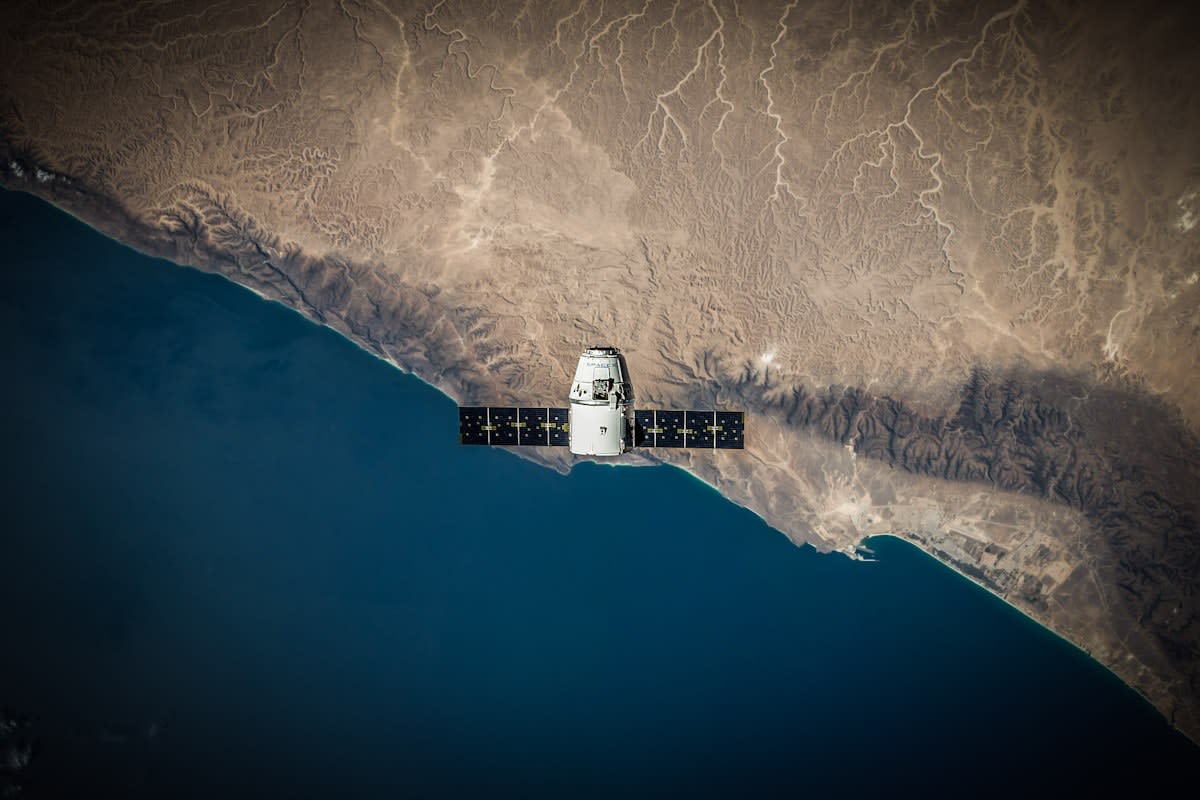
Does this render Earth-bound foundries obsolete? Not immediately. Intel's investment in the Xeon 6 and next-gen Xeon chips is essential for the ground-layer infrastructure. However, the ceiling for terrestrial manufacturing is fixed. The ceiling for orbital manufacturing is the edge of the solar system. The integration of Arizona State University's Mastcam-Z and the Niels Bohr Institute's calibration targets on the Perseverance rover shows that we already have the precision instrumentation to monitor and manage complex systems in extreme environments. The jump from monitoring to manufacturing is the final step.
The timeline is accelerating. With FCC approvals granted and venture capital flowing into optical ground stations, the transition is no longer theoretical. We are seeing a divergence in strategy: while traditional giants expand their footprint on the ground, the new guard is architecting the 'Highway to the Cosmos.' The winners of the next decade will not be those who build the biggest factory on Earth, but those who master the art of building without gravity.