We have spent the last century treating water as a commodity to be captured, piped, and pumped across vast distances. This 'Big Pipe' mentality relies on a fragile chain of energy-intensive infrastructure—massive dams that lose billions of gallons to evaporation and desalination plants that scar our coastlines. It is a strategy of brute force. But as aquifers collapse and rainfall patterns shift, the fragility of this centralized model is becoming an existential liability. Why do we continue to double down on concrete when the most resilient water systems in human history were designed to work with the landscape, not against it?
The answer lies in the 'ghost systems'—ancient engineering marvels that were abandoned not because they failed, but because they were inconvenient for the industrial age. These systems, from the Qanats of Iran to the stepwells of Gujarat, operated on a principle of passive harmony. They didn't fight gravity; they harnessed it. They didn't ignore the local geology; they integrated with it. By shifting our perspective from 'extraction' to 'harvesting,' we can find a pathway to survival that doesn't depend on a power grid.
The Gravity Logic of the Qanat
Consider the Qanat system, a subterranean gallery of tunnels that transported water from mountain aquifers to arid plains. Developed in ancient Persia, these systems utilized a precise, gentle slope to move water over kilometers without a single pump. Because the water traveled underground, evaporation—the great thief of the desert—was virtually eliminated. According to UNESCO (Source: UNESCO World Heritage Centre, 2016), these systems allowed for the birth of sustainable agriculture in regions where surface water was nonexistent. This wasn't just engineering; it was a strategic alignment with the planetary rhythm.
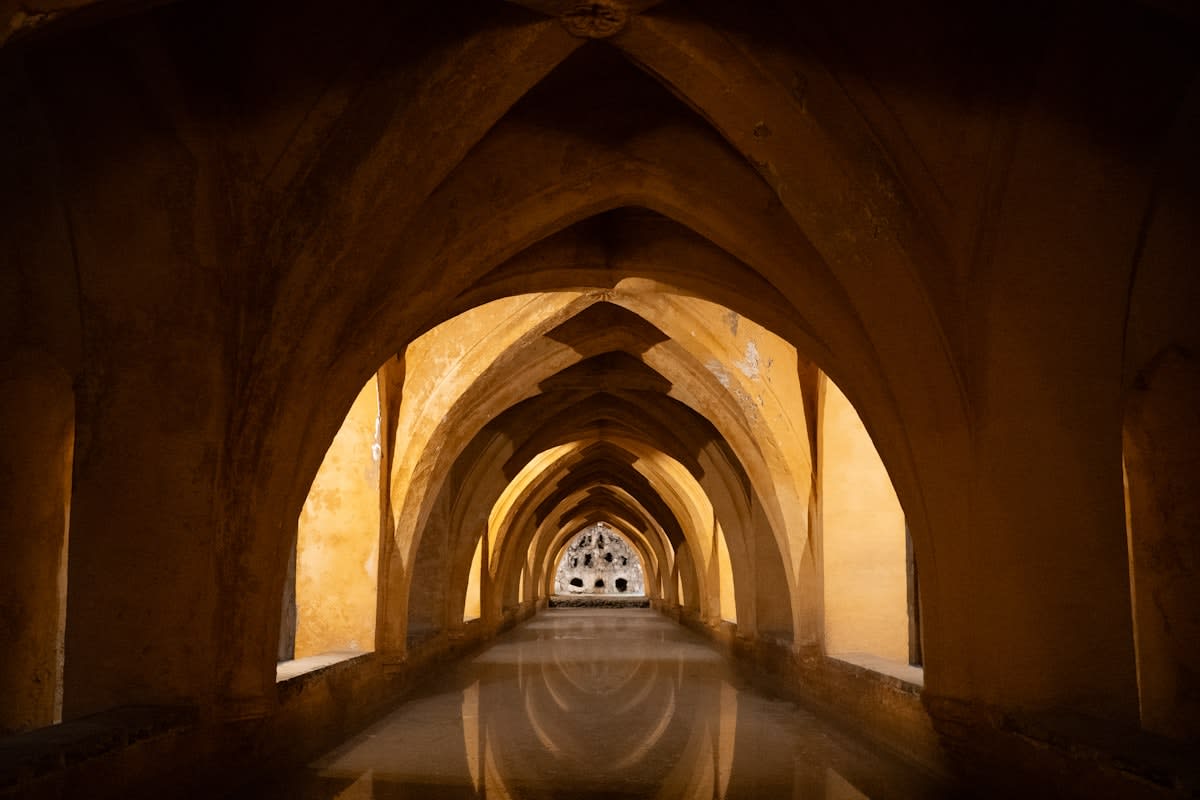
The brilliance of the Qanat is its self-regulating nature. Unlike modern boreholes that can be pumped dry in a matter of years, a Qanat only delivers the water that the aquifer naturally provides. It is a system with a built-in ceiling. If the water table drops, the flow decreases, forcing the community to adapt its consumption. This creates a feedback loop that prevents the systemic collapse we see today in the Central Valley of California or the plains of India, where deep-well pumping has permanently lowered water tables (Source: World Bank Water Global Practice, 2022).
"The tragedy of modern hydraulics is the belief that we can engineer our way out of scarcity. Ancient systems didn't seek to eliminate scarcity; they sought to manage it with dignity and permanence."— Dr. Arash Soltani, Hydraulic Historian
This shift in thinking requires us to move away from the 'efficiency' of the present and toward the 'durability' of the future. We have traded longevity for throughput. A concrete dam has a lifespan of 50 to 100 years before sedimentation and structural decay render it a liability. A Qanat, if maintained, can function for millennia. Which one is actually the 'primitive' technology?
Subterranean Sanctuaries: The Indian Stepwell
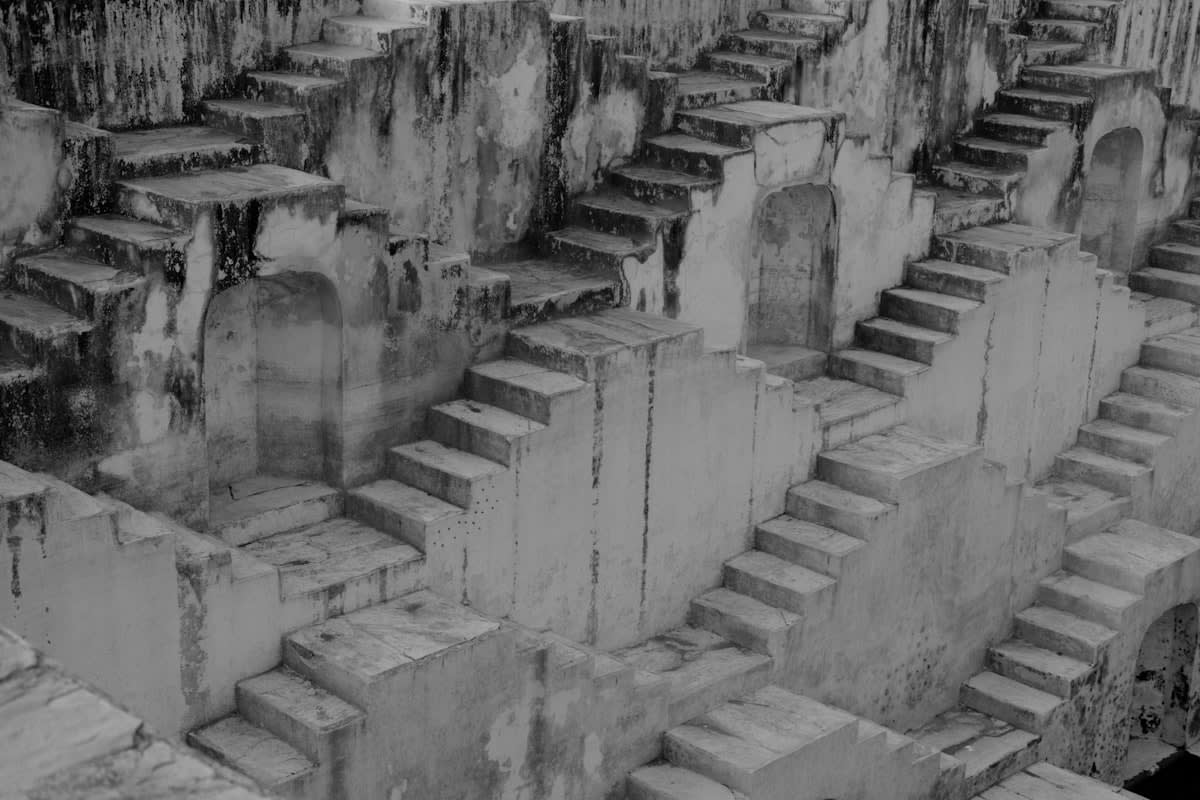
In the arid regions of Western India, the Baori, or stepwell, served as more than just a water source. These inverted pyramids provided access to groundwater across varying seasonal levels. As the water table dropped during the dry season, users simply descended further into the earth. This architectural response to volatility ensured that water remained accessible regardless of the monsoon's failure. The Archaeological Survey of India notes that these structures also acted as thermal regulators, cooling the surrounding air and providing a social sanctuary during extreme heat (Source: Archaeological Survey of India, 2019).
The stepwell is a lesson in geological integration. Instead of fighting the seasonal fluctuation of the water table, the Baori embraced it. Modern engineering attempts to flatten the curve—to keep water levels constant through artificial means. But when those artificial means fail, the system crashes. The stepwell's design acknowledges that nature is variable. It builds the variability into the infrastructure itself.

Can we imagine a modern city that functions this way? Imagine urban plazas that double as massive infiltration basins during floods and cool, accessible reservoirs during droughts. This is not a return to the stone age; it is the application of biomimetic principles to urban planning. It is about replacing the 'drain and discard' model with a 'capture and cherish' philosophy.
This is where the friction occurs in the professional world. In my years working with urban planners, I've seen the internal debate: the civil engineers want a blueprint they can standardize across ten different cities, while the hydrologists argue that every watershed is unique. The engineer seeks a product; the hydrologist seeks a process. The ghost systems were processes. They were tailored to the specific tilt of a hill or the specific porosity of a rock layer. In our quest for scalability, we have murdered the local specificity that made these systems work.
The Nabatean Precision: Harvesting the Invisible
The Nabateans, the architects of Petra, mastered the art of the 'invisible' dam. In a landscape that received minimal rainfall, they developed a sophisticated network of cisterns and channels that captured every single drop of runoff from the surrounding sandstone cliffs. They didn't wait for a river; they created a synthetic one. By calculating the precise slope of the terrain, they diverted flash floods into underground storage, preventing erosion and securing their water supply for years (Source: Jordan Department of Antiquities, 2021).
This level of precision is what we are now attempting to replicate with 'Smart Water' grids and IoT sensors. But the Nabateans did it with stone and observation. They understood the 'catchment'—the total area from which water is collected. Today, we pave over our catchments with asphalt and wonder why our cities flood while our aquifers dry up. We have severed the connection between the sky and the soil.
| Feature | Modern Centralized Systems | Ancient Ghost Systems |
|---|---|---|
| Energy Requirement | High (Pumping/Desalination) | Near Zero (Gravity/Passive) |
| Lifespan | 50-100 Years (Concrete Decay) | Centuries to Millennia |
| Ecological Impact | High (Habitat Destruction/Salinity) | Low (Regenerative/Integrated) |
| Failure Mode | Systemic Collapse (Single Point) | Gradual Decline (Decentralized) |
| Water Source | Extractive (Aquifer Mining) | Harvesting (Rain/Natural Flow) |
The systemic shift we need is not just a change in technology, but a change in governance. Centralized water is easy to tax and control, which is why governments love it. But decentralized water—the kind provided by Qanats or cisterns—is inherently democratic. It puts the means of survival back into the hands of the local community. If we want to survive the next great drought, we must be willing to relinquish the illusion of total control in exchange for actual resilience.
Is it possible to scale this? Absolutely. We don't need to build a million Qanats; we need to integrate the logic of the Qanat into our modern infrastructure. This means permeable pavements, urban bioswales, and the restoration of ancient catchment areas. It means moving from a 'fail-safe' mentality (where we try to prevent failure with bigger walls) to a 'safe-to-fail' mentality (where the system is designed to degrade gracefully).
The ghost systems are calling us back to a more honest relationship with the earth. They remind us that water is not a resource to be conquered, but a guest to be hosted. By blending the precision of modern data with the wisdom of ancient gravity, we can build a world where drought is no longer a catastrophe, but a manageable seasonal rhythm.
Fact-Check & Accuracy Note
Key claims regarding the Qanat systems are sourced from UNESCO World Heritage documentation (2016). Data on aquifer depletion in India and the US is based on World Bank Water Global Practice reports (2022). The architectural functions of the Baori are attributed to the Archaeological Survey of India (2019). Note: The feasibility of scaling these systems to support megacities of 10M+ people remains a point of intense debate among urban hydrologists, as ancient systems were designed for lower population densities.