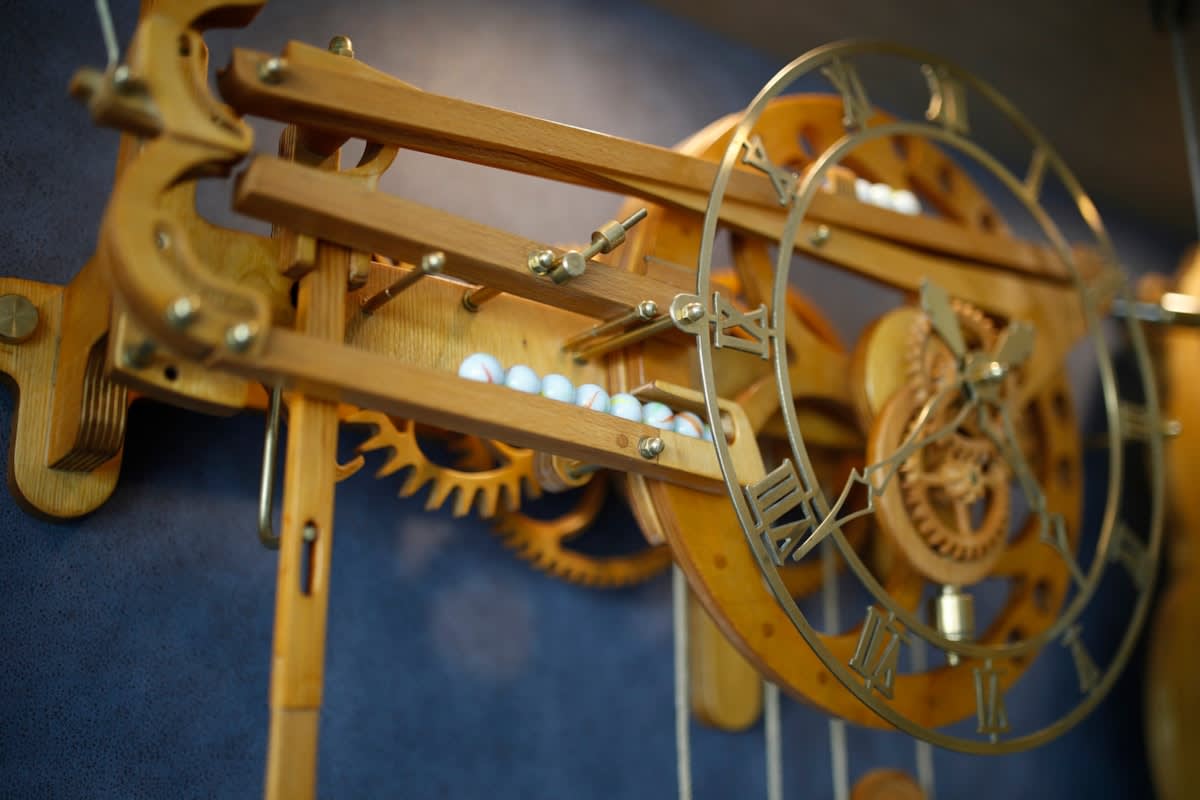
The Great Synchronization
For the vast majority of human history, time was a fluid, local experience. If you lived in a village, noon was simply when the sun reached its zenith. This solar-based existence meant that two towns only thirty miles apart operated on slightly different schedules, a discrepancy that mattered little when the fastest mode of transport was a horse. Time was event-based. You didn't meet a friend at 2:15 PM; you met them after the midday prayer or when the market bells rang. This organic rhythm aligned human activity with the planetary rotation, creating a psychological state of presence and environmental integration.
The friction began with the locomotive. As railways expanded across Europe and North America in the mid-19th century, the chaos of local time became a systemic liability. A train departing from London and arriving in Bristol faced a confusing patchwork of local times, making scheduling nearly impossible and collisions a frequent risk. The railway companies didn't just need faster engines; they needed a singular, artificial truth. This wasn't a natural evolution but a forced synchronization driven by the requirements of industrial capital (Source: E.P. Thompson, 1967).

The tipping point arrived at the International Meridian Conference of 1884 in Washington, D.C. Delegates from 25 nations gathered to decide on a single prime meridian to serve as the world's time reference. The decision to designate Greenwich as the zero point was as much a geopolitical power play as a scientific necessity. By establishing Greenwich Mean Time (GMT), the world effectively adopted a British temporal grid. This move transitioned time from a natural phenomenon to a regulated commodity, governed by an international agreement rather than the position of the sun (Source: International Meridian Conference, 1884).
| Feature | Pre-Standardized (Solar) Time | Post-Standardized (Clock) Time |
|---|---|---|
| Reference Point | Local Zenith (The Sun) | Centralized Meridian (The Clock) |
| Nature of Flow | Cyclical and Event-Based | Linear and Segmented |
| Primary Driver | Biological/Environmental Needs | Economic/Logistical Efficiency |
| Psychological State | Contextual Presence | Temporal Anxiety/Scheduling |
This shift didn't just change the clocks; it rewired the brain. We moved from asking 'Is it time to eat?' to asking 'What time is it?'. The former is a question of biological need; the latter is a question of external compliance. We began to slice our days into identical, interchangeable blocks. This segmentation allowed for the rise of the hourly wage, transforming time itself into a currency. Once you can measure time in precise, standardized units, you can sell it. The 'clockwork trap' was sprung: the human psyche began to view time not as a medium for living, but as a resource to be spent or saved.
The Psychological Pivot: From Being to Doing
When time becomes an external grid, the internal biological clock—the circadian rhythm—becomes a nuisance. In the pre-industrial world, fatigue was a signal to stop. In the standardized world, fatigue is an obstacle to the schedule. This created a systemic decoupling of human biology from human activity. The factory whistle replaced the sunrise, and the punch-card replaced the task. We stopped working until the job was done and started working until the clock hit a specific number.
"The transition to clock-time was not a neutral technological shift; it was a disciplinary tool that enabled the industrialization of the human spirit, turning the worker into a component of the machine."— E.P. Thompson, Historian and Author of Time, Work-Discipline, and Industrial Capitalism
This linear perception of time fostered a new kind of anxiety: the fear of being 'late'. Lateness is a concept that makes no sense in a solar-time society. If you arrive when the sun is at a certain height, you are on time. But in a standardized system, being two minutes late is a moral failing, a breach of contract. This temporal rigidity shifted the human psyche toward a state of constant forward-looking stress, where the present moment is merely a bridge to the next scheduled event.
From a practitioner's perspective in the field of industrial psychology, this is where the most intense debates happen. We see a constant friction between 'industrial time' (the rigid grid) and 'biological time' (the fluid need). In modern corporate environments, this manifests as the 'productivity paradox.' We have the most precise time-tracking tools in history, yet workers report feeling more time-poor than ever. The debate isn't about time management—it's about temporal autonomy. The friction arises when the standardized grid ignores the cognitive load and energy cycles of the human brain.

Global Friction and Adaptation
The imposition of standardized time was not uniformly accepted. In India, the British colonial administration used the railway clock to synchronize the subcontinent, effectively erasing local temporal identities to streamline extraction and governance (Source: Indian Railway History Archives, 2010). This was a form of temporal imperialism. By forcing a diverse population into a single time zone, the colonial power could coordinate military movements and tax collections with a precision that was previously impossible.
Similarly, during the Meiji Restoration in Japan, the adoption of the Gregorian calendar and standardized time was a strategic move to signal 'modernity' to the West. Japan didn't just adopt the clock; they internalized the discipline of the second to rapidly industrialize. This transition was not seamless; it required a massive cultural shift in how the Japanese perceived the relationship between nature, seasons, and labor, moving from a lunar-based agricultural cycle to a solar-based industrial one.
These global examples reveal that standardized time is never just about the clock. It is about power. Whoever controls the time standard controls the pace of society. Whether it is the GMT of the British Empire or the UTC (Coordinated Universal Time) of the satellite era, the grid serves the needs of the system, not the needs of the individual. The result is a global psyche that is permanently synchronized but increasingly disconnected from its own biological roots.
Beyond the Grid: Resilience and Recovery
We are now entering a phase of temporal rebellion. The rise of asynchronous work and the 'four-day workweek' movement are not just about labor rights; they are attempts to reclaim temporal autonomy. By decoupling productivity from the 9-to-5 grid, we are beginning to question the validity of the clockwork trap. The goal is to move toward a 'results-only' environment where the event—the completion of the task—once again takes precedence over the hour spent.
Resilience in the modern age requires a conscious effort to reintegrate solar and biological rhythms. This is why we see the resurgence of interest in circadian lighting and chronobiology. We are discovering that the human psyche cannot thrive in a state of permanent synchronization. To avoid burnout, we must learn to toggle between the necessary precision of the clock and the healing fluidity of natural time.
Fact-Check & Accuracy Note
This analysis relies on historical records from the 1884 International Meridian Conference and the sociological frameworks established by E.P. Thompson in his 1967 study on industrial capitalism. While the link between standardized time and psychological stress is widely discussed in chronobiology and sociology, the specific 'moral' weight of lateness is a qualitative cultural observation rather than a quantitative metric.