This free Mac app reveals the truth about your mystery USB-C cables
Source Entity
Sean Hollister
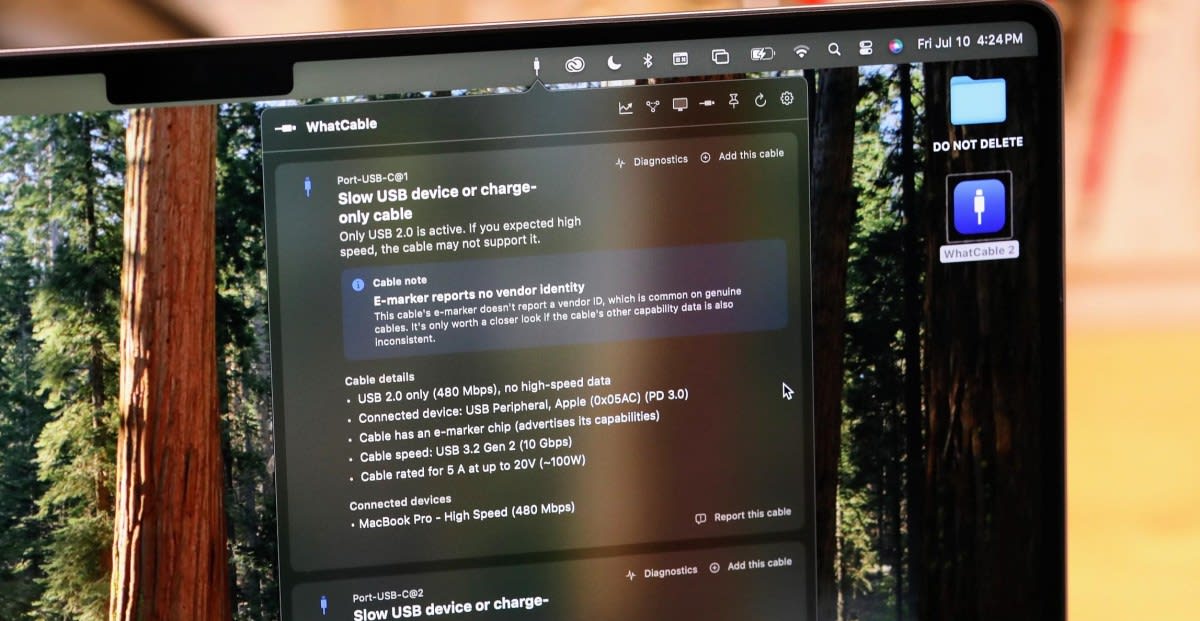
Nearly three years ago, I showed you an awesome $8 cable tester that quickly tells you if your USB-C cable is likely fast, slow, powerful, or weak. Sadly, that gadget got discontinued, and I've never found anything as intuitive or inexpensive since. But if you've got a Mac with Apple Silicon chips, you can simply […]
Unmasking the USB-C Mystery: Software-Driven Hardware Diagnostics
For years, the tech industry has promised that USB-C would be the "one cable to rule them all." However, this promise has come with a significant caveat: while the physical connector is standardized, the internal capabilities of these cables vary wildly. Users often find themselves with a drawer full of identical-looking cables, some of which can transfer data at 40Gbps and deliver 100W of power, while others are limited to USB 2.0 speeds (480Mbps) and basic charging. This phenomenon, often referred to as the "mystery cable" problem, creates a frustrating user experience where a simple cable swap can unexpectedly throttle a high-speed SSD or slow down a MacBook's charging speed.
The Technical Gap: Physical Form vs. Functional Spec
To understand why a dedicated app is necessary, one must understand the architecture of USB-C. The USB-C connector is merely the shell. The actual performance is determined by the wiring and the presence of an "e-marker" chip. High-power cables (those supporting over 60W) and high-speed cables (USB 3.1, 3.2, or Thunderbolt) require these chips to communicate their capabilities to the connected devices. Without a way to read this data, the user is left guessing. The mentioned free Mac app fills this critical void by leveraging the deep hardware integration of Apple Silicon chips to query the cable's internal identity, translating complex electronic signals into human-readable categories like "fast," "slow," "powerful," or "weak."
Transitioning from Hardware Testers to Software Solutions
Historically, the only way to truly verify a cable's specs was through dedicated hardware testers—such as the $8 gadget mentioned in the report. These physical devices acted as intermediaries, measuring voltage and data handshake protocols to determine the cable's grade. However, the discontinuation of affordable, intuitive hardware testers left a gap in the market. The emergence of a software-based solution for Apple Silicon Macs represents a significant shift in how we diagnose hardware. By utilizing the built-in capabilities of the M-series chips, the need for external dongles is removed, making hardware verification accessible to any Mac user without additional financial investment.
Broader Implications for Productivity and Hardware Longevity
The ability to distinguish between cable types has direct implications for professional productivity. For creative professionals moving terabytes of data from external NVMe drives, using a "slow" cable (USB 2.0) instead of a "fast" one (USB 3.2 or Thunderbolt) can turn a ten-minute transfer into a multi-hour ordeal. Similarly, in terms of power delivery, using a "weak" cable for a high-wattage laptop can lead to "slow charger" warnings or, in some cases, the battery draining even while plugged in. By providing transparency, this app prevents these bottlenecks and ensures that users are maximizing the ROI of their expensive hardware peripherals.
Future Trends in Hardware Transparency
This development points toward a broader trend of "software-defined hardware transparency." As devices become more complex and standardized connectors hide varying capabilities, we can expect more OS-level tools to reveal the hidden specs of connected peripherals. While the USB-IF (USB Implementers Forum) has attempted to standardize labeling (e.g., using logos for 10Gbps or 20Gbps), these labels are often missing or ignored by third-party manufacturers. Software tools like this Mac app act as a necessary check-and-balance, empowering consumers to hold manufacturers accountable for the specs they claim on the packaging.
Conclusion
In summary, the introduction of a free app to identify USB-C cable capabilities is more than just a convenience; it is a solution to one of the most persistent frustrations of the modern computing era. By transforming a Mac with Apple Silicon into a diagnostic tool, users can finally organize their cables with confidence and ensure their workflow is not being throttled by an invisible hardware limitation. This transition from niche hardware testers to integrated software utility marks a win for the average consumer in an increasingly opaque hardware ecosystem.