MacKenzie Scott's Giving, in Quality-Adjusted Life Years (QALYs)
Source Entity
Hacker News
<a href="https://news.ycombinator.com/item?id=48886311">Comments</a>
Quantifying Altruism: MacKenzie Scott and the QALY Metric
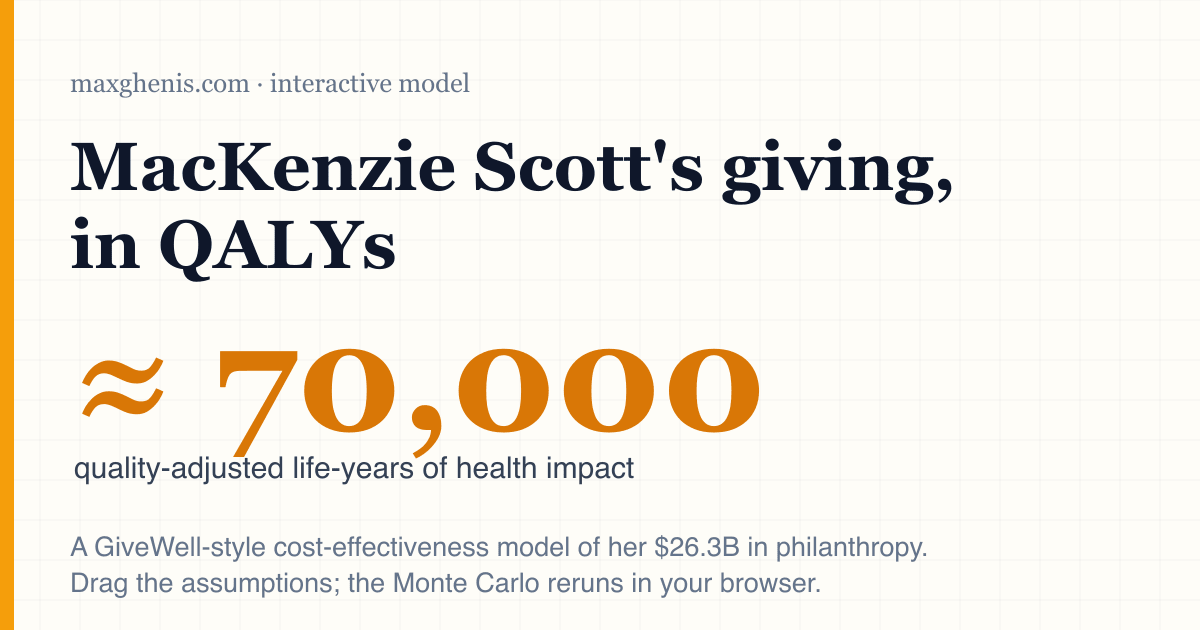
The intersection of extreme wealth and global health is often measured in raw currency, but a more sophisticated approach involves the use of Quality-Adjusted Life Years (QALYs). The discussion surrounding MacKenzie Scott's giving patterns highlights a critical shift in philanthropic analysis: moving from tracking the amount of capital deployed to quantifying the actual human impact and health outcomes generated by that capital.
Understanding QALYs in Philanthropy
QALYs are a generic measure of disease burden, encompassing both the quality and the quantity of life lived. In health economics, one QALY represents one year of perfect health. When applied to philanthropic analysis, this metric allows researchers to compare the effectiveness of vastly different interventions—such as funding malaria nets versus supporting systemic educational reforms—by estimating how many years of healthy life are gained per dollar spent. This transforms a financial ledger into a human-centric impact report.
The Tension Between Trust-Based Giving and Metric-Driven Analysis
MacKenzie Scott has gained global recognition for her "trust-based" philanthropy, characterized by large, unrestricted grants provided to organizations without the exhaustive reporting requirements typically demanded by traditional foundations. This approach stands in contrast to the Effective Altruism (EA) movement, which prioritizes rigorous, data-driven evidence to maximize the "good" done per dollar. The attempt to analyze Scott's giving through the lens of QALYs represents a conceptual bridge between these two philosophies: it respects the autonomy of the grantees while still attempting to derive a macro-level understanding of the benefit to global human longevity and wellness.
Broader Implications for Wealth Redistribution
Applying health-economic metrics to unrestricted giving provides a framework for other ultra-high-net-worth individuals to evaluate their societal contributions. By translating billions of dollars into QALYs, analysts can visualize the scale of impact in terms of lives saved or improved. This methodology suggests that while the method of giving (unrestricted vs. restricted) is a matter of strategy, the ultimate goal remains the maximization of human wellbeing and the reduction of global suffering.
Conclusion
By framing MacKenzie Scott's contributions in terms of QALYs, the discourse moves beyond the spectacle of wealth and toward a scientific evaluation of altruism. This analysis underscores the importance of translating financial generosity into tangible human outcomes, providing a deeper understanding of how strategic wealth redistribution can fundamentally alter global health trajectories.