'Living in Norway changed how I think about childhood': Man compares kids in India and Norway
Source Entity
Latest News: Today's Latest News Headlines from India & World | Hindustan Times | Hindustan Times
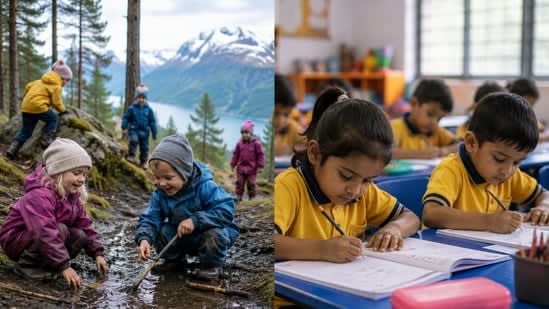
A man's comparison of childhood in Norway and India has started a conversation about early learning and education.
The Great Pedagogical Divide: Analyzing Childhood in Norway and India
Recent social media discourse has been ignited by a man's reflections on the stark contrasts between childhood in Norway and India. This comparison transcends a simple personal anecdote, touching upon the fundamental philosophies of early childhood development and the societal pressures that shape a child's formative years. The core of the discussion lies in the tension between the Nordic model of 'learning through play' and the traditional Indian model of 'academic excellence through discipline.'
The Nordic Philosophy: Autonomy and Nature
In Norway, the approach to childhood is deeply rooted in the concept of Friluftsliv (open-air living) and a belief that children should be allowed to be children. Formal schooling typically begins later than in many Asian countries, with a heavy emphasis on social-emotional learning, creativity, and physical exploration. By prioritizing autonomy and allowing children to interact freely with nature, the Norwegian system aims to foster resilience, independence, and a lifelong love for learning. This environment reduces early-age stress and promotes a holistic development path where the psychological well-being of the child is paramount.
The Indian Paradigm: Competition and Rigor
Conversely, the Indian educational landscape is often characterized by intense competition and an early introduction to formal academic structures. Driven by a high-density population and a hyper-competitive job market, there is significant pressure on children to excel in STEM subjects from a very young age. While this rigor often produces individuals with exceptional technical skills and a strong work ethic, it can come at the cost of unstructured play and creative exploration. The man's comparison highlights a systemic drive toward achievement that often begins in preschool, reflecting a societal belief that early academic discipline is the primary gateway to future success.
Societal Implications and Mental Health
The divergence in these two approaches has profound implications for the mental health and cognitive development of children. The Norwegian model's focus on low-pressure environments is linked to lower rates of childhood anxiety and a stronger sense of self-efficacy. In contrast, the high-pressure environment in India, while producing top-tier global professionals, has been linked to increased stress and burnout among students. This viral conversation serves as a mirror to a growing global realization that academic metrics alone are insufficient measures of a child's growth and potential.
Global Trends and the Shift Toward Holistic Learning
This comparison arrives at a time when educational trends are shifting globally. Many countries, including India through the National Education Policy (NEP) 2020, are attempting to integrate more play-based and experiential learning into early childhood education. The resonance of this man's story suggests a growing appetite among parents and educators to move away from rote memorization and toward a more balanced approach that incorporates the strengths of the Nordic model—such as critical thinking and emotional intelligence—without sacrificing the discipline inherent in the Indian system.
Future Outlook: Toward a Hybrid Model
Looking forward, it is likely that we will see a gradual convergence of these philosophies. As the global economy increasingly values 'soft skills' like adaptability, creativity, and empathy over pure technical proficiency, the 'Norway style' of childhood is becoming more attractive to parents worldwide. We can predict a trend where Indian urban centers, in particular, adopt more holistic early-learning centers that prioritize outdoor play and emotional health, recognizing that a child who is allowed to explore freely is often better equipped for the complexities of the modern workforce.
Conclusion
Ultimately, the comparison between Norway and India is not about determining which system is 'better,' but about understanding the trade-offs between freedom and structure. The dialogue sparked by this account underscores a critical need to re-evaluate how society defines a 'successful' childhood, suggesting that the ideal path lies in a synthesis of academic aspiration and the uninhibited joy of play.
Verification Required?