The Alpha Centauri Gamble
The traditional playbook for space exploration has always been a sprint: maximize thrust, minimize transit time, and burn through fuel as quickly as possible. But a new, more patient philosophy is emerging. The founders of Starcloud are pivoting away from this high-energy model, proposing a mission to send a miniature spacecraft on an 80,000-year journey to Alpha Centauri (Source: TechCrunch, 2026). This isn't just a change in destination; it is a fundamental shift in how we calculate the cost of crossing the void. By trading speed for sustainability, the mission aims to test the limits of the Fermi paradox and achieve a historical first in interstellar exploration.
This strategic pivot relies on a combination of rocket rideshares and efficient, low-power electric propulsion to slingshot the vehicle into a series of orbits that eventually lead out of our solar system (Source: TechCrunch, 2026). Why accept a timeline that spans millennia? Because the energy requirements for a 'fast' interstellar trip remain mathematically prohibitive. By optimizing for the lowest possible power draw and utilizing gravitational assists, Starcloud is effectively rewriting the Delta-V equation, treating the journey not as a flight, but as a permanent drift.
"We are launching this mission in the spirit of human exploration; to achieve a historical first; and to test the limits of the Fermi paradox, which attempts to explain why we have yet to find other intelligent life in the universe."— Founders of Starcloud, as cited in TechCrunch (2026)
This shift toward extreme longevity and low power is not happening in a vacuum. It reflects a broader global trend toward efficiency over intensity.
The Physics of the Slingshot
The 'breakthrough' in cost-slashing for deep space transit isn't found in a new fuel, but in the optimization of the trajectory. The use of electric propulsion allows for a continuous, albeit tiny, acceleration that, over centuries, results in velocities unattainable by chemical rockets. When paired with 'rideshare' launches, the entry cost for such missions drops precipitously. Instead of commissioning a dedicated heavy-lift vehicle, these probes hitch a ride on existing commercial launches, treating the initial boost as a sunk cost provided by another entity (Source: TechCrunch, 2026).
But the real optimization happens during the cruise phase. By utilizing gravitational slingshots—using the gravity of planets to whip the craft forward—mission planners can gain massive amounts of Delta-V without burning a single gram of propellant. This is the ultimate efficiency hack. The challenge shifts from chemical engineering to orbital mechanics, requiring algorithms that can calculate the perfect window of alignment across multiple planetary bodies over vast timescales.
On the ground, this creates a fierce debate among practitioners. The 'Fast-Transit' camp argues that 80,000 years is essentially a dead mission, as no human civilization can guarantee the continuity of the project. Meanwhile, the 'Efficiency' camp—the architects of the Starcloud model—contends that the only way to actually leave the solar system is to stop fighting the clock. They debate the reliability of low-power electric systems over geological timeframes, questioning whether the hardware can survive the radiation of the interstellar medium without active, energy-heavy shielding.
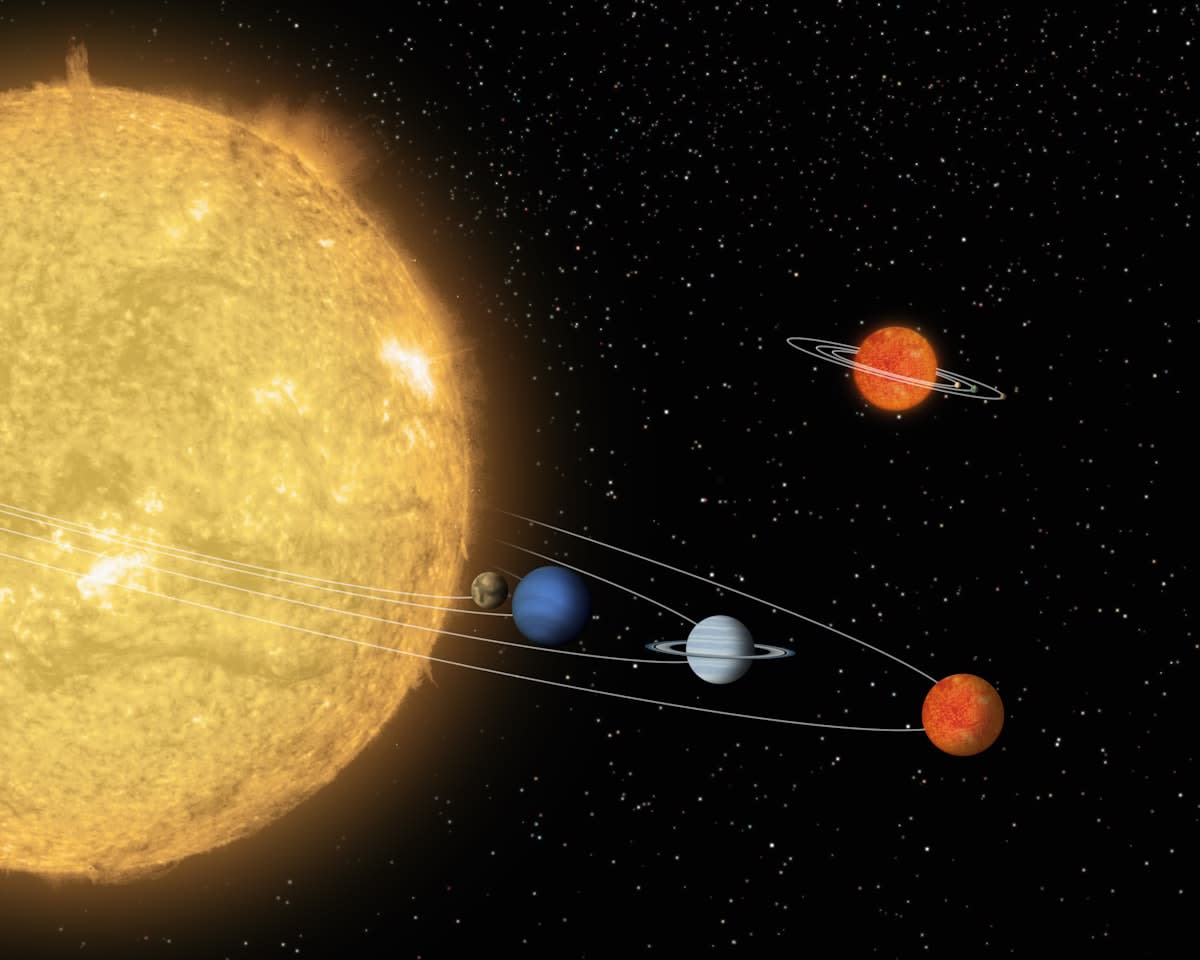
While the trajectory provides the path, the environment of the destination provides the constraints.
Navigational Optimization: The Mars Model
Transit optimization doesn't end when the spacecraft reaches its destination; it extends into the atmospheric entry. Recent research into the Martian atmosphere has revealed that the Hadley circulation is the dominant force driving material isolation and pole-to-pole teleconnection on the planet (Source: Nature, 2026). Using a Lagrangian tracking method based on reanalysis data, researchers found that the mean circulation's dominance over eddy transport creates a transport regime fundamentally distinct from Earth or Venus (Source: Nature, 2026).
Why does this matter for Delta-V? Because knowing how the atmosphere moves allows for more precise 'aerobraking'—using the atmosphere to slow down the craft instead of using fuel. If the Hadley circulation creates predictable zones of material isolation, mission planners can optimize their entry vectors to utilize the thickest or thinnest parts of the atmosphere, slashing the amount of propellant needed for the final descent. It turns the Martian atmosphere into a natural brake, reducing the mass of the spacecraft and, consequently, the cost of the launch.
The Broader Optimization Trend
The logic applied to space transit—balancing energy consumption against latency and time—is mirrored in other cutting-edge fields. In the realm of terahertz cell-free mobile edge computing, researchers are using the multi-agent proximal policy optimization (MAPPO) algorithm to solve NP-hard problems regarding resource allocation (Source: Nature, 2026). The goal there is a long-term optimal tradeoff between energy consumption and latency. While one is about data packets and the other is about spacecraft, the mathematical soul is the same: solving for the most efficient path in a dynamic, resource-constrained environment.
We see this same obsession with 'premium efficiency' in terrestrial transport. In the maritime industry, the shift toward permanent magnet (PM) motors is reducing energy losses by up to 50% compared to induction motors, with efficiency ratings reaching 98% (Source: Maritime Executive, 2026). This pursuit of near-perfect efficiency is the prerequisite for deep space transit. Whether it is a hybrid ferry in a harbor or a probe bound for Alpha Centauri, the goal is the same: eliminate waste to extend the range.
| Metric | Traditional Transit | Optimized Transit (Starcloud/Modern) |
|---|---|---|
| Propulsion Focus | High-Thrust Chemical | Low-Power Electric |
| Primary Velocity Gain | Fuel Combustion | Gravitational Slingshots |
| Time Horizon | Decades | Millennia (80,000 years) |
| Efficiency Goal | Payload Mass | Energy/Latency Tradeoff |
This convergence of multi-agent optimization and high-efficiency hardware is what makes the 'Delta-V breakthrough' possible. We are no longer just building bigger rockets; we are building smarter trajectories.
The financial implications are already manifesting. While Starcloud is a non-profit, the energy storage sector supporting these innovations is booming. DeltaX, for instance, recently raised 32 billion won to expand its Battery Energy Storage System (BESS) production, targeting revenues of over 100 billion won by 2027 (Source: thelec.net, 2026). The ability to store and manage energy with extreme precision is the terrestrial foundation upon which interstellar ambitions are built.
Fact-Check & Accuracy Note
Key claims regarding the 80,000-year transit and electric propulsion are sourced from TechCrunch (2026). Martian atmospheric data regarding Hadley circulation and Lagrangian tracking is sourced from Nature (2026). Efficiency data for PM motors is sourced from The Maritime Executive (2026). The specific application of MAPPO algorithms is cited from Nature (2026), though it is applied to THz networks and used here as a parallel in optimization logic.
Editorial Note
The editorial perspective emphasizes the shift from 'speed' to 'efficiency.' While some in the aerospace community view 80,000-year timelines as impractical, this article frames it as a necessary strategic adaptation to the physics of interstellar space.