
Most designers think luxury waste is a tragedy of aesthetics. They see a bolt of discarded silk or a TPU scrap and think of downcycling it into a tote bag or a cushion. That is a waste of potential. Why settle for a handbag when you can build a pavilion? The real opportunity lies in treating high-end apparel waste not as refuse, but as a raw feedstock for structural membranes. We are talking about a hard turn from garment construction to spatial engineering. Can we actually trust a discarded dress to hold up a roof? Yes, provided you stop thinking like a tailor and start thinking like a materials scientist.
The Prerequisites: Your Toolkit for Material Conversion
You cannot just glue scraps together and call it architecture. You need a specific set of tools to move from the atelier to the construction site. First, you need access to high-grade thermoplastic polyurethane (TPU) waste, often found in technical sportswear and avant-garde luxury footwear. Second, you need additive manufacturing capabilities—specifically 3D printers capable of handling flexible filaments. Third, you need a way to prove where your waste came from. In a world of greenwashing, traceability is your only currency.
- Industrial-grade TPU 3D printer with a hardened steel nozzle.
- Material characterization software for tensile strength testing.
- Digital ledger or blockchain tool for supply chain traceability (Source: Nature, 2026).
- Modular assembly frames for membrane tensioning.
- UV-resistant coatings to prevent apparel-grade plastics from degrading in sunlight.
The Implementation Playbook
Turning waste into a membrane is a process of layering. You start with the substrate—the fabric waste—and reinforce it with a printed skeleton. This is not about sewing; it is about fusing. The goal is to create a material that is both structural and breathable, mimicking the functional benefits of high-end technical gear but scaled for a building's envelope.
- Sourcing and Certification: Collect high-end waste. Use a decentralized ledger to record audit evidence and verify compliance indicators for the waste stream (Source: Nature, 2026). This ensures the material is actually post-industrial waste and not virgin plastic masquerading as recycled.
- Material Characterization: Test the elasticity and thermal properties of your TPU scraps. You must determine the melting point and adhesion capabilities of the specific luxury blend you are using to avoid structural failure during the printing phase.
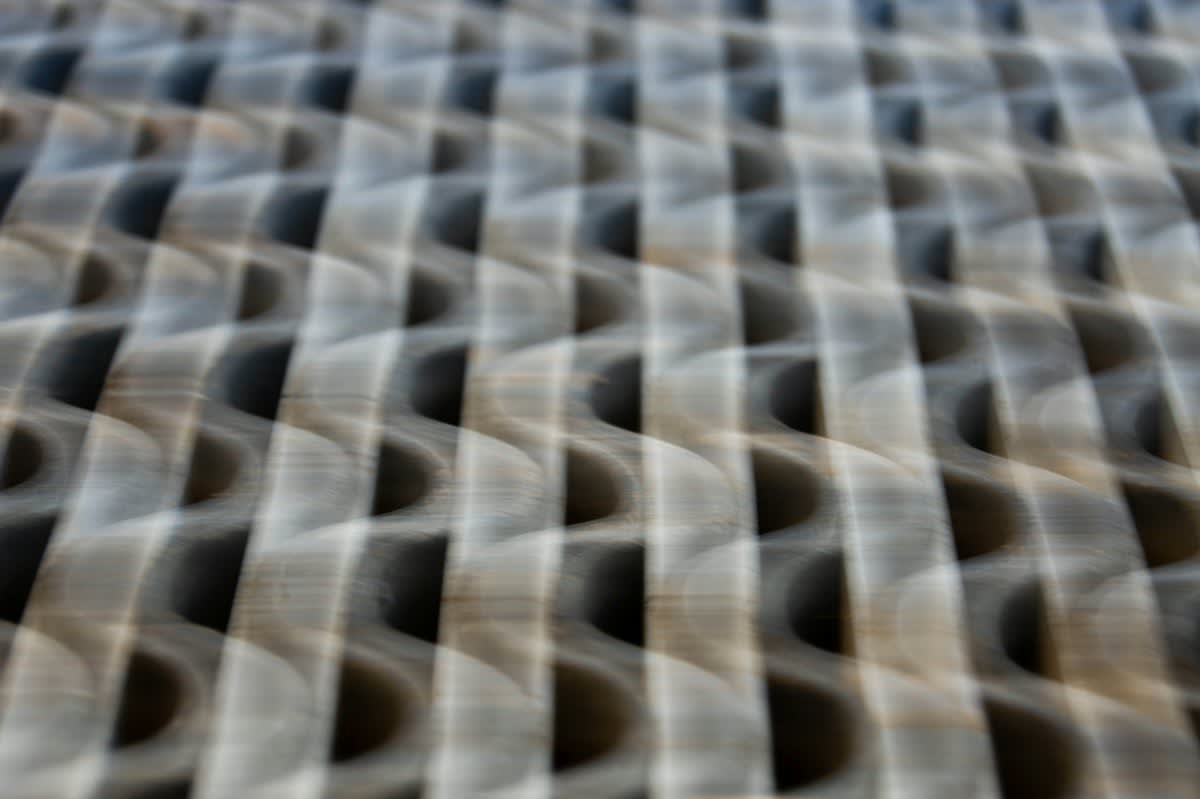
- Lattice Design: Design an open lattice architecture. According to research on TPU pads, an open lattice provides interconnected pathways for airflow and vapor transport, which exhibits lower resistance to airflow than conventional polyurethane foam structures (Source: Preprints.org, 2026).
- Additive Fusion: Use a 3D printer to deposit the TPU lattice directly onto the textile substrate. This creates a mechanical bond where the plastic weaves into the porous textile structure (Source: Preprints.org, 2026).
- Modular Assembly: Instead of one giant sheet, create modular panels. Follow the lead of Neo Couture Studio, which utilizes modular design collections to combine craftsmanship with environmental technology (Source: Mariliis R., 2023).
- Tensioning and Installation: Stretch the resulting membrane across a structural frame. The TPU lattice acts as the ribbing, while the fabric waste provides the skin.
The magic happens in the overlap between the soft and the hard. When you print a TPU lattice onto a discarded luxury fabric, you aren't just adding strength. You are creating a breathable skin. This is exactly how technical sportswear is built, but when we apply it to a pavilion in Miami or a temporary installation in Tallinn, it becomes architectural. The membrane breathes. It moves. It lasts.
"The company currently collaborates with several Nordic and Central European designer brands, driving the transformation of traceable supply chains... combining haute couture craftsmanship with environmental technology to develop zero-waste and modular design collections."— Mariliis R., Founder of Neo Couture Studio

The Invisible Friction: What They Don't Tell You
Here is the reality of the workshop: designers and engineers hate each other in this process. The designer wants a drape that looks like a Kenan Van Kooij couture piece, using upcycled plastic bottles to create bold, statement-making shapes (Source: Instagram/Kenan Van Kooij). The engineer, however, is screaming about wind loads and fire ratings. Most apparel-grade TPU is not rated for building codes. You will spend more time arguing with a building inspector about the flammability of a discarded luxury sneaker than you will actually designing the structure. This is the grit of the work. You have to find a middle ground where the material is treated as a non-structural aesthetic skin, supported by a certified steel or timber frame.
Then there is the problem of adhesion. Not all TPU is created equal. If you mix a TPU from a Nordic brand with a TPU from a US-based luxury house, they might not bond. You get delamination. The skin peels away from the lattice. I have seen entire installations sag in the humidity of Miami because the material characterization was rushed. You cannot skip the testing phase. If you do, your architectural membrane becomes a very expensive, very large piece of laundry.
Common Pitfalls and How to Avoid Them
Most failures in this terrain come from a lack of technical rigor. People treat it like an art project. It is not. It is a chemistry project. If you ignore the molecular compatibility of your waste streams, the project will fail. You must treat the waste as a variable, not a constant.
- Ignoring UV Degradation: Apparel plastics are not designed for 24/7 sun exposure. Use a UV-stabilized clear coat or accept that the membrane will yellow and brittle within two years.
- Over-Tensioning: If you stretch the membrane too far, the TPU lattice will snap at the points of fusion. Always leave a 5-10% slack margin.
- Poor Traceability: Using 'mystery waste' makes it impossible to predict how the material will react to heat. Always use a certified supply chain (Source: Nature, 2026).
- Neglecting Airflow: If you close the lattice too much, you lose the primary benefit of TPU architecture—the vapor transport and ventilation (Source: Preprints.org, 2026).
Fact-Check & Accuracy Note
This guide relies on emerging data from 2026 regarding TPU lattice performance and blockchain waste certification. The primary academic debate currently centers on the long-term structural viability of additive manufacturing in outdoor environments compared to traditional PVC membranes. While TPU offers superior breathability and recycling potential, its tensile longevity under extreme weather is still being quantified in professional trials.
Editorial Note
Editorial Note: This guide is written from the perspective of a practitioner. It prioritizes implementation and failure-avoidance over theoretical sustainability. The goal is to provide a playbook for those actually building these structures.