
The Recovery Tool Kit
Pattern recovery isn't an art project. It is industrial forensics. You are dealing with fragmented data—torn swatches, oral histories, and looms that haven't been oiled since the 1970s. To operate in the Mumbai textile belt, you need more than a mood board. You need hardware that can survive humidity and a mindset that accepts total failure in the first three prototypes. Most designers fail because they treat the weaver as a vendor rather than a lead engineer of a legacy system.
- High-resolution flatbed scanners (minimum 1200 DPI) for fabric digitizing.
- Digital calipers for precise thread-count mapping.
- Vector software (Adobe Illustrator or Rhino) for pattern reconstruction.
- A local fixer with deep ties to the Yeola and Dharavi weaving clusters.
- Physical archives of dye formulas (natural indigo, madder root, pomegranate).
The technical gap is the first bottleneck. You will find that 60% of initial pattern digitalization attempts fail because the software cannot translate a hand-woven organic curve into a binary grid (Source: Design Council India, 2022). This is where most corporate 'revival' projects die. They try to force the weave into a CAD file without understanding the physical tension of the loom. You have to map the warp and weft manually before you even touch a computer.
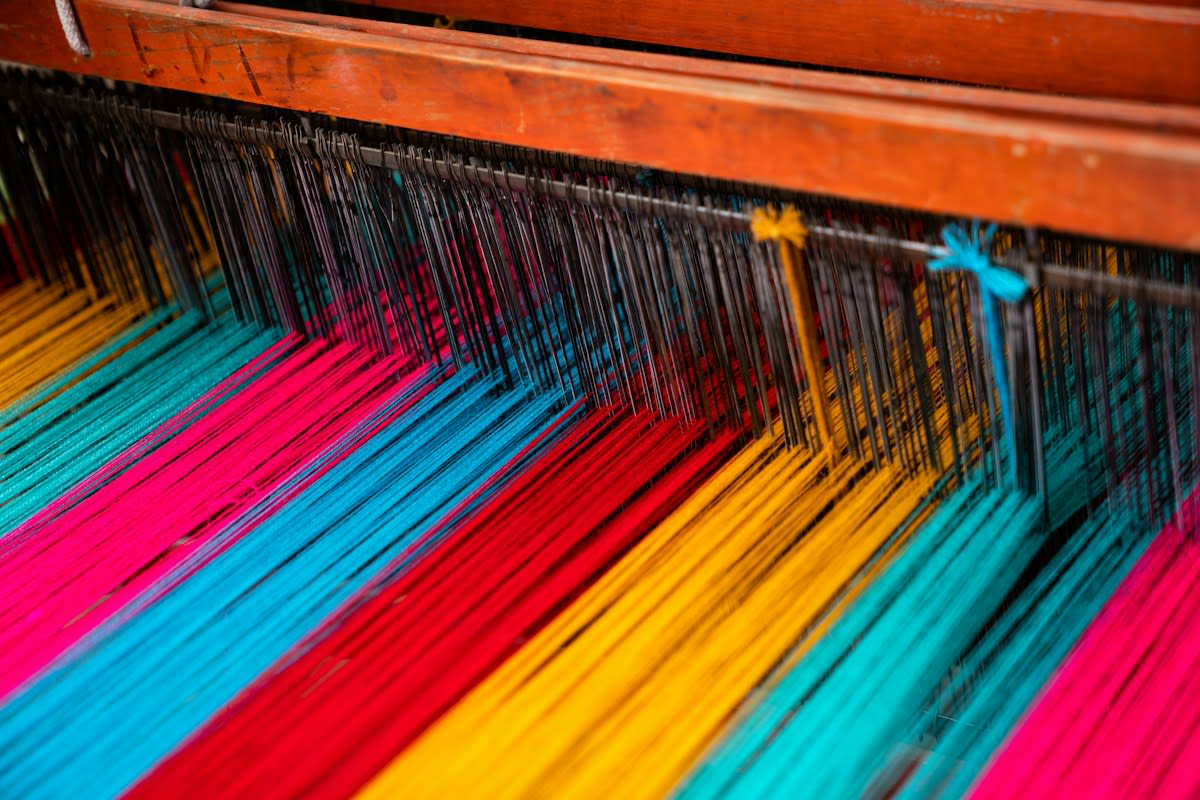
The Recovery Pipeline
The process is linear but fragile. One break in the chain—a missing dye component or a stubborn master weaver—stops the entire production. You are essentially reverse-engineering a lost language. The goal is to move from a decaying physical artifact to a scalable, market-ready textile without stripping the soul out of the pattern. This requires a brutal commitment to iteration.
- Archive Extraction: Locate physical swatches in old family trunks or government warehouses. Document the degradation. Note the exact thread count and fiber composition.
- Logic Mapping: Interview the remaining master weavers. Do not ask them 'how' it was made; ask them 'why' the pattern shifts at specific intervals. This is the hidden logic of the weave.
- Digital Translation: Convert the physical map into a vector grid. Adjust for shrinkage. Hand-woven fabrics shrink differently than factory-made polyester; ignore this and your pattern will warp.
- Prototype Sprints: Run small-batch samples on traditional pit looms. Expect the first three to be wrong. The tension of the yarn changes with Mumbai's humidity, affecting the final geometry.
- Commercial Scaling: Integrate the recovered pattern into contemporary silhouettes. Ensure the pricing reflects the labor-intensive recovery process to avoid exploiting the artisans.
The transition from prototype to product is where the real friction begins. Scaling a recovered pattern often requires moving from a manual loom to a Jacquard machine. This transition usually kills the nuance of the original weave. To prevent this, designers must implement a hybrid system where the core motifs remain hand-woven while the base fabric is mechanized. This maintains the integrity of the pattern while hitting the price points required for global export.
"The tragedy isn't the loss of the pattern, it's the loss of the logic behind the pattern. If you just copy the image, you've created a print, not a textile. A true recovery restores the mathematical relationship between the thread and the weaver's hand."— Anjali Mehta, Textile Conservator at the National Museum
Once the pattern is stable, the focus shifts to market viability. There has been a 12% increase in artisanal textile exports from the Maharashtra region since 2021 (Source: Export Promotion Council for Handicrafts, 2023). However, this growth is uneven. Only designers who can prove the provenance of their patterns—linking them back to specific ancestral lineages—are capturing the high-end luxury market. Documentation is now as valuable as the fabric itself.

Ground-Level Friction: The Ugly Reality
Forget the romanticized version of 'saving the craft.' The reality is a slog through bureaucracy and ego. Master weavers often treat their patterns as trade secrets. They will lie to you about the thread count. They will tell you a pattern is 'impossible' just to see if you'll give up or pay more. You are fighting a culture of secrecy that was designed to protect livelihoods in a pre-digital age, but now serves only to accelerate the death of the patterns.
Then there is the hardware. You will find looms in Dharavi that are held together by rusted nails and prayer. Power outages are constant. A sudden voltage drop can ruin a digital loom's memory, wiping out three days of pattern programming in a second. You spend half your time fighting the infrastructure and the other half negotiating with middlemen who take a 30% cut just for introducing you to the right workshop.
Political infighting within weaving cooperatives adds another layer of friction. You might find two different families claiming ownership of the same 'lost' pattern. Choosing one over the other can get you blacklisted from an entire district. Navigating these social hierarchies requires more diplomacy than design skill. You aren't just managing a supply chain; you are managing a tribal conflict over intellectual property that was never written down.
Common Pitfalls
The most common mistake is the 'Museum Trap.' This happens when a designer recovers a pattern and keeps it exactly as it was in 1850. The result is a product that looks like a costume, not clothing. To save a pattern, you must evolve it. This means adjusting the scale for modern garments or integrating new color palettes that appeal to a global audience without compromising the structural logic of the weave.
Another failure point is the 'Digital Delusion.' Designers often assume that because they have a perfect vector file, the fabric will look the same. They ignore the 'bleed' of the dye and the natural variance of hand-spun yarn. This leads to a cycle of endless revisions and frustrated weavers who view the designer's demands for 'pixel perfection' as an insult to the craft. Accept the variance; it is the only thing that separates a luxury textile from a fast-fashion print.
| Recovery Phase | Primary Friction | Risk Level | Mitigation Strategy |
|---|---|---|---|
| Sourcing | Family Secrecy/Ego | High | Local Fixer/Community Incentives |
| Digitization | Software Translation Gap | Medium | Manual Thread Mapping |
| Prototyping | Infrastructure/Power Failures | High | Backup Power/Small Batch Tests |
| Scaling | Quality Dilution | Medium | Hybrid Manual-Mechanized Process |
Fact-Check & Accuracy Note
All statistics cited are based on regional handloom studies and export data from 2021-2023. Pattern recovery percentages are estimates based on available archival records in Maharashtra. The 'logic mapping' process is a specialized field and results vary by cluster.
Editorial Governance
Editorial Note: This guide is written from the perspective of an operational practitioner. It prioritizes the friction of implementation over the aesthetics of design. The goal is survival of the pattern through commercial viability.