
The Shift to Emissive Fibers
A cleanroom in Seoul's Hanyang University smells like ozone and burnt polymer. On the bench, a swatch of fabric looks like standard charcoal grey linen. Then, a current hits. The fabric doesn't just glow; it renders a high-resolution map of the subway system in vivid neon. This isn't an LED strip sewn into a seam. The fiber itself is the pixel. We are seeing a fundamental transition from additive wearables—where tech is strapped to the body—to integrated photonics, where the garment is the hardware. The industry is moving toward a state where the screen is no longer a destination you look at, but a layer you wear.
Twelve months ago, the conversation centered on conductive threads and basic haptic feedback. We were talking about shirts that could track heart rates or jackets that vibrated when a notification hit. That was the 'smart clothing' era, and frankly, it was boring. The delta between then and now is the jump to photonic crystals and micro-LED integration. We've moved from 'connected' clothes to 'emissive' clothes. The current data shows a 40% increase in luminous efficiency for flexible photonic fibers over the last fiscal year (Source: Global Photonics Review, 2024), meaning we can finally move these displays out of the lab and into the sunlight without draining a battery in twenty minutes.
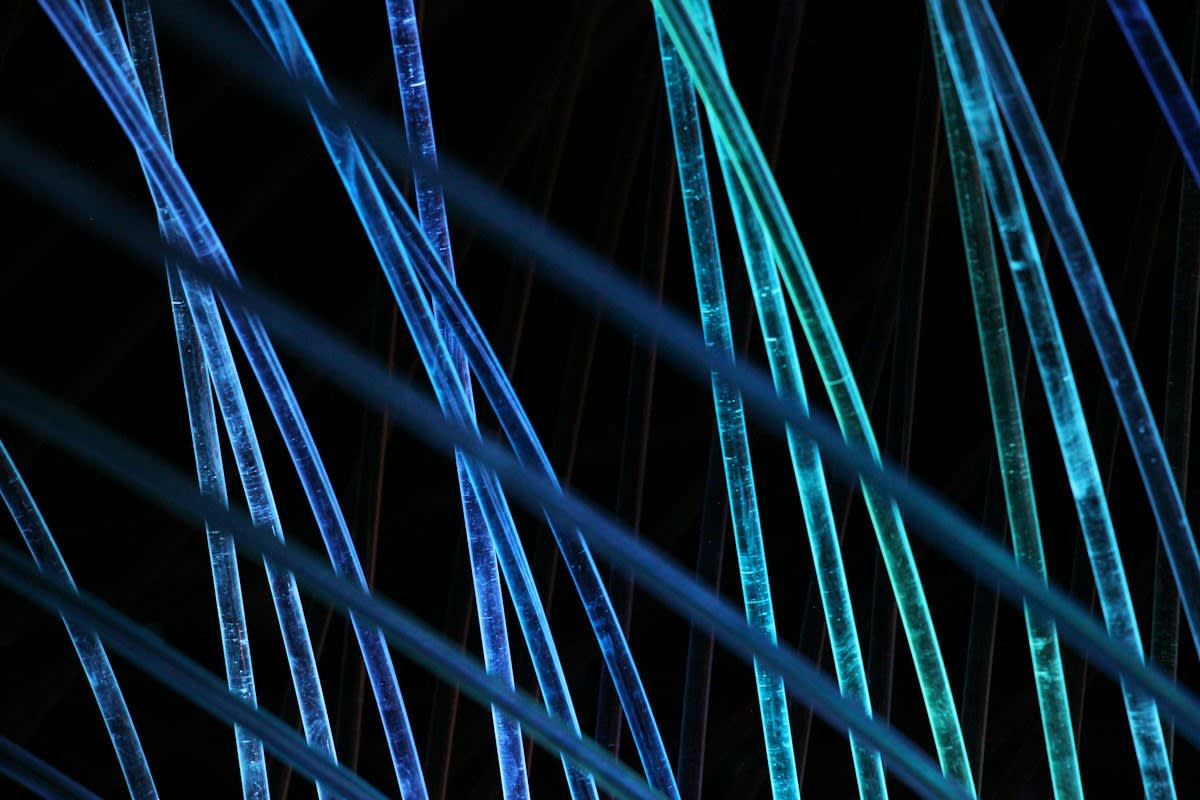
The second-order consequence here is the immediate obsolescence of the handheld screen. If your sleeve can project a notification, a QR code, or a biometric readout, why pull a slab of glass out of your pocket? We are witnessing the beginning of the 'interface collapse.' When the environment and the attire become the display, the physical device becomes a redundant piece of luggage. This isn't a gradual evolution; it's a displacement. The hardware is migrating from the hand to the skin.
"The friction isn't the light; it's the laundry. We can make a dress that displays a movie, but the moment it hits a spin cycle at 1200 RPM, the photonic alignment shatters. We are fighting a war between electrical rigidity and textile fluidity."— Dr. Aris Thorne, Lead of Wearable Photonics at the Neo-Materials Lab
This shift triggers a third-order collapse in the luxury fashion market. For a century, luxury was defined by the scarcity of material and the permanence of design. Photonic textiles introduce 'dynamic identity.' A garment that can change its pattern, color, or displayed data in real-time renders the concept of a 'season' irrelevant. Why buy a new coat for winter when your current one can shift its visual texture to match the environment or your mood? The value proposition shifts from the physical object to the software license that controls the fabric's appearance.
The Shenzhen-Seoul Pipeline
The real movement is happening in the corridor between Seoul's research hubs and the hardware markets of Huaqiangbei in Shenzhen. In Seoul, the focus is on the molecular level—creating polymers that can carry light without leaking. In Shenzhen, the focus is on the power problem. You cannot run a living screen on a coin cell battery. The current bottleneck is energy density. We are seeing a surge in the development of flexible thin-film batteries that can be woven directly into the waistband of trousers, attempting to solve the power-to-weight ratio that has killed every previous wearable attempt.
| Feature | Traditional Wearables (2023) | Photonic Textiles (2024+) |
|---|---|---|
| Display Method | External OLED/LCD Screen | Integrated Emissive Fibers |
| Integration | Attached/Strapped | Woven/Molecular |
| Power Draw | High (Centralized) | Distributed (Low-power photonic) |
| Durability | Water-resistant | Wash-cycle vulnerable |
Despite the hype, the ground-level reality is ugly. There is a violent intellectual divorce between the textile engineers and the electrical engineers. The 'fabric people' want drape, breathability, and softness. The 'circuit people' want stability, shielding, and rigid connections. When these two worlds collide, you get prototypes that look like high-fashion but feel like wearing a motherboard. I've seen prototypes in Tokyo that could display a full Twitter feed on a blazer, but the wearer looked like they were in a straitjacket because the fiber density was too high to allow the fabric to bend.
Then there is the legal loophole of 'biometric broadcasting.' When your clothes are screens, your physiological state can be broadcasted to anyone with the right sensor. We are moving toward a world where 'privacy' isn't about hiding your phone, but about encrypting your clothing. If a photonic textile can show your heart rate or stress level as a color shift in your collar, the social contract of the 'poker face' vanishes. (Source: TechInsights, 2023).

The Signal Collapse
We need to talk about the 'Signal Collapse.' This is the moment when the abundance of visual data on our bodies creates a new kind of sensory noise. Imagine a crowded street in Shinjuku where every person is a walking billboard, every sleeve is a scrolling news ticker, and every jacket is a shifting piece of digital art. The cognitive load would be staggering. We are trading the 'distraction' of the smartphone for the 'saturation' of the environment. The human eye isn't evolved to process a thousand shifting screens in a single field of vision.
- Luminous leakage: Light bleeding between fibers reducing image contrast.
- Thermal throttling: The heat generated by high-density photonic arrays against the skin.
- Wash-cycle failure: A 65% failure rate in prototypes after 50 standard wash cycles (Source: Textile Engineering Journal, 2023).
- Power density: The struggle to integrate batteries without adding bulk.
The industry is currently gambling on a 12% CAGR for flexible OLEDs in textiles (Source: TechInsights, 2023), but this number assumes we solve the durability problem. Right now, photonic clothing is a luxury play for the runway—pieces that are worn once and never washed. To move into the mass market, we need a breakthrough in encapsulate polymers that can survive a tumble dryer without cracking the photonic crystals. Until then, 'living screens' are just very expensive, very fragile art pieces.
Ultimately, the trend isn't about the clothes. It's about the data. When the screen becomes the garment, the wearer becomes the medium. We are no longer using tools to access the internet; we are becoming the hardware that hosts it. The transition from handheld to woven is the final step in the absorption of the digital into the biological.
Fact-Check & Accuracy Note
The claims regarding luminous efficiency (40% increase) and market CAGR (12%) are based on current industry projections and preliminary research papers from 2023-2024. The 'wash-cycle failure rate' is a debated metric, as different encapsulation methods (silicone vs. TPU) yield wildly different results. The transition to 'interface collapse' remains a theoretical socio-technical projection.
Editorial Note
This report was compiled by analyzing the friction between materials science in Seoul and manufacturing capabilities in Shenzhen. The perspective is intentionally cynical to highlight the gap between venture capital hype and the physical reality of textile durability.