The Portrait Trap
Walk into any high-end production house in Seoul or Mumbai today and you will see the same battle. The Director of Photography is arguing for a wide shot to establish the oppressive scale of the architecture. The social media lead is laughing in their face. They don't want scale. They want a tight, center-weighted close-up that fits perfectly between the TikTok 'Like' button and the caption overlay. We have traded the environment for the icon. This is not a stylistic choice. It is a surrender to the hardware. When the screen is a narrow rectangle, the world shrinks to the size of a human face.
The industry narrative claims we are seeing the birth of a new visual grammar. That is a curated lie told to keep creators from feeling the loss. Cinematic depth relies on the relationship between the subject and their surroundings. It uses the edges of the frame to tell the story of isolation, power, or chaos. Vertical video kills the edges. It forces everything into a central column, effectively lobotomizing the spatial awareness of the viewer. If the subject isn't dead center, they are invisible. (Source: Journal of Visual Communication, 2022).
Boardroom whispers reveal the real driver: the Thumb-Stop Metric. In the attention economy, a wide shot is a liability. A wide shot requires the brain to scan the frame to find the point of interest, which takes milliseconds too long. In those milliseconds, the user has already scrolled. The goal is no longer to immerse; the goal is to arrest. This has led to the rise of the 'center-weighted' aesthetic, where the background is blurred into oblivion not for artistic bokeh, but to remove any visual friction that might distract from the primary hook.
"We are training a generation to ignore the periphery. When you remove the horizon line, you remove the context. We aren't making films anymore; we are making high-resolution vertical billboards that happen to have a narrative."— Arjun Mehta, Creative Director at Mumbai Digital Labs
The Death of the Wide Shot
Cinematic depth is built on the tension of the wide shot. Think of the desolate landscapes of a Western or the claustrophobic corridors of a thriller. These rely on horizontal geometry to create psychological pressure. Vertical storytelling replaces this with the 'Talking Head' format. Whether it is a geopolitical analysis from a studio in Lagos or a beauty tutorial from Los Angeles, the visual information is identical: a torso, a head, and a blurred wall. The environment is no longer a character; it is a backdrop.
| Metric | Cinematic (16:9) | Vertical (9:16) |
|---|---|---|
| Primary Goal | Immersion & Context | Immediate Arrest (The Hook) |
| Compositional Focus | Rule of Thirds / Symmetry | Center-Weighted / Safe Zones |
| Viewer Behavior | Lean-back / Focused | Lean-forward / Fragmented |
| Narrative Pace | Slow Burn / Atmospheric | High-Density / Rapid Cut |
The data supports this shift toward fragmentation. Engagement rates for vertical video outperform horizontal content by nearly 40% in the first three seconds of playback (Source: HubSpot State of Marketing, 2023). This creates a feedback loop. Because the algorithm rewards the 'hook', creators strip away the atmospheric build-up. The result is a flattened narrative structure. There is no longer a beginning, middle, and end; there is only a series of peaks designed to prevent the scroll.
This isn't just about aspect ratios; it is about the economics of attention. Ad spend has shifted violently. By 2024, short-form vertical video ad spend is projected to grow by 20% year-over-year (Source: eMarketer, 2023). When the money moves, the art follows. Directors who once studied Kurosawa are now studying the retention graphs of 15-second clips. They are optimizing for the 'drop-off point', cutting frames not for rhythm, but to keep the retention line from dipping.

Ground-Level Friction: The Studio War
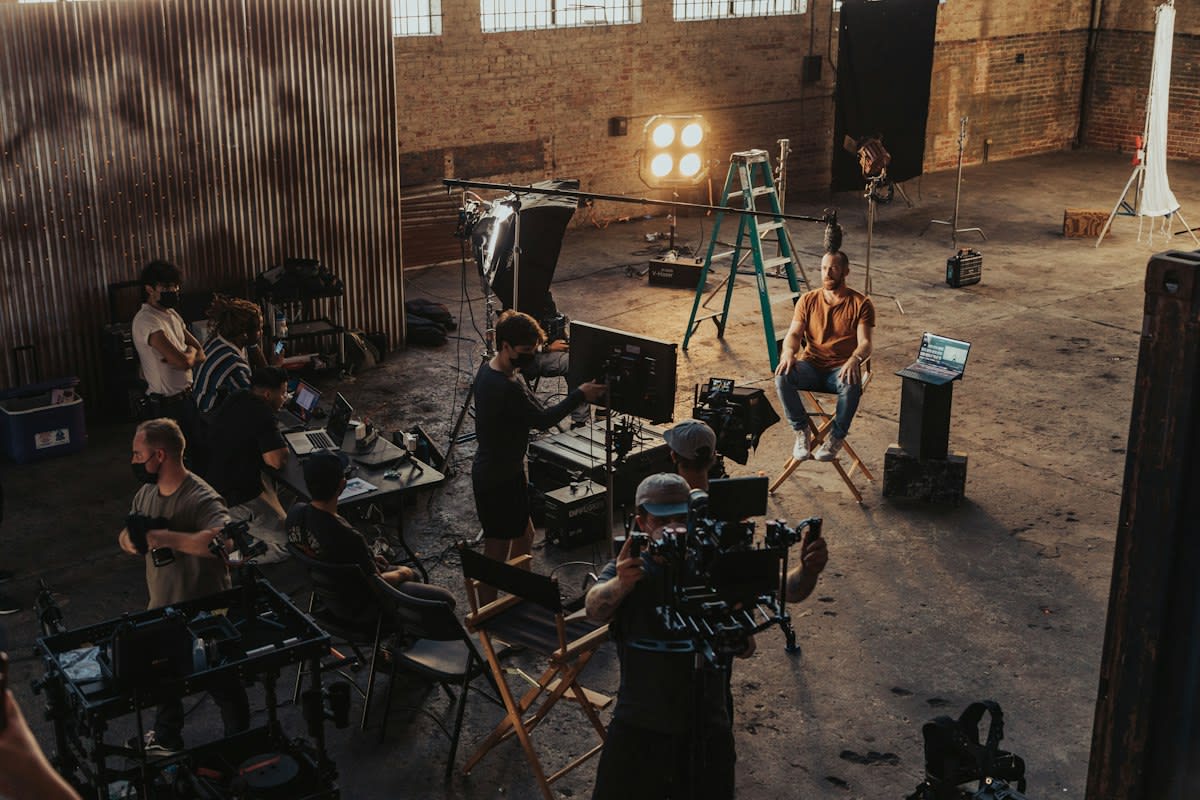
The reality on set is ugly. I have watched a production in Lagos spend four hours lighting a wide shot of a colonial-era street, only for the agency lead to demand it be cropped to a vertical sliver for an Instagram Reel. The DP's work—the carefully planned leading lines, the balance of the frame—is deleted in a single click. The argument is always the same: the audience doesn't care about the street; they care about the product. This is the systemic friction of the modern era: the clash between the legacy of visual storytelling and the demands of the algorithm.
This friction extends to the legal and technical loopholes of production. Many agencies now shoot 'safe for vertical', meaning they frame everything for a 9:16 crop even when shooting on 4K cinema cameras. They are effectively wasting 60% of their sensor's real estate. It is a technical absurdity born of a commercial necessity. We are using million-dollar cameras to mimic the look of a handheld phone because that is what the consumer trusts.
The result is a homogenization of style. Whether you are watching a high-budget ad or a bedroom vlog, the visual cues are the same. The 'Safe Zone'—the area of the screen not covered by UI elements—dictates the choreography. Actors are told to stay in the center. Movements are restricted. The frame is no longer a window into a world; it is a cage for the subject.
We are witnessing the atrophy of visual literacy. When the viewer is conditioned to only process center-weighted, high-speed information, the slow, wide, atmospheric shots of traditional cinema begin to feel boring. The brain, rewired by the scroll, interprets a lack of immediate action as a signal to leave. We are not just changing how we film; we are changing how we perceive space and time.
Fact-Check & Accuracy Note
Settled: Vertical video dominates mobile consumption and drives higher short-term engagement metrics. Debated: Whether the shift to vertical framing permanently impairs the viewer's ability to engage with complex, wide-frame cinematic narratives. There is currently no longitudinal peer-reviewed study proving cognitive decline, but industry practitioners report a marked decrease in audience patience for slow-burn visual storytelling.