The Lithium Mirage
For a decade, the global energy conversation has been held hostage by the lithium-ion battery. We were told that chemical storage was the only path to a decarbonized grid. It is a compelling narrative, but it is strategically flawed. Lithium-ion is an exceptional tool for your pocket or your driveway, but it is a catastrophic choice for storing a city's worth of winter heat. The cost of scaling chemical batteries to meet seasonal demand is not just economically prohibitive; it is ecologically suicidal. Why are we mining the depths of the earth for cobalt and lithium when the solution might be sitting in a common sandbox?
The fundamental mismatch lies in the duration of storage. Most electrochemical batteries are designed for short-burst discharge—four hours, perhaps eight. But the wind doesn't always blow for a week in January, and the sun doesn't shine in the depths of a Nordic winter. To bridge these gaps, we need Long-Duration Energy Storage (LDES). According to the International Energy Agency (Source: IEA, 2023), the global transition requires a diversified portfolio of storage technologies to avoid systemic fragility. This is where thermal energy storage (TES) enters the fray, shifting the focus from storing electrons to storing heat.
The shift is less about a new discovery and more about a return to first principles: thermodynamics.
The Finnish Experiment: Power in the Sand
In Finland, a company called Polar Night Energy has turned a mundane material into a strategic asset. Their sand battery is effectively a giant, insulated silo filled with low-grade sand, heated by resistive elements powered by wind or solar. By cranking temperatures up to 500-600 degrees Celsius, they can store energy for months. This isn't high-tech wizardry; it is an exercise in heat capacity. Sand is cheap, abundant, and remarkably stable at high temperatures. It does not degrade over thousands of cycles, unlike the chemical cathodes in a Tesla Powerwall.
"The goal is to turn the volatility of renewable energy into a steady, reliable stream of heat for district heating networks, which are the backbone of Northern European urban infrastructure."— Polar Night Energy, Institutional Statement (2022)
The genius of the sand approach is its integration. In regions with established district heating—where hot water is piped directly into homes—the sand battery doesn't even need to convert heat back into electricity. Converting heat to electricity always incurs a loss. By using the stored energy directly for warmth, the system achieves an efficiency that chemical batteries cannot touch in a heating context. It is a localized solution to a global problem, proving that the most effective technology is often the one that fits the existing infrastructure.
Molten Salt: The Industrial Heavyweight
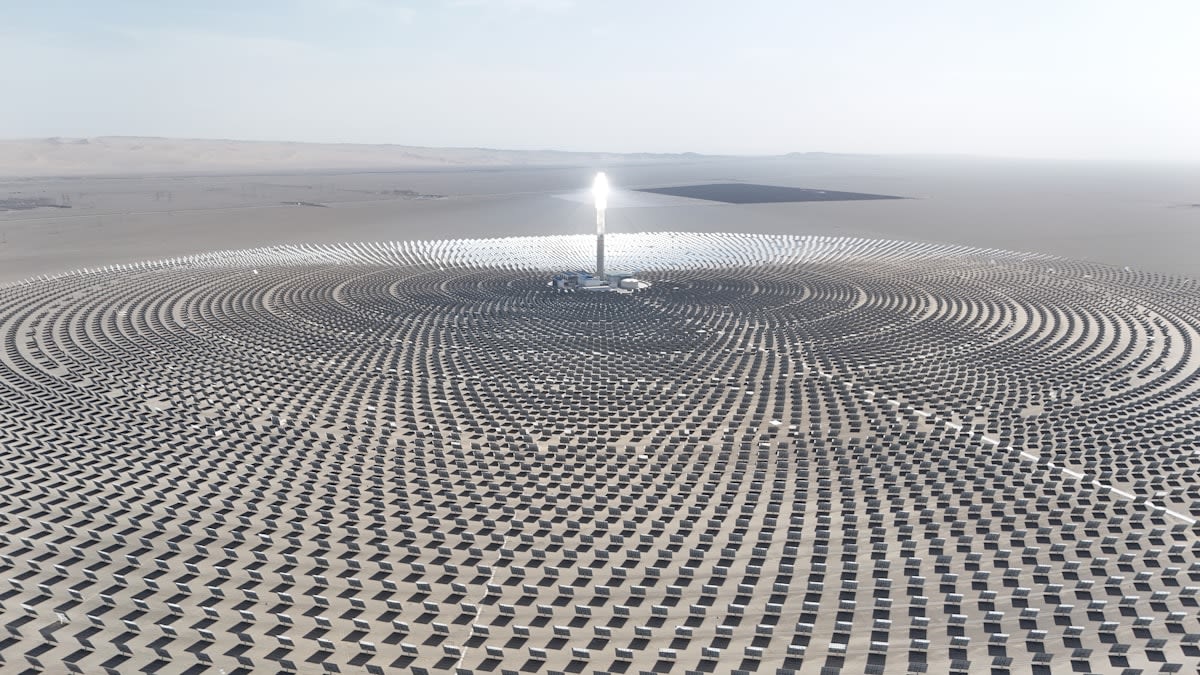
While sand handles the residential heating needs of the North, molten salt is the engine of the global South. Concentrated Solar Power (CSP) plants, such as the Noor Complex in Morocco, use mirrors to focus sunlight onto a receiver, heating a mixture of sodium and potassium nitrates until they liquefy. This molten salt is then stored in massive insulated tanks. When the sun sets, the salt is pumped through a heat exchanger to create steam, which spins a traditional turbine. This allows solar plants to generate electricity 24/7, effectively erasing the intermittency of the sun.
The scale here is staggering. Molten salt systems can store gigawatt-hours of energy, providing a level of grid stability that lithium batteries simply cannot provide without an absurd amount of capital expenditure. According to the National Renewable Energy Laboratory (Source: NREL, 2022), thermal storage is significantly more cost-effective for durations exceeding 10 hours. The salt doesn't just store energy; it provides inertia to the grid, helping to maintain frequency and voltage stability—a critical requirement for preventing mass blackouts.
| Metric | Lithium-Ion | Sand Battery | Molten Salt |
|---|---|---|---|
| Primary Use | Short-term / Mobile | Long-term / Heat | Industrial / Grid |
| Cycle Life | 1,000 - 5,000 | Virtually Unlimited | High (Decades) |
| Material Cost | High (Rare Earths) | Negligible | Low (Abundant Salts) |
| Environmental Impact | High (Mining/Toxins) | Very Low | Low |
| Best Duration | 1-4 Hours | Weeks to Months | 10-100 Hours |
But if the physics are so sound, why isn't every city filled with salt tanks and sand silos?
The Engineering Friction: A Practitioner's View
On the ground, the debate isn't about whether thermal storage works—it's about how to stop it from eating itself. Anyone who has actually managed a molten salt plant will tell you that salt is a nightmare. At 565 degrees Celsius, it is incredibly corrosive. It eats through standard steel pipes and creates a maintenance cycle that can bankrupt a project if not managed with precision. The internal industry debate focuses heavily on cladding materials and the precise chemistry of the salt mixtures to prevent crystallization when temperatures dip.
Sand is less corrosive, but it presents its own set of headaches. Thermal stratification is the enemy. If the heat doesn't distribute evenly through the sand, you get hot spots that can damage the containment vessel or cold zones that render the storage inefficient. Practitioners spend their days arguing over the optimal grain size of the sand and the flow dynamics of the heat-exchange pipes. It is a gritty, mechanical struggle that is often glossed over in glossy investor slide decks.
The Strategic Realignment
We are witnessing a strategic realignment of how we value energy. For too long, we tried to force all energy into the form of electricity. But the world runs on heat. Industrial processes—cement, steel, glass—require massive amounts of thermal energy that a battery cannot provide. By storing energy as heat, we bypass the inefficient conversion steps. A salt battery doesn't just power a lightbulb; it fuels a furnace. This is the real opportunity: decoupling industrial production from fossil fuels by using the sun to heat the earth itself.
The geopolitical implications are equally profound. Lithium creates new dependencies on a handful of mining regions. Sand and salt are ubiquitous. By shifting toward thermal storage, nations can build energy resilience using materials found in their own backyards. This is not just an environmental choice; it is a national security imperative. The race for the next generation of batteries is not a race for the best chemistry, but a race for the most scalable thermodynamics.
Fact-Check & Accuracy Note
Key claims regarding the efficiency and cost-effectiveness of LDES over lithium-ion are sourced from IEA's 2023 reports and NREL's technical assessments. The specific application of sand batteries is based on operational data from Polar Night Energy. Ongoing debates regarding salt corrosion and thermal stratification are well-documented in materials science literature and industry practitioner forums.