
The mid-May retreat of Nvidia, which saw a market value erosion of roughly US$1 trillion, serves as a stark reminder that the semiconductor industry is merely a sophisticated front for a mining operation. When the gap between a chipmaker and the world's 50 most valuable mining companies narrows to its tightest margin in a year, the distinction between software-driven valuation and dirt-driven valuation vanishes. Why does the market treat a GPU architect like a gold miner? Because the physical reality of a chip is a dense cluster of rare earths, precious metals, and critical minerals that cannot be synthesized in a lab. If you cannot grow it, you must dig it, and digging is an increasingly volatile bet.
A single high-end chip is a geological map of the planet's most contested territories. The inputs are exhaustive: silicon, copper, gold, silver, tungsten, tantalum, titanium, cobalt, aluminium, tin, nickel, palladium, gallium, germanium, and rare earth elements like praseodymium. These materials are the invisible scaffolding of the digital age, yet their procurement relies on a fragile web of primary extraction. When gold dipped below US$4,000/oz in the second quarter of 2026, erasing US$228 billion from the top 50 miners, the ripple effects were felt far beyond the pits of the Andes or the plains of Africa. The industry is tethered to a commodity cycle that is fundamentally incompatible with the precision and stability required for semiconductor fabrication.
The Refining Bottleneck
The world often confuses mining with processing, a mistake that has left Western economies dangerously exposed. While many nations possess raw ore, the ability to turn that ore into semiconductor-grade material is a concentrated power. China's dominance in rare earth elements is not merely a matter of having the most minerals in the ground, but of controlling the refining and permanent magnet manufacturing pipelines. This is where the real leverage lies. If the raw material is the crude oil, refining is the refinery, and for too long, the West has been importing the finished fuel while ignoring the machinery of production.
"Refining and magnet production—not mining—have become the industry’s biggest battleground."— Gracelin Baskaran, Director of the Critical Minerals Security Program at CSIS
This realization is driving a frantic rush to build domestic processing capabilities. The United States government recently committed US$25 million, part of a larger US$38 million investment, to ReElement Technologies to expand a critical minerals refinery in Marion, Indiana. This is not a venture into environmentalism; it is a national security play. By focusing on domestic refining capacity for rare earths, the U.S. is attempting to decouple its high-tech future from the whims of foreign processing monopolies. The goal is to create a closed-loop system where the material is not just found, but recovered and purified within sovereign borders.
| Critical Mineral | Primary Source Risk | Urban Mining Potential | Industrial Application |
|---|---|---|---|
| Praseodymium | High (China Dominance) | High (Magnet Recovery) | Permanent Magnets/Sensors |
| Gallium/Germanium | Extreme (Refining Monopolies) | Medium (E-waste Scrap) | High-frequency Chips |
| Silver | Moderate (Mexico 25% Share) | High (Circuit Board Recovery) | Conductive Traces |
| Cobalt | High (Geopolitical Instability) | High (Battery Recycling) | Power Management |
| Palladium | High (Regional Concentration) | Medium (Industrial Catalyst) | Multi-layer Ceramic Caps |
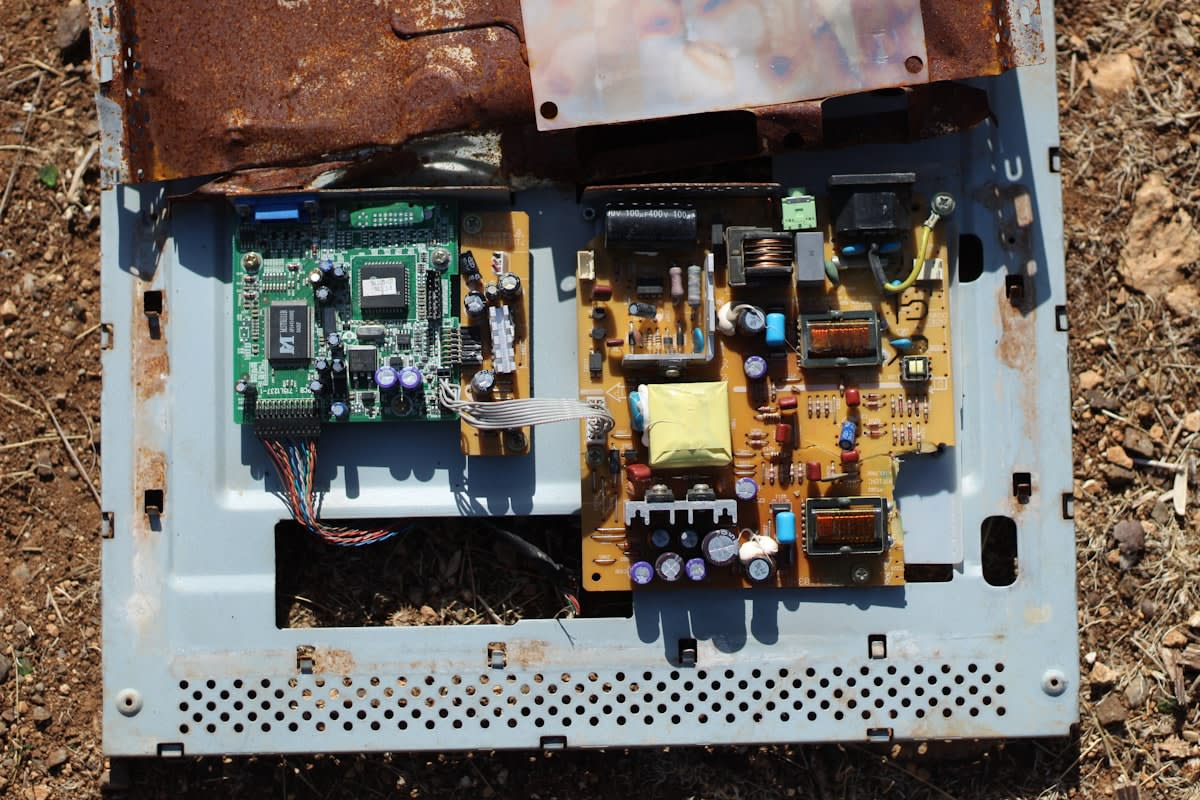
The logic of this shift is mirrored in the emerging strategies of Japan, which the West is now studying with intensity. The Japanese model emphasizes the entire value chain, treating the waste stream as a strategic reserve. Instead of looking for the next great mine in a distant land, they look at the mountains of discarded electronics as the new frontier. Why venture into the geopolitical minefield of primary extraction when the necessary elements are already present in the urban environment, waiting to be harvested?
Industrial Metabolism and the Circular Mandate
To understand how urban mining scales, we must look at the broader trend of industrial metabolism. In Italy, the Feralpi Group is attempting to rewrite the rules of steel production, targeting net-zero emissions by 2050. Their roadmap involves reducing Scope 1, 2, and 3 emissions by 90% compared to 2022 levels through the electrification of industrial processes. While steel is not a semiconductor, the underlying logic is identical: the replacement of linear consumption with a circular loop. When an industrial giant decides that the traditional way of producing material is a liability, the semiconductor industry must follow suit.
Even small-scale innovations prove the viability of this waste-to-value transition. In Ecuador, a start-up called Ovomas has successfully reintegrated eggshell waste into a pharmaceutical value chain, producing high-purity calcium citrate and nutraceuticals. While the biological nature of eggshells differs from the chemical nature of gallium or tantalum, the operational blueprint is the same. Ovomas has demonstrated that waste streams, when processed with high-precision technology, can become high-value products. The semiconductor industry is simply applying this logic to a more complex set of elements.
The Processing Paradox
The critical distinction in the current resource war is not who owns the mine, but who owns the refinery. Mining is a geological accident; refining is a technological achievement.
Mexico provides another case study in the risks of primary reliance. The country produces 12 of the 60 minerals classified as critical by the U.S. Geological Survey and leads global silver output with a 25% share. However, relying on these exports leaves the supply chain vulnerable to regional shocks and trade disputes. Urban mining mitigates this by diversifying the source of the material. If a chipmaker can recover 30% of its silver and copper from recycled urban sources, it reduces its dependency on any single sovereign entity, effectively hedging its bets against geopolitical instability.

The Economic Imperative of Recovery
The financial argument for urban mining is becoming undeniable. The volatility of primary commodities—seen in the erratic pricing of palladium and the fluctuations of gold—creates an unpredictable cost structure for semiconductor manufacturers. By contrast, the cost of recovering materials from e-waste is more stable and predictable. As the volume of discarded hardware grows, the concentration of critical minerals in urban centers will eventually exceed the concentration found in primary ores. We are moving toward a reality where it is cheaper to mine a ton of old iPhones than a ton of rock from a remote mountain.
This is not a utopian vision but a cold calculation of resource efficiency. The investment in Indiana's refining capacity is a signal that the era of blind reliance on global mining is ending. The future of semiconductor security lies in the ability to capture, purify, and reuse the elements that already exist within the economy. The companies and nations that master the art of urban mining will not just save the planet; they will secure the keys to the digital kingdom.
Ultimately, the narrow gap between Nvidia's market cap and the value of the world's largest miners is a warning. It tells us that the digital economy is only as strong as its physical foundation. By transitioning to an urban mining model, the industry can finally decouple its growth from the volatility of the earth's crust. The question is no longer whether we can afford to build these recycling infrastructures, but whether we can afford the cost of not having them when the next supply shock hits.