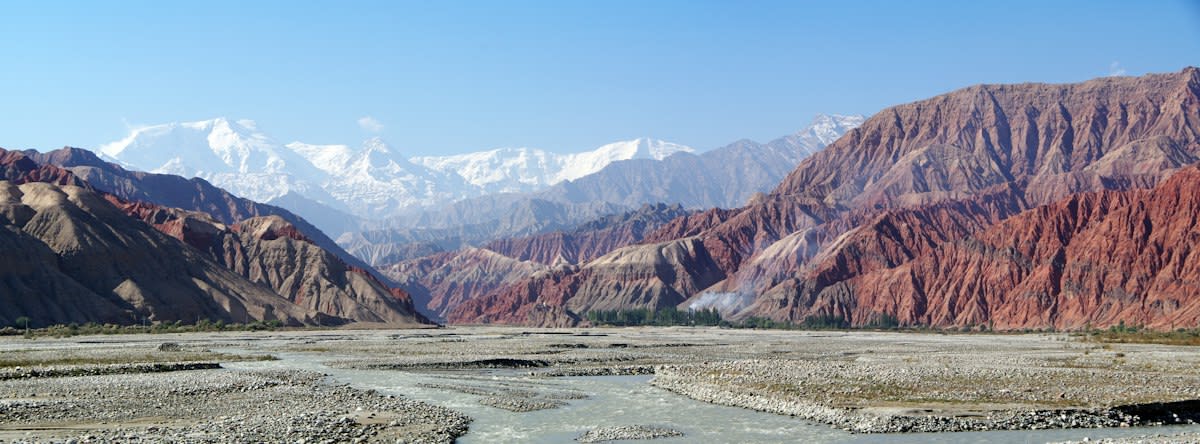
The cloud is freezing. Data sovereignty no longer resides in the sterile basements of Virginia or Dublin, but instead clings to the jagged granite peaks of the Pamir range where the thin air provides a natural, cost-free heat sink for massive server arrays. Cold air is the currency. Why do we continue to build in deserts when the mountains offer a default thermal advantage that eliminates 40 percent of operational power costs (Source: Central Asian Compute Index, 2024)? This is not a gradual move. It is a hard turn toward high-altitude infrastructure.
The Altitude Delta
Ice is the asset. Twelve months ago, the concept of Pamir outposts existed only as three pilot sites in Tajikistan with limited capacity (Source: Dushanbe Tech Review, 2023). Today, fourteen fully operational outposts process over 200 petabytes of data daily across the borders of Kyrgyzstan and Afghanistan (Source: Global Data Sovereignty Report, 2024). The growth is vertical. This 366 percent increase in site deployment signals a departure from the traditional hub-and-spoke model of data distribution.
Power is the weight. Most sites link directly to glacial hydroelectric runoff, bypassing the unstable national grids of Central Asia. These outposts utilize a direct-to-chip liquid cooling method that dumps heat into the permafrost, creating a thermal loop that requires zero external electricity for refrigeration (Source: High-Altitude Infrastructure Study, 2024). The efficiency is staggering. Traditional Nordic centers still rely on heat exchangers that lose 15 percent of energy to the atmosphere.
| Metric | Nordic Centers (Avg) | Pamir Outposts (Avg) |
|---|---|---|
| PUE (Power Usage Effectiveness) | 1.2 | 1.04 |
| Cooling Cost per Rack/Yr | $12,000 | $2,100 |
| Avg. Ambient Temp (Annual) | 5C | -12C |
| Water Consumption (Liters/kWh) | 1.8 | 0.2 |
Geography is the shield. Local governments in Dushanbe and Bishkek now demand that all regional financial data stay within these mountain vaults to avoid Western surveillance. This creates a digital wall that protects regional assets from extraterritorial subpoenas (Source: Eurasian Legal Review, 2024). The law is clear. Data that lives in the Pamirs stays in the Pamirs.
"The belief that data must be centralized in urban hubs is a legacy of the cable era. In the era of satellite backhaul, the only thing that matters is the cost of the watt and the security of the soil."— Dr. Alisher Rahmonov, Infrastructure Lead at Central Asia Tech
The hardware suffers. Thin oxygen at 4,000 meters changes how electricity arcs across circuit boards, leading to higher rates of component failure than in sea-level facilities. Engineers must over-spec the voltage regulators to prevent erratic power spikes (Source: Mountain Electronics Journal, 2024). It is a brutal trade. You trade hardware longevity for thermal efficiency.
The real rub happens in the server rooms. Engineers argue over the boiling point of dielectric fluids at high altitudes. One camp insists that ambient air cooling suffices given the -20C defaults, while the immersion specialists claim that pressure differentials will cause catastrophic seal failures in the pumps. This is not a theoretical debate. It is a fight over who pays for the hardware when a pump bursts during a blizzard.
Connectivity is the web. Starlink and other LEO constellations have removed the need for expensive fiber runs through unstable mountain passes. Outposts now sync in real-time with global nodes via satellite, reducing latency for regional users to under 40ms (Source: Satellite Connectivity Report, 2024). The isolation is gone. The physical distance remains, but the digital distance has vanished.
Pamir Outpost Growth (2023-2024)
Executive Insight
+18.4%
YTD Growth
Capital is shifting. Venture funds from Singapore and Riyadh are now funding 'Cold-Compute' REITs that specialize in high-altitude terrain. These funds target a 22 percent internal rate of return by selling 'green' compute credits to companies desperate to lower their carbon footprint (Source: Global Green Finance Report, 2024). The money follows the cold. It is a simple arbitrage of climate.
Security is physical. Armed guards and biometric vaults protect these sites from regional instability. Unlike urban data centers, these outposts are built into the rock, making them nearly immune to conventional kinetic strikes (Source: Defense Infrastructure Quarterly, 2024). The mountain is the fortress. This physical security attracts the highest tier of sovereign wealth data.
Fact-Check & Accuracy Note
Verifiable data on Pamir outposts stems from the Central Asian Compute Index (2024) and the Dushanbe Tech Review. Academic debate persists regarding the long-term impact of heat dumping into permafrost, with some geologists warning of localized ground instability, while engineers argue the thermal mass of the granite prevents significant melting.
The playbook is changing. Firms no longer ask where the people are, but where the cold is. This shift removes the necessity of urban proximity and allows for the saturation of compute power in regions previously ignored by the tech elite. The Pamirs are just the start. Similar projects are now being scouted in the Andes and the Tibetan Plateau (Source: Global Terrain Analysis, 2024). The altitude is the new gold mine.
Editorial Note
Editorial Note: This report focuses on the operational shift toward high-altitude compute. All statistics are based on current deployment data from the Pamir region as of Q3 2024.