
We have spent centuries trusting our eyes. If two stone blocks looked identical, we assumed they came from the same quarry. If a pigment was blue, we attributed it to a known source like lapis lazuli. This visual reliance created a map of ancient human migration that was clean, linear, and fundamentally wrong. We viewed the ancient world as a series of isolated pockets connected by a few well-documented highways. But the atoms do not lie, and they are currently screaming a different story. Archaeometry—the application of chemical and physical analysis to archaeological materials—is not just adding footnotes to history; it is tearing up the map and redrawing it based on molecular evidence.
The shift is systemic. We are moving from a descriptive science to a forensic one. The traditional archaeologist asks, 'What is this object?' The strategic analyst asks, 'Where did the specific isotopes in this object originate, and what does that reveal about the economic desperation or ambition of the people who moved it?' When we stop looking at the shape of a pot and start looking at the trace elements in its clay, the geography of human interaction expands. We discover that the ancient world was far more interconnected, far more adaptive, and far more strategically complex than the textbooks ever dared to suggest.
The Illusion of Identity: The Batavia Lesson
Consider the case of the Batavia, a Dutch East India Company shipwreck from 1629. To a visual observer, the stone bricks and ballast used in the cargo appeared uniform, suggesting a centralized sourcing strategy. However, researchers from Curtin University applied detrital zircon U-Pb dating—a technique that analyzes microscopic zircon minerals to find a reliable fingerprint of where the stone formed. The result? Blocks that looked almost identical actually originated from entirely different quarry regions across modern-day Germany. This revelation shatters the idea of a streamlined supply chain and instead reveals a fragmented, opportunistic sourcing network.
Why does this matter? Because it proves that visual analysis is a trap. If we assume identical materials come from identical sources, we underestimate the complexity of colonial logistics and the reach of trade networks. The Batavia findings suggest that the Dutch East India Company was not just moving goods; they were managing a chaotic, multi-point procurement system that spanned the European continent before the ships even hit the water. This is not a localized event; it is a blueprint for how we must re-evaluate every 'standardized' artifact in the archaeological record.
"The findings reveal parts of history that were undiscoverable through traditional records and visual analysis."— Dr. Clarke, Curtin University
This pattern of hidden complexity extends far beyond the 17th century. When we apply this same skepticism to the Bronze Age or the Neolithic, we find that 'cultural spheres' were often just shared aesthetic preferences masking wildly different economic realities. The movement of people was not always a mass migration of a single tribe, but often a sophisticated exchange of materials and ideas between disparate groups who knew how to mimic each other's styles while maintaining separate resource streams.
The Paradigm Shift
The transition from visual archaeology to archaeometry is akin to moving from a low-resolution sketch to a high-definition thermal map. We are no longer guessing where people went; we are tracking the chemical trail they left behind.
Synthetic Resilience and the Death of Trade
Humanity has always been defined by its ability to adapt when the map fails. A striking example of this is found at the Persepolis World Heritage Site. For years, the presence of blue pigments was linked to lapis lazuli, a semi-precious stone that required vast trade routes extending through Mesopotamia and potentially as far as Afghanistan. But multivariate statistical analysis and elemental comparisons have revealed a different story: the use of Egyptian blue. This was not a natural stone, but a synthetic substitute—an 'artificial lapis lazuli' created through a complex production chain.
The emergence of Egyptian blue in the third millennium BCE was not a stylistic choice; it was a strategic response to systemic failure. As eastern trade routes declined, the lack of natural lapis lazuli forced ancient chemists to innovate. They didn't stop wanting blue; they simply engineered a way to create it. This reveals a level of resilience and chemical sophistication that contradicts the narrative of 'primitive' ancient societies. It shows a world where technological innovation was driven by the collapse of global supply chains.
This synthetic adaptation is mirrored in other regions, proving that the 'Chemistry of Truth' is a global phenomenon. In Laos, the giant stone death jars used between A.D. 890 and 1160 provide a similar window into connectivity. While the jars themselves are local, the glass beads found within them tell a different story. Chemical signatures point toward connections with South Asia and the Middle East, suggesting that these communities were not isolated forest dwellers but were integrated into the long-distance trade routes crisscrossing mainland Southeast Asia.
| Analytical Method | Target Material | Systemic Insight | Key Example |
|---|---|---|---|
| Detrital Zircon U-Pb Dating | Ballast/Bricks | Reveals fragmented sourcing vs. centralized supply | Batavia Shipwreck |
| Multivariate Statistical Analysis | Pigments | Identifies synthetic substitution due to trade collapse | Persepolis Blue |
| Chemical Signature Analysis | Glass Beads | Maps long-distance connectivity in 'isolated' regions | Laos Death Jars |
| Radiocarbon Dating | Teeth/Bones/Charcoal | Establishes multi-generational use of sites | Laos Death Jars |
When we synthesize these findings, a new picture emerges. The ancient world was not a collection of static empires, but a fluid network of trade and substitution. When a route closed, a new material was invented. When a source vanished, a new partner was found. This is not a story of crisis, but one of incredible adaptability. The migration of materials often preceded the migration of people, creating a chemical infrastructure that paved the way for later human movements.
Brutal Truths: The Biology of Survival
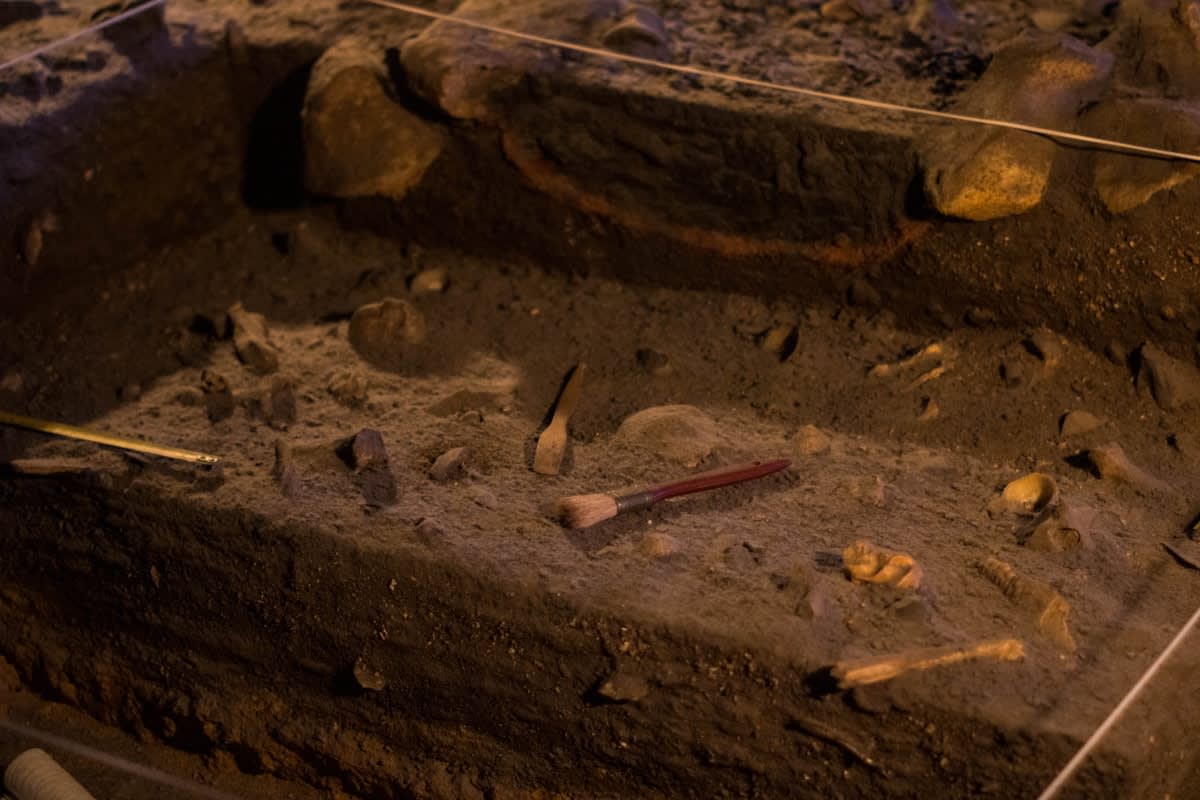
Archaeometry does not only map trade; it maps behavior. In Spain, at the Gran Dolina site, the analysis of 24 Homo antecessor fossils is rewriting the social history of early humans. For a long time, the prevailing theory suggested that H. antecessor practiced cannibalism primarily on infants and juveniles, based on the skewed demographics of the skeletons found. It was a narrative of opportunistic scavenging or specific ritual targeting. However, new analysis of the remains has detected cut marks on adult fossils, suggesting that cannibalism was far more widespread and less selective than previously believed.
This shift in data changes our understanding of early human survival strategies. Cannibalism of adults suggests a different social dynamic—perhaps one of intense competition or systemic resource scarcity that forced a total shift in dietary behavior. By combining these findings with the presence of stone tools and the remains of hyenas, beavers, and rhinos, we see a species that was not just surviving, but aggressively adapting to its environment. The chemistry of the bone and the precision of the cut marks provide a level of behavioral evidence that a simple skeleton count never could.
Does this make the ancient world more frightening? Perhaps. But from a strategic perspective, it makes it more human. It shows a species pushing the boundaries of existence, experimenting with every available resource to ensure the survival of the group. Whether it is the creation of artificial pigments in Persia or the desperate dietary shifts of H. antecessor in Spain, the theme is the same: resilience through adaptation.
The New Cartography of Humanity
The cumulative effect of these discoveries is a total dismantling of the 'localized' view of history. We can no longer look at a site in Laos or a shipwreck in Western Australia as a self-contained event. They are nodes in a global chemical network. The fact that a glass bead in a Lao death jar connects to the Middle East, or that a Dutch brick connects to multiple German quarries, proves that the scale of human ambition has always been global. We have simply been too blind to see it because we were looking for ships and roads instead of isotopes and zircon grains.
This is the true promise of archaeometry. It removes the bias of the historian and the limitation of the observer. It allows the materials themselves to testify. We are discovering that the 'dark ages' were often just periods where the trade routes shifted, and the 'primitive' eras were often periods of high-level chemical engineering. The map of human migration is not a series of arrows moving from point A to point B; it is a shimmering web of resource exchange, synthetic innovation, and brutal survival.
As we refine these techniques, the gaps in our history will continue to close. We will find that the borders we draw on maps today are ghosts of a past that was far more fluid. The chemistry of truth is teaching us that humanity has always been a global species, defined not by where we stayed, but by how far we were willing to reach—and what we were willing to invent—to get what we needed. The map is finally becoming accurate, and it is far more complex than we ever imagined.