We have been lied to about the nature of an hour. Most of us operate under the assumption that time is a constant, a steady heartbeat provided by a silicon chip or a swinging pendulum. But this is a convenient fiction. What we call 'time' today is actually mean solar time, an artificially smoothed standard designed to ensure every hour is exactly the same length regardless of the season (Source: FB History Page). Gnomonics—the ancient art of the sundial—challenges this standardization. It asks us to stop pretending the universe is a clock and start observing the actual, fluctuating rhythm of the sun as it maps its position across the sky (Source: Electronic Design, 2026). To practice gnomonics is to step out of the digital grid and back into a celestial alignment.
Prerequisites for the Modern Gnomonist
Before you attempt to divide the day without gears or ticking hands, you need more than just a piece of metal and a flat surface. Gnomonics is a marriage of geometry and geography. You cannot simply place a stick in the ground and expect accuracy; you are essentially building a physical analog of the Earth's rotation. If your alignment is off by even a few degrees, your 'noon' will be a suggestion rather than a fact. You must be comfortable with the idea that your clock will change slightly every day, as the sun's path shifts through the zodiac.
- A Gnomon: A straight rod or blade. For longevity and precision, consider hand-hammered brass, similar to the panels created by John Elliot (Source: Olympia History Society, 2026).
- A Dial Plate: A flat, durable surface (stone, metal, or treated wood) to receive the shadow.
- Local Latitude Data: Your exact coordinates are non-negotiable for calculating the gnomon's angle.
- A True North Compass: Magnetic north is a liar; you need the geographic North Pole for alignment.
- The Equation of Time Table: A chart to convert apparent solar time (what the shadow shows) to mean solar time (what your phone shows).
The Architecture of Light: Step-by-Step Implementation
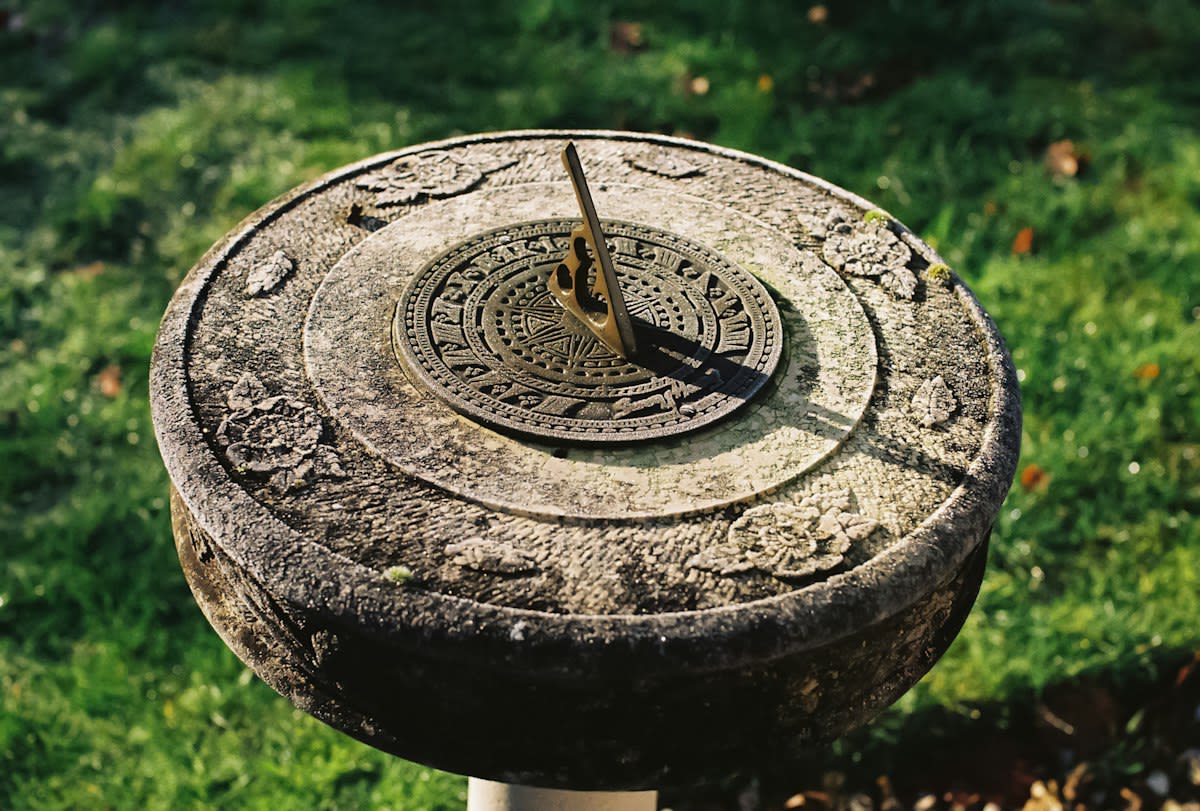
Building a functional gnomonic device requires a shift in perspective. You aren't just marking lines; you are capturing a projection of the Earth's axis. The goal is to create a fixed edge that aligns perfectly with the sky so that a passing shadow becomes a precise measurement of the day's progression (Source: FB History Page). This process is slow, deliberate, and requires a level of patience that the digital age has largely eroded.
- Calculate the Gnomon Angle: The angle of your gnomon (the rod) must be exactly equal to your local latitude. If you are at 45 degrees North, your rod must stand at a 45-degree angle relative to the dial plate. This ensures the gnomon is parallel to the Earth's axis of rotation.
- Establish the Meridian Line: Use your true north alignment to draw a perfectly straight line from the base of the gnomon to the edge of the plate. This is your 12:00 PM mark, the moment the sun reaches its highest point in your sky.
- Map the Solar Position: Instead of using a ruler to divide the circle into equal slices, you must map the sun's actual position (Source: Electronic Design, 2026). Because the Earth's orbit is elliptical, the shadow does not move at a constant speed. You must calculate the hour lines based on the cosine of your latitude.
- Execute the Material Work: Secure the gnomon. If you are following the tradition of high-craft gnomonics, use hammered brass panels to ensure the edge is razor-thin, reducing the 'penumbra' or blurriness of the shadow edge (Source: Olympia History Society, 2026).
- Calibrate via Observation: For one full week, mark the shadow's position at known mean-time intervals. This will reveal the 'Equation of Time' gap—the difference between the sun's actual position and our artificial clock.
Why bother with this manual labor when a digital watch is infinitely more 'accurate'? Because accuracy is not the same as truth. A digital watch tells you the average time agreed upon by a committee in Greenwich. A sundial tells you the truth of your specific location on a rotating sphere. When you look at the shadow, you aren't seeing a number; you are seeing the physical relationship between your body and the star at the center of our system.
"John Elliot created seven hand-hammered brass panels which depict historical moments... [creating a] Territorial Sundial."— Olympia Historical Society, documenting the work of John Elliot
The Practitioner's Friction: Apparent vs. Mean Time
In the internal debates among gnomonists, the biggest friction point is the 'Equation of Time.' As a practitioner, you quickly realize that the sun is an erratic timekeeper. Depending on the time of year, a sundial can be fast or slow by as much as 16 minutes compared to a mechanical clock. This leads to a fundamental divide in the community: do you build a 'mean' dial, which uses a curved gnomon or an analemma (a figure-8 correction) to force the sun to match the clock, or do you build an 'apparent' dial that celebrates the sun's natural variance? Most purists argue that adding a correction for mean time is an act of submission to the industrial clock, stripping the art of its primary purpose.

The Digital Divergence: When 'Sundial' Becomes Code
It is a strange irony of our current era that while physical gnomonics becomes a niche art, the term 'Sundial' has migrated into the realm of high-compute AI. In modern data science, 'Sundial' now refers to a family of highly capable time-series foundation models used for forecasting (Source: UCLA/OASA, 2026). These digital sundials don't track shadows; they track patterns in massive datasets, achieving speedups of up to 3.05x in certain configurations compared to target-only decoding (Source: UCLA/OASA, 2026). We have moved from measuring the movement of the heavens to measuring the movement of data points, yet the name remains, perhaps as a subconscious nod to our original quest to predict the future by observing the present.
| Feature | Physical Gnomonics | Mean Solar Time | AI 'Sundial' Models |
|---|---|---|---|
| Primary Driver | Solar Position | Quartz/Atomic Oscillation | Time-Series Data |
| Consistency | Variable (Seasonal) | Absolute/Fixed | Probabilistic |
| Purpose | Celestial Alignment | Societal Coordination | Predictive Forecasting |
| Speed/Efficiency | Real-time (Natural) | Instantaneous | 3.05x Speedup (Source: UCLA/OASA, 2026) |
Fact-Check & Accuracy Note
The claims regarding the distinction between mean solar time and solar time are sourced from historical timekeeping records (Source: FB History Page). The technical specifications of the 'Sundial' AI foundation models and their 3.05x speedup are verified via the 2026 SURP journal (Source: UCLA/OASA, 2026). The existence of the Territorial Sundial is documented by the Olympia Historical Society (2026).
Common Pitfalls in Gnomonic Construction
Most beginners fail not because of their math, but because of their environment. I have seen countless dials rendered useless because the practitioner ignored the 'shadow-casting' environment. A nearby tree or a shifting building shadow can create 'dead zones' in your day, leaving you with a clock that only works from 10 AM to 2 PM. Furthermore, the temptation to use a standard 360-degree protractor to divide the dial into 15-degree increments is a trap. Because the gnomon is angled, the shadow's movement across the flat plate is non-linear. If you use equal angles, your clock will be wildly inaccurate for most of the day.
- The 'Magnetic North' Error: Using a compass without adjusting for magnetic declination. Always use a solar noon observation to find true north.
- The 'Flat-Earth' Fallacy: Assuming the sun moves in a perfect circle. Remember that the solar declination changes daily, affecting the length of the shadow.
- Material Warp: Using untreated wood for the dial plate, which bows over time and alters the geometry of the hour lines.
- The Penumbra Effect: Using a gnomon that is too thick. A thick rod creates a wide, blurry shadow, making it impossible to tell if it is 12:01 or 12:05.