15M web servers on one VM – smoltcp, DPDK, AF_XDP
Source Entity
Hacker News
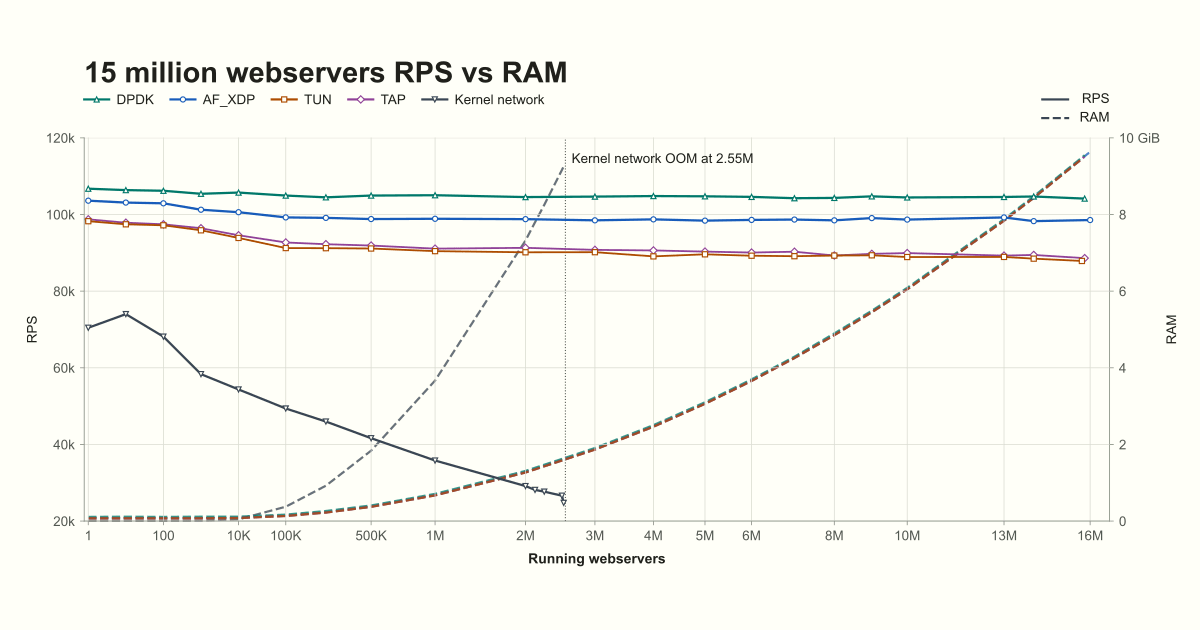
A developer is attempting to run 15 million web servers on a single virtual machine using smoltcp, DPDK, and AF_XDP. The project aims to democratize server access to mitigate cybersecurity threats caused by supply-demand imbalances.
The Quest for Hyper-Scalability: 15 Million Servers on One Core
In a radical experiment aimed at challenging modern infrastructure limitations, a developer has embarked on a project to host 15 million web servers on a single virtual machine (VM). Utilizing a minimal resource footprint of just 10GB of RAM and a single CPU core, this effort leverages high-performance networking stacks including smoltcp, DPDK (Data Plane Development Kit), and AF_XDP. By bypassing traditional, resource-heavy networking overheads, the project seeks to prove that extreme density is possible through optimized kernel-bypass techniques.
The Economic Philosophy of Ubiquitous Hosting
The driving motivation behind this technical feat is rooted in a provocative economic theory: the scarcity of web servers creates an artificial demand that fuels cybersecurity vulnerabilities. The developer posits that if every individual on Earth were provided with their own dedicated web server, the market saturation would collapse the current incentive structures for malicious hacking. This "bootstrapping" project serves as a proof-of-concept for a future where personal infrastructure is as ubiquitous as email addresses, theoretically nullifying the value of mass-targeted cyberattacks.
Technical Pillars: smoltcp, DPDK, and AF_XDP
To achieve such unprecedented density, the project rejects "vibe coding"—the practice of guessing at implementation—in favor of rigorous engineering. The choice of smoltcp is critical; it is a standalone TCP/IP stack designed for embedded systems that excels in resource-constrained environments. By combining this with DPDK and AF_XDP, the developer moves network packet processing into user space. This avoids the latency and context-switching overhead inherent in the standard Linux kernel networking stack, which is simply not designed to manage millions of concurrent, distinct server instances.
Analyzing the Syscall Bottleneck
The fundamental challenge of this endeavor lies in the management of system calls. A standard web server relies on basic primitives like listen to monitor for incoming traffic. When scaled to millions of instances, the overhead of managing state, file descriptors, and memory allocation becomes the primary constraint. The project focuses on granular optimization of these essential syscalls to ensure that the single CPU core is not saturated by the mere act of maintaining connections, but rather remains available to serve data.
Future Implications and Scalability
While currently limited by the constraints of a single VM, the project looks toward unconventional scaling solutions, such as repurposing hardware like old microwaves to act as makeshift server nodes. While clearly experimental, the implications for edge computing and micro-services are profound. If successful, this research could pave the way for a new architecture of "personal clouds," where individuals retain full control over their digital footprint on a massive, decentralized scale, fundamentally altering the topology of the modern internet.