56k.rip – the 1996 dial-up internet experience
Source Entity
Hacker News
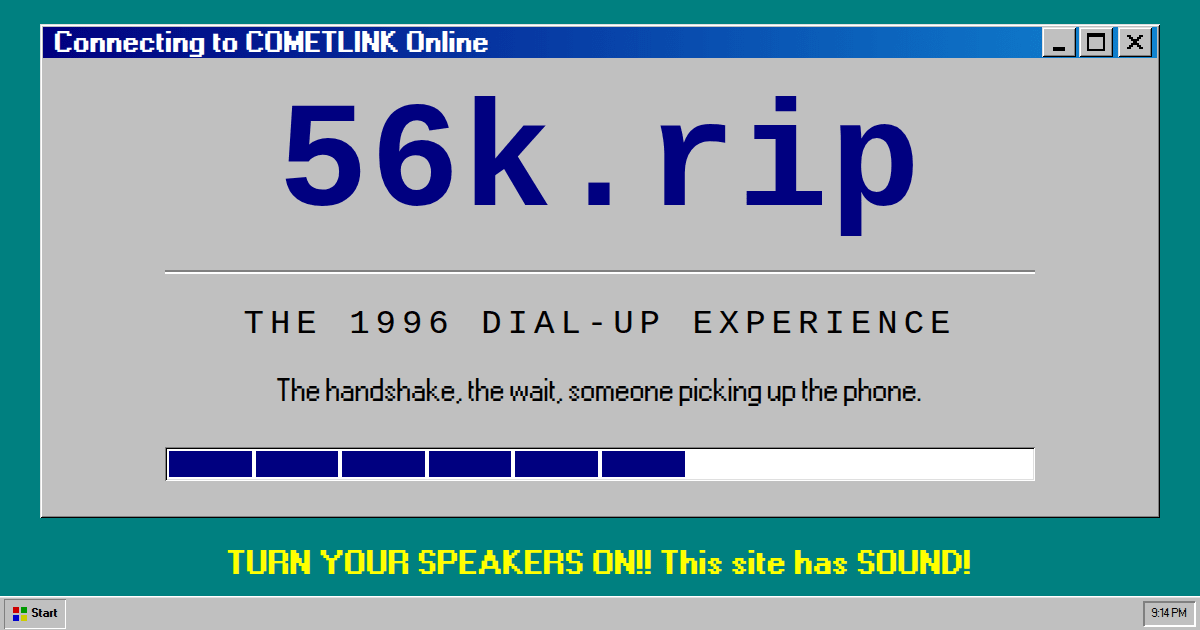
56k.rip is a browser-based simulation that recreates the authentic, hardware-constrained experience of 1996 dial-up internet. It replicates the specific latency, handshake rituals, and connection instability that defined the early web era.
The Digital Time Capsule: Exploring 56k.rip
In an era defined by gigabit fiber optics and instantaneous cloud synchronization, the website 56k.rip serves as a poignant digital time capsule. It does not merely mimic the aesthetic of the 1990s web; it rigorously simulates the technical limitations of 1996-era dial-up networking. By forcing users to endure the familiar, agonizing rituals of the past—the off-hook click, the specific frequency of touch tones, and the twenty-second handshake—the project highlights how far modern infrastructure has evolved in less than three decades.
The Engineering of Nostalgia
What distinguishes 56k.rip from static retro-themed websites is its commitment to simulated performance. The experience is not a faked animation; it is a functional environment where users choose between 14.4k, 28.8k, and 56k connection speeds. The site enforces a strict byte budget, meaning that page delivery speeds are directly throttled by the user's chosen speed. Images render line-by-line, mimicking the progressive interlacing that was a hallmark of low-bandwidth browsing, providing a visceral reminder of the patience required to consume content in the mid-90s.
Simulating Technical Volatility
Beyond bandwidth constraints, the simulation captures the inherent instability of the analog era. The inclusion of features such as failing downloads and the classic 'call drop' triggered by a household member picking up an extension phone, adds a layer of realism that borders on the traumatic for those who lived through it. This attention to detail emphasizes that the 1996 web experience was not just slow; it was fragile, requiring a dedicated, uninterrupted phone line that was frequently at the mercy of domestic life.
A Window into Early Web Culture
Behind the technical facade, 56k.rip hosts a curated collection of 1996-era content, including a fishing page, a recipe page, a guest book, a webring, and classifieds. These elements act as an anthropological study of the early internet. The 'webring' in particular serves as a reminder of a decentralized, community-driven web that existed before the dominance of centralized search engines and social media algorithms. This content provides a clear picture of how early users navigated the digital landscape, relying on human-curated links rather than algorithmic feeds.
Historical Context and Broader Implications
Reflecting on the 56k era allows us to appreciate the rapid acceleration of global information architecture. In 1996, the internet was a novelty that required significant intent and technical troubleshooting to access. Today, the ubiquity of high-speed mobile data has transformed the web into a background utility rather than a destination. By engaging with 56k.rip, users are invited to contrast the 'dial-up ritual' with the 'always-on' reality of the modern era, underscoring the shift from a tool of exploration to a fundamental layer of human infrastructure.
Conclusion: The Value of Digital Preservation
Ultimately, 56k.rip is more than a novelty; it is a vital piece of digital heritage preservation. As the hardware required to replicate these experiences—analog modems and landline phone systems—becomes increasingly obsolete, simulations like this become the primary way for future generations to understand the constraints of the early web. It serves as a stark, effective reminder that the speed and convenience of today’s internet were hard-won through decades of infrastructure development.