BRICS leaders call for stronger international cooperation, wider access to AI resources
Source Entity
India Latest News: Top National Headlines Today & Breaking News | The Hindu
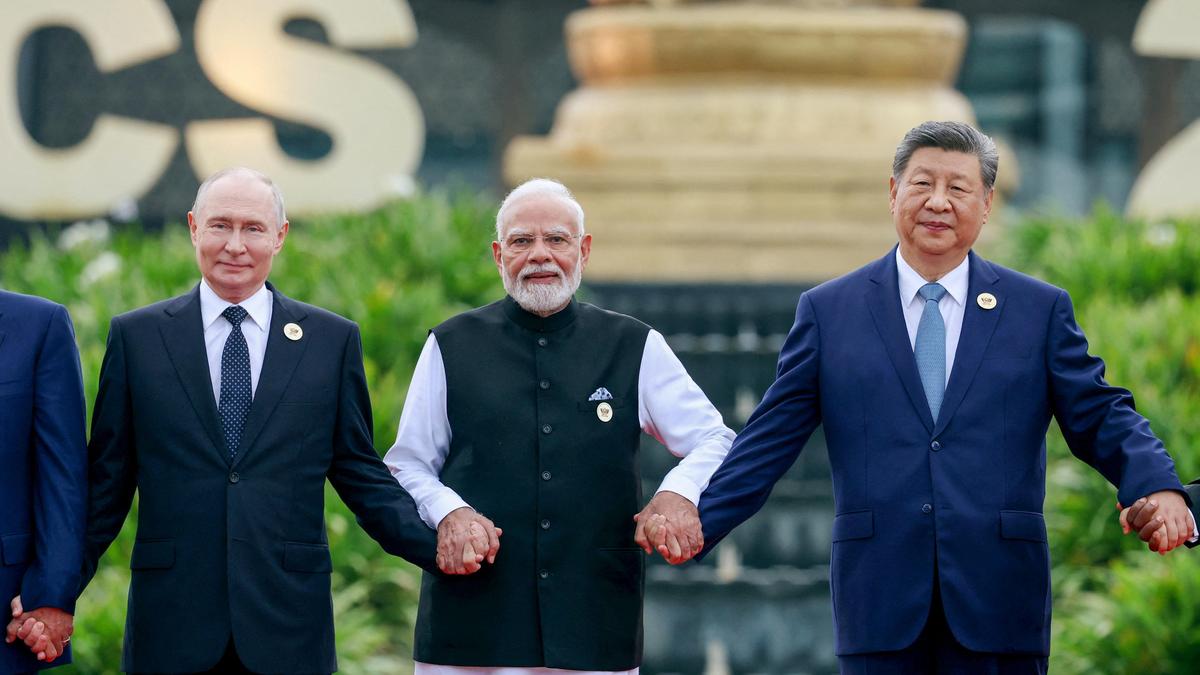
The BRICS summit in New Delhi highlights a strategic convergence between India, the UAE, and Iran. Leaders are navigating complex geopolitical tensions, focusing on economic infrastructure, regional security, and the necessity of open maritime trade routes.
Strategic Realignment at the 18th BRICS Summit
The 18th BRICS summit, hosted in New Delhi, has emerged as a critical venue for addressing the intersection of economic stability and regional security. With the arrival of Iranian President Masoud Pezeshkian and the active participation of UAE leadership, the summit serves as a platform for balancing competing geopolitical interests. Prime Minister Narendra Modi’s engagement with these leaders underscores a deliberate effort to harmonize India's growing economic ambitions with the volatile security landscape of the Middle East.
Advancing the India-UAE Partnership
Prime Minister Modi’s discussions with UAE officials regarding the India-Middle East-Europe Economic Corridor (IMEC) signal a deepening of bilateral ties. By focusing on energy infrastructure and logistics, both nations are positioning themselves to capitalize on a post-fossil fuel transition, effectively transforming their historical trade relations into a modern, strategic partnership. This initiative is not merely about commerce; it represents a long-term commitment to integrated regional infrastructure that bypasses traditional maritime bottlenecks.
The Iranian Perspective: Sanctions and Security
President Pezeshkian’s address at the BRICS Business Forum brought the harsh realities of international sanctions to the forefront. By framing economic security as an inseparable component of national sovereignty, Iran is leveraging the BRICS platform to challenge the impact of U.S. and Israeli policies. The assertion that current pressures have entered a 'dangerous phase' highlights the urgency with which Tehran is seeking alternative economic alliances to mitigate the effects of its isolation from Western financial systems.
Navigation Safety and Global Trade
Amidst the rhetoric of regional aggression, Prime Minister Modi’s specific appeal for 'secure sea lanes' reflects India’s broader concern for the stability of global supply chains. As tensions in the Middle East spike, the vulnerability of critical maritime chokepoints has become a primary anxiety for emerging economies. By championing the protection of seafarers and the freedom of navigation, India is positioning itself as a neutral, stabilizing force capable of facilitating dialogue between adversarial parties.
The Future of BRICS as a Diplomatic Bridge
Looking forward, the success of this summit will be measured by its ability to maintain the 'dialogue' that Prime Minister Modi emphasized during his meeting with President Pezeshkian. As BRICS expands its influence, the challenge remains to integrate states with vastly different political trajectories—such as the UAE’s integrationist approach and Iran’s defensive stance—into a cohesive economic bloc. If successful, this gathering may set a precedent for how non-Western alliances can effectively mediate regional conflicts while pursuing collective economic growth.
Multiple Citing Sources
Verification Required?