The math behind Databricks' $190B price doesn't add up—yet
Source Entity
Yahoo Finance
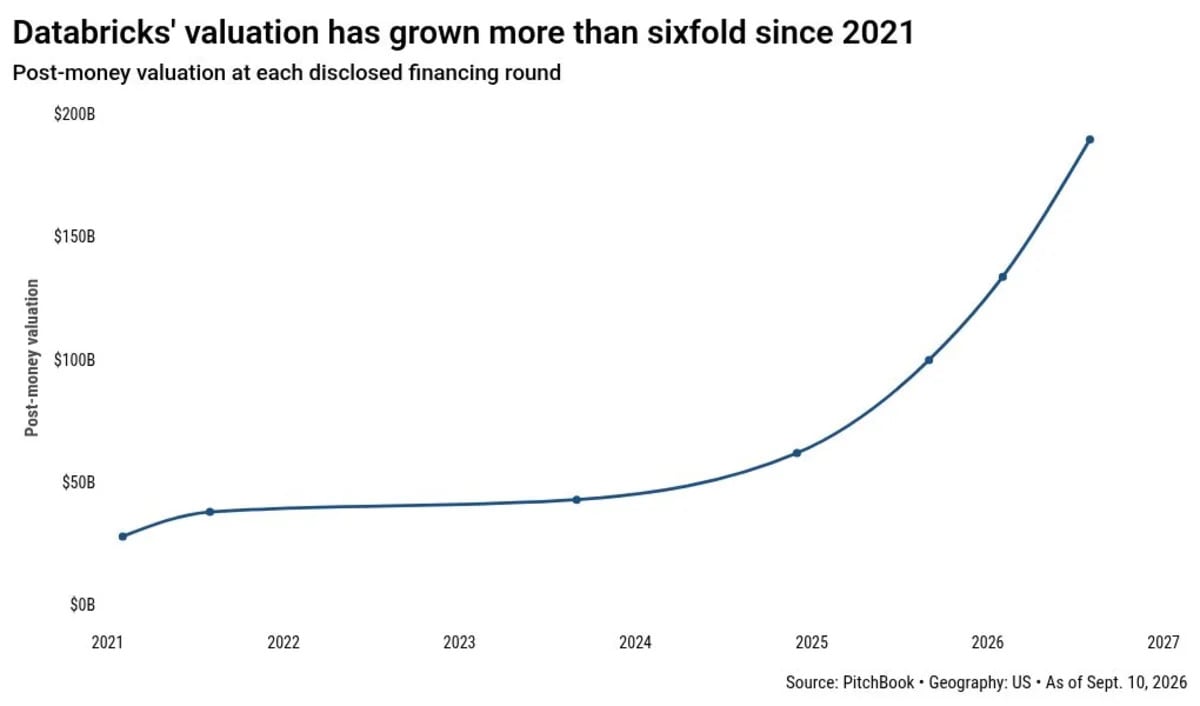
A new PitchBook report suggests Databricks' $190 billion valuation is significantly overinflated compared to its actual operating value. While the company demonstrates strong growth, analysts caution that the current price tag is detached from fundamental performance metrics.
The Valuation Paradox: Analyzing Databricks' $190 Billion Benchmark
Databricks, a titan in the private software sector, has recently found itself at the center of a valuation debate. Following a $5 billion funding round in August led by Coatue, the company achieved a staggering $190 billion valuation. This marks a significant 41.8% increase from its February valuation of $134 billion. However, recent analysis from PitchBook suggests that this financial milestone may be disconnected from the company’s underlying economic realities.
The Discrepancy Between Growth and Valuation
While Databricks has demonstrated impressive operational momentum, reporting an increase in its annualized run rate from $5.4 billion to $7 billion—a growth of 29.6%—the valuation growth has outpaced these revenue gains. Harrison Rolfes, a senior analyst at PitchBook, characterizes Databricks as a high-quality business but explicitly labels it as an unattractive investment at its current price point. This tension highlights a common challenge in the late-stage private equity market, where investor sentiment regarding future AI and data dominance often supersedes current revenue multiples.
Deconstructing the Operating Value
The most striking finding in the PitchBook report is the estimate of the company's operating value, which Rolfes pegs at approximately $68.7 billion. This figure represents the intrinsic worth of the business before adjusting for cash and debt. The gulf between this $68.7 billion figure and the $190 billion market valuation suggests that current investors are paying a significant premium based on speculative future performance rather than immediate financial yield.
Broader Implications for Private Equity
This discrepancy serves as a cautionary tale for the broader software-as-a-service (SaaS) sector. When private market valuations diverge so sharply from internal operating values, it often signals a bubble-like environment driven by the scarcity of high-growth assets. For Databricks, maintaining this valuation will require not just continued revenue growth, but a clear path toward justifying these multiples through sustained profitability and market expansion.
Future Trends and Market Expectations
The market’s reaction to the Databricks valuation will likely influence how future late-stage funding rounds are structured. As the company continues to scale, it faces the dual pressure of satisfying institutional investors who demand high-growth metrics and market observers who are increasingly skeptical of tech-sector inflation. If the gap between the $190 billion price tag and the $68.7 billion operating value does not tighten through either massive revenue surges or a market correction, Databricks may face significant headwinds during its eventual transition to the public markets.
Conclusion
In summary, while Databricks remains one of the most formidable software companies globally, the math behind its current valuation remains contentious. The divergence between its $7 billion run rate and its $190 billion price tag underscores the complexity of valuing private tech giants in an era of aggressive capital deployment. Whether this valuation reflects genuine long-term potential or an overvaluation remains one of the most critical questions in the current private equity landscape.