Dust: Pretraining Transformers Without Backpropagation
Source Entity
Hacker News
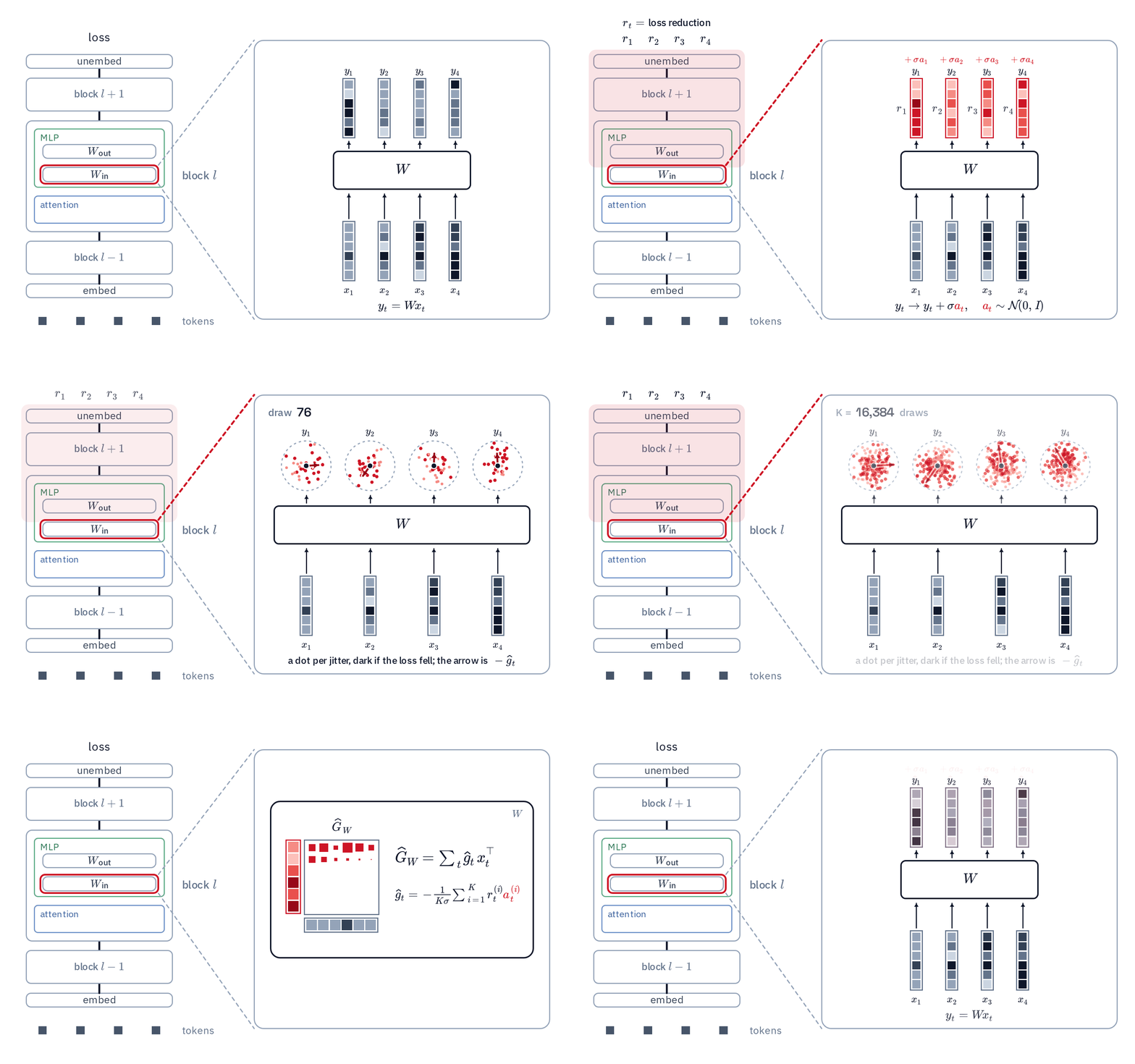
Researchers have introduced 'Dust,' a novel zeroth-order optimization method that enables transformer pretraining without traditional backpropagation. By perturbing activations at each token, Dust allows for parallel evaluation, offering a competitive alternative to standard gradient-based learning.
Rethinking Neural Network Optimization: The Dust Paradigm
The landscape of artificial intelligence research has been dominated for decades by backpropagation, the algorithmic backbone that enables deep learning models to learn from their errors. However, a new research paper titled Dust: Pretraining Transformers Without Backpropagation, authored by Samip Dahal, Bishwas Mandal, Serdar Gülbahar, and Akshay Vegesna, challenges this hegemony. By introducing a zeroth-order optimization method, the team proposes a fundamental shift in how transformer language models can be pretrained.
Understanding the Mechanism: Node Perturbation
At the core of the Dust methodology is the concept of node perturbation. Unlike backpropagation, which relies on calculating exact gradients through the chain rule, Dust perturbs activations independently at every token. This innovative approach treats each token as a member of a virtual population, allowing researchers to evaluate these perturbations in parallel during a single forward pass. This departure from standard gradient descent could potentially mitigate some of the memory and computational bottlenecks currently associated with backpropagating through massive model architectures.
Computational Trade-offs and Scalability
While the authors report that Dust is competitive with backpropagation, the methodology involves a distinct set of computational requirements. The research indicates that Dust approximates backpropagation more closely as the population size increases. This suggests that while Dust offers a new path for training, it necessitates substantially more compute resources to reach the performance levels expected of modern large language models. The scalability of this method will be a critical factor for hardware manufacturers and researchers looking to optimize training pipelines for future architectures.
Implications for Future Transformer Architectures
One of the most intriguing aspects of this study is the finding that in multiple settings, Dust actually exceeds the performance of traditional backpropagation. This hints at a potential future where the reliance on gradient-based learning is no longer the sole standard for deep learning. If zeroth-order methods can consistently outperform backpropagation in specific contexts, it may lead to the development of novel neural architectures that were previously impractical to train due to the limitations of gradient-based optimization.
A New Frontier in AI Research
As the field of machine learning continues to expand, the emergence of techniques like Dust signifies a healthy diversification of optimization strategies. By moving beyond the constraints of backpropagation, researchers are opening doors to more flexible, parallelizable training regimes. While the 2026 research remains in its nascent stages, it provides a compelling proof-of-concept that may redefine the efficiency and effectiveness of pretraining in the coming years.
Concluding Perspectives
The introduction of Dust represents a significant milestone in algorithmic innovation. By successfully pretraining transformers without the traditional backpropagation mechanism, Dahal et al. have provided the community with a robust alternative that warrants further investigation. As computational resources evolve to favor parallelized node perturbation, we may see a transition toward these zeroth-order methods as a staple in the development of next-generation artificial intelligence.