A Jupiter-size planet that escaped its star's death
Source Entity
Jacek Krywko
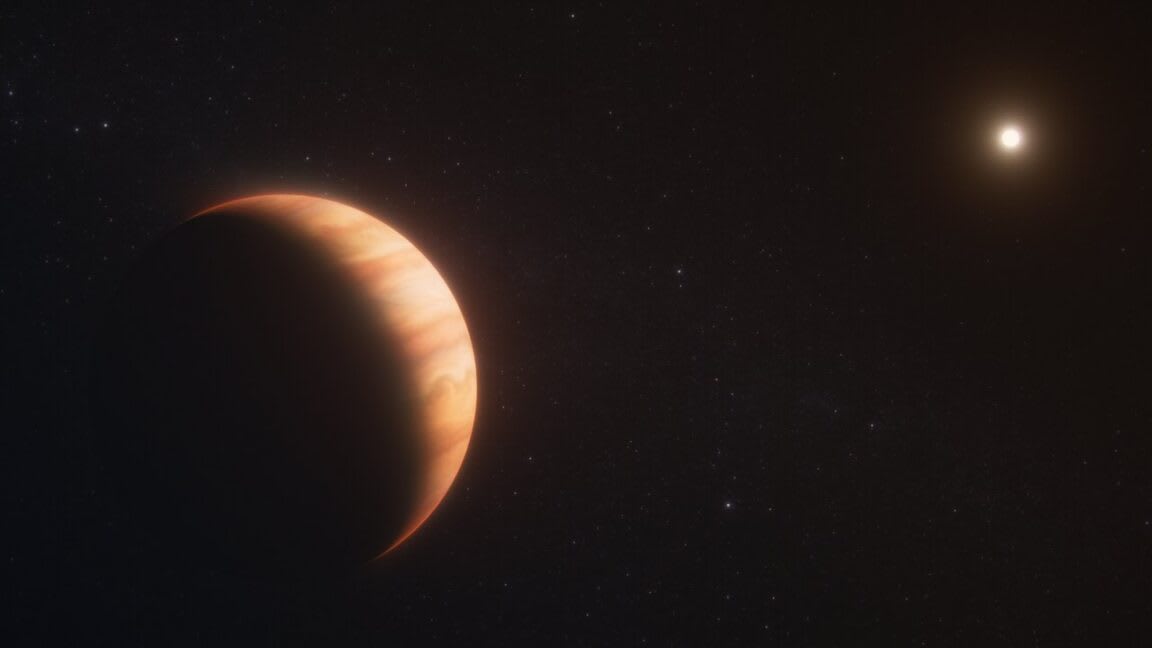
It's unclear how the planet avoided its star's bloated red giant stage.
The Cosmic Survivor: A Gas Giant's Narrow Escape
The discovery of a Jupiter-sized planet that managed to survive the death throes of its parent star marks a significant milestone in our understanding of stellar evolution and planetary dynamics. Typically, when a star exhausts its hydrogen fuel, it enters the red giant phase, expanding its outer layers to an immense size. This process usually results in the incineration of any nearby planets, turning once-stable orbits into fiery graves. The existence of this specific survivor suggests that the fate of planetary systems is far more complex and varied than previously theorized.
The Mechanics of Stellar Expansion
To understand why this discovery is so shocking, one must first examine the nature of the red giant stage. As a star like our Sun ages, its core contracts and heats up, causing the outer envelope to expand outward. During this period, the star's radius can increase by a factor of hundreds, effectively swallowing inner planets. For a Jupiter-sized planet to remain intact, it must have either started at a vast distance or undergone a significant orbital shift. The fact that this planet remains in a position where it is detectable yet survived the "bloated" phase of its star creates a theoretical paradox for astrophysicists.
Challenging Current Planetary Models
This event forces a re-evaluation of orbital migration theories. Most models suggest that planets move inward or outward over millions of years; however, the survival of this gas giant suggests a precise balance of gravitational forces. It is possible that the loss of mass from the star as it shed its outer layers allowed the planet's orbit to widen, pushing it just beyond the reach of the expanding stellar surface. This "orbital migration" provides a crucial clue into how planetary systems reorganize themselves during the transition from a main-sequence star to a white dwarf.
Parallels to Our Own Solar System
The implications of this discovery extend directly to our own neighborhood. In several billion years, our Sun will undergo a similar transformation into a red giant. While Mercury and Venus are certain to be consumed, the fate of Earth and the outer gas giants, including Jupiter, remains a subject of intense debate. If a Jupiter-sized planet in another system could escape such a cataclysm, it provides a scientific precedent that outer planetary bodies can persist even after their suns have undergone a violent metamorphosis.
Future Directions in Exoplanetary Research
Looking forward, this discovery will likely trigger a surge in searches for "survivor planets" around white dwarfs. With the advanced capabilities of the James Webb Space Telescope (JWST) and upcoming ground-based observatories, astronomers will be able to analyze the atmospheric composition of such survivors. By studying whether the planet's atmosphere was stripped or altered by the red giant phase, scientists can determine exactly how close the planet came to destruction, further refining the laws of celestial mechanics.
Conclusion
The survival of this gas giant is more than just a cosmic anomaly; it is a window into the eventual fate of all planetary systems. By challenging the assumption that stellar expansion is an absolute death sentence for nearby worlds, this discovery opens new avenues for researching the resilience of planets. As we continue to uncover these anomalies, we move closer to predicting the ultimate destiny of our own Solar System.