LeMario: Training a JEPA World Model on Super Mario Bros
Source Entity
Hacker News
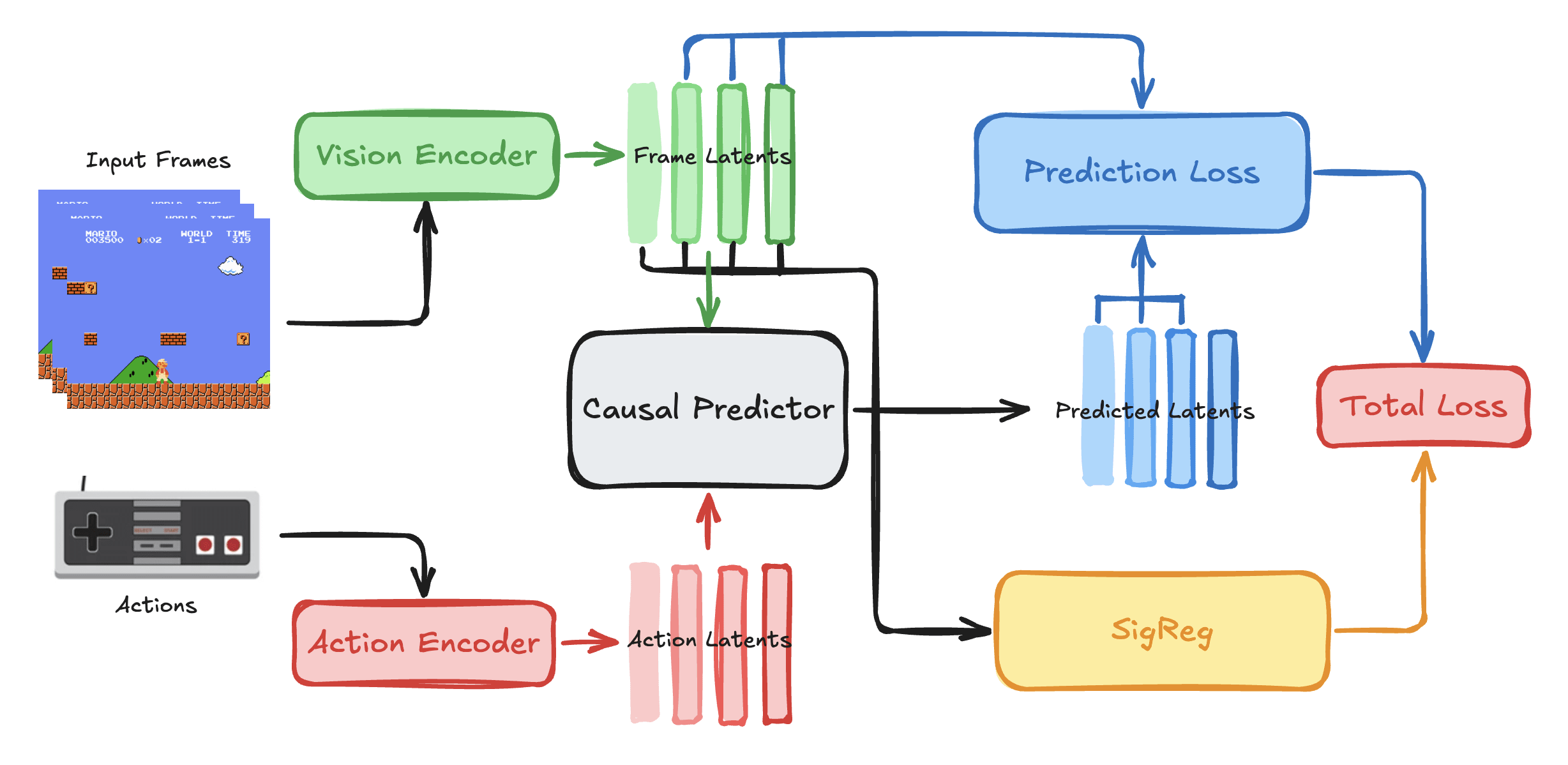
LeMario is an AI project that implements a Joint-Embedding Predictive Architecture (JEPA) to create a world model of Super Mario Bros, shifting the focus from pixel-perfect generation to latent space prediction for more efficient environmental understanding.
LeMario: Redefining Environmental Understanding through JEPA
The emergence of LeMario marks a significant milestone in the application of Joint-Embedding Predictive Architecture (JEPA) within simulated environments. Unlike traditional AI agents that simply learn to map inputs to outputs via reinforcement learning, LeMario attempts to build a "World Model" of the classic Super Mario Bros game. This approach represents a fundamental shift in how AI perceives and predicts its surroundings, moving away from the computationally expensive process of generating every pixel of a future frame and instead focusing on the underlying logic and structural representations of the game world.
The Shift from Generative to Predictive Architectures
To understand the significance of LeMario, one must first understand the distinction between generative models and JEPA. Most current AI models are generative; they attempt to predict the exact next state of an environment (e.g., predicting the exact color of every pixel in the next frame of a video). However, as championed by Yann LeCun, this is often an inefficient use of compute because many details in a scene are irrelevant to the agent's goal.
LeMario utilizes JEPA, which operates in a latent space. Instead of predicting a pixel-perfect image, it predicts the representation of the next state. By ignoring the "noise" of the visual rendering and focusing on the "signal" of the game's state (such as Mario's position, enemy movement, and platform layouts), LeMario can develop a more robust and abstract understanding of the world's physics and rules.
Super Mario Bros as the Ideal Benchmark
Super Mario Bros serves as an ideal testbed for this architecture due to its deterministic physics and clear causal relationships. In a world model, the AI must learn that pressing the "jump" button leads to an upward trajectory and that colliding with a Goomba results in a state change (either defeat or the enemy's removal).
By training on this specific environment, LeMario demonstrates that a model can internalize the "laws" of its universe. This allows the AI to simulate potential futures internally—essentially "imagining" the outcome of an action before executing it. This capability is the cornerstone of efficient planning and is a prerequisite for any AI attempting to operate in complex, real-world scenarios where trial-and-error is too costly or dangerous.
Overcoming the 'Collapse' Challenge
One of the primary technical hurdles in training JEPA-based models is the risk of "representation collapse," where the model finds a trivial solution by mapping all inputs to a single constant vector, thereby achieving low error without actually learning anything. The implementation of LeMario must navigate this precarious balance, utilizing specific regularization techniques or architectural constraints to ensure that the latent space remains expressive and informative.
Analyzing the project through this lens reveals the sophistication of the training pipeline. The ability to maintain a diverse and meaningful latent space while predicting future states in a dynamic environment like Super Mario Bros proves that non-generative world models are viable and potentially superior for high-level reasoning tasks.
Broader Implications for AGI and Robotics
The implications of LeMario extend far beyond the realm of retro gaming. The transition toward latent-space world models is a critical step toward achieving Artificial General Intelligence (AGI). If an AI can learn the "world model" of a 2D platformer, the same principles can be scaled to 3D environments, autonomous driving, and humanoid robotics.
In robotics, for example, an agent does not need to predict the exact reflection of light on a metallic surface to know that a wall is an obstacle. By adopting the JEPA philosophy seen in LeMario, future robots will be able to plan movements based on abstract physical constraints rather than being bogged down by visual minutiae, leading to faster learning cycles and safer interactions with human environments.
Summary and Future Outlook
LeMario is more than a technical curiosity; it is a practical demonstration of a new paradigm in AI. By successfully training a JEPA world model on Super Mario Bros, the project validates the theory that predicting abstract representations is a more efficient path to intelligence than pixel-level generation. As this technology evolves, we can expect a shift in AI development toward models that prioritize conceptual understanding and internal simulation, bringing us closer to machines that truly understand the cause-and-effect nature of the physical world.