Show HN: Parseable, an open observability datalake, handles 100M time-series/min
Source Entity
Hacker News
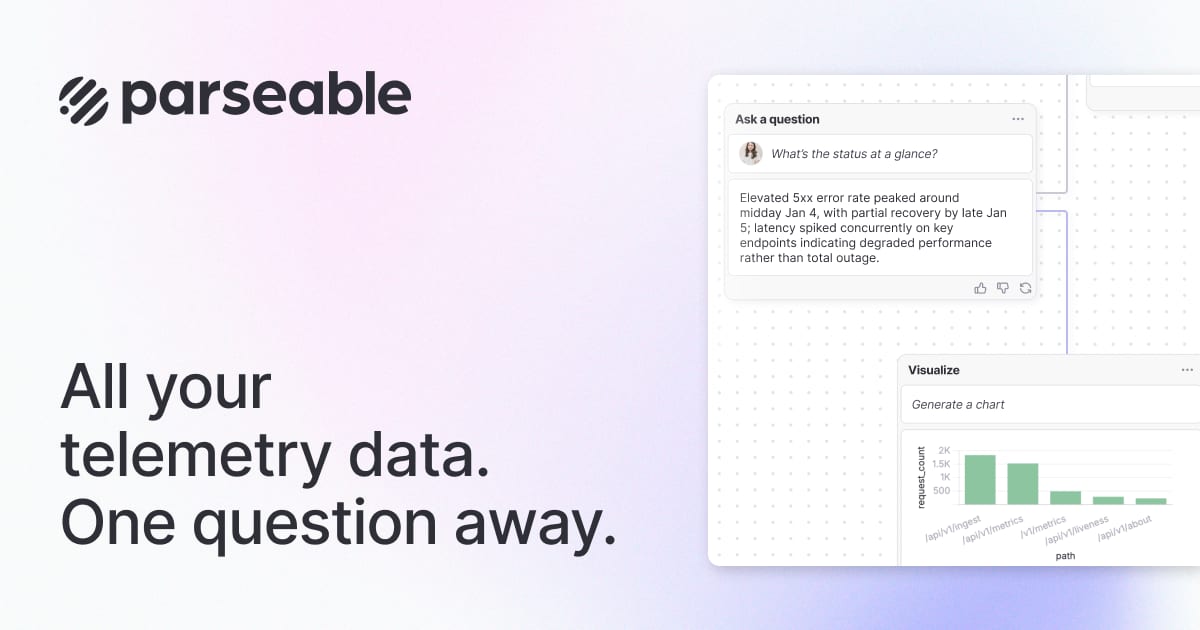
Parseable has launched an open observability datalake capable of processing 100 million time-series data points per minute. The platform utilizes AI agents to automate root cause analysis for complex telemetry anomalies.
The Evolution of Observability: Parseable’s New Data Benchmark
In the rapidly evolving landscape of DevOps and site reliability engineering (SRE), the ability to process massive telemetry volumes is no longer a luxury but a necessity. The recent announcement regarding Parseable—an open observability datalake—highlights a significant shift in data handling capabilities, boasting the capacity to ingest and process 100 million time-series data points per minute. This technical milestone addresses the growing 'data tax' that modern distributed systems impose on engineering teams, who are often overwhelmed by the sheer volume of logs, metrics, and traces generated by microservices architectures.
Integrating AI Agents for Incident Response
Beyond raw throughput, Parseable has introduced an AI-assisted telemetry investigation framework that fundamentally changes how teams respond to outages. By deploying an autonomous AI agent that operates on a 24/7 basis, the platform can detect anomalies in real-time. For instance, the system recently identified an error rate spike of 12.6% compared to a baseline of 1.2%. Rather than alerting a human to manually sift through dashboards, the agent autonomously synthesized logs, metrics, and traces to pinpoint a connection pool exhaustion in a checkout service, significantly reducing the mean time to resolution (MTTR).
The Role of Multimodal Telemetry Analysis
What differentiates Parseable from legacy monitoring tools is its holistic approach to data. Traditional systems often silo logs from metrics, forcing engineers to perform 'context switching' during high-stress incidents. By unifying these signals into a single datalake, Parseable allows LLMs and traditional machine learning models to correlate disparate data points. This is particularly effective at identifying 'unknown unknowns'—patterns that human operators might miss due to cognitive bias or the sheer complexity of modern cloud-native environments.
Impact on Operational Efficiency
Analyzing the specific incident reported—a 7-minute and 32-second outage affecting 6,450 users—we can see the profound impact of automated root cause analysis. In a conventional environment, identifying a connection pool exhaustion could take hours of manual investigation. By automating the identification of the root cause, Parseable effectively turns a potential prolonged service disruption into a manageable, short-duration incident, thereby protecting user experience and revenue streams.
Future Trends in Observability
The trajectory of observability is clearly moving toward 'autonomous operations.' As systems grow more complex, the human-in-the-loop model is becoming a bottleneck. The integration of AI agents that can not only detect but also diagnose—and potentially remediate—issues represents the next frontier in platform engineering. Parseable’s architectural choice to build an open datalake ensures that teams are not locked into proprietary formats, allowing them to leverage the best of LLM innovation as it continues to evolve.
Conclusion
Parseable’s ability to handle high-velocity time-series data while providing actionable, AI-driven insights positions it as a critical tool for modern infrastructure management. By bridging the gap between massive data ingestion and intelligent, human-readable analysis, it addresses the most persistent pain points in contemporary software development, setting a new standard for how organizations monitor and maintain their digital services.