US-Iran war LIVE: Brent crude price climbs as both sides exchange fresh strikes
Source Entity
Latest News: Today's Latest News Headlines from India & World | Hindustan Times | Hindustan Times
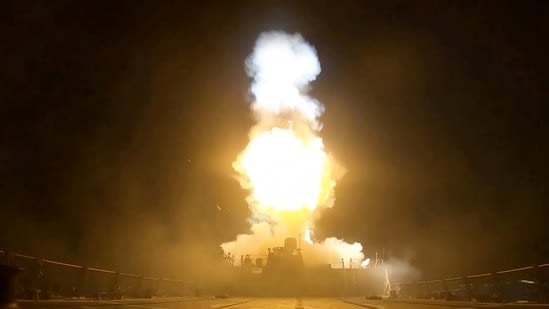
US-Iran war LIVE: A US military spokesperson said the latest strikes were launched after Iran's Islamic Revolutionary Guard Corps (IRGC) allegedly fired on another commercial vessel transiting the strait.
Escalation in the Middle East: US-Iran Military Confrontation
The geopolitical landscape has shifted violently following a series of direct military exchanges between the United States and Iran. The current crisis was triggered by reports from a US military spokesperson stating that the Islamic Revolutionary Guard Corps (IRGC) targeted a commercial vessel transiting a critical maritime strait. In immediate retaliation, the US launched a series of strikes aimed at neutralizing the threats posed by the IRGC. This cycle of aggression marks a dangerous escalation in a long-standing rivalry, moving from proxy conflicts to direct kinetic engagement.
The Strategic Significance of Maritime Choke Points
The 'strait' referenced in the reports is almost certainly the Strait of Hormuz, one of the world's most vital oil transit choke points. By targeting commercial shipping, the IRGC leverages its geographical advantage to exert pressure on the global economy. The strategy of interfering with commercial vessels is a known tactic used to signal strength and demand concessions from Western powers. When the US responds with military strikes, it is not merely reacting to a single incident but is attempting to uphold the principle of 'freedom of navigation,' which is essential for the stability of international trade.
The Role of the IRGC and Asymmetric Warfare
The IRGC operates as a powerful wing of the Iranian state, often employing asymmetric warfare tactics to offset the conventional military superiority of the United States. By utilizing fast attack craft, mines, or drones to target commercial shipping, the IRGC creates a high-risk environment that forces the US to deploy significant naval assets for escort duties. This specific event—firing on a commercial vessel—serves as a catalyst that transforms regional tension into an active military confrontation, testing the resolve of both administrations.
Economic Shockwaves and Brent Crude Volatility
One of the most immediate and tangible impacts of this confrontation is the climb in Brent crude prices. Oil markets are hypersensitive to instability in the Persian Gulf, as any disruption to the flow of oil through the strait can lead to global supply shortages. The surge in prices reflects a 'risk premium' added by traders who anticipate prolonged instability or a potential blockade of the strait. This economic volatility has far-reaching implications, potentially driving up inflation and energy costs for consumers worldwide, thereby linking a localized military strike to global economic health.
The Cycle of Deterrence and Escalation
From a military perspective, the US strikes are designed as a deterrent, intended to signal that attacks on commercial shipping will incur a high cost. However, the history of US-Iran relations suggests that such actions often lead to a 'tit-for-tat' cycle. The danger lies in the possibility of a miscalculation where a tactical strike leads to a strategic war. Each side is currently operating in a high-stakes environment where the line between 'signaling' and 'full-scale conflict' is dangerously thin.
Future Outlook and Geopolitical Implications
Looking forward, the trajectory of this conflict will likely depend on whether diplomatic channels can be reopened to de-escalate the military posture. If the IRGC continues to target commercial vessels, the US may increase its permanent naval presence in the region, further aggravating tensions. Conversely, a shift toward diplomatic negotiations could stabilize oil prices, but only if there is a verifiable cessation of hostilities in the strait. The world remains on edge as the risk of a broader regional war looms over the global energy supply.
Summary of the Crisis
In summary, the exchange of strikes between the US and Iran, sparked by the IRGC's attack on a commercial vessel, has created a volatile intersection of military conflict and economic instability. The rise in Brent crude prices serves as a barometer for the global anxiety surrounding this confrontation. While the US seeks to protect international shipping lanes, the IRGC continues to use the strategic geography of the region as a weapon, leaving the international community in a state of precarious uncertainty.
Verification Required?