
Greenery does not always cool. While the instinct is to blanket every concrete surface in ivy or moss, the actual thermal outcome depends on a complex interaction between Leaf Area Index, urban morphology, and the available water table. Most developers treat plants as aesthetic wallpaper. They assume more leaves equal lower temperatures. This is a dangerous oversimplification that ignores the nonlinear thresholds of thermal insulation.
The goal is not just to add plants, but to manipulate the thermal environment. Urban vegetation can reduce surface temperatures by up to 8°C (Source: Preprints, 2026). This happens through two primary mechanisms: shading and transpiration. The canopy intercepts solar radiation before it hits the pavement, while transpiration consumes energy to evaporate moisture, cooling the surrounding air layer. When executed correctly, forests can maintain surface temperatures 19-23°C lower than open asphalt (Source: Preprints, 2026).
Prerequisites for Thermal Integration
- Detailed Urban Morphology Maps: Data on building heights, street widths, and topographic orientation.
- Leaf Area Index (LAI) Projections: Estimates of the total one-sided leaf area per unit ground surface area.
- Hydrological Baseline: Current soil-water availability and downstream water yield data.
- Topographic Context: Altitude and slope data to account for spatial heterogeneity (Source: MDPI, 2026).
You cannot design for cooling without these metrics. Guesswork leads to dead plants and hot streets. A global meta-analysis across 98 sites on five continents proves that the canopy acts as a thermal insulator, but its effectiveness is not a straight line (Source: Preprints, 2026). You need to know where your threshold is before you dig the first hole.
The Implementation Process
- Map the Urban Morphology: Identify areas of high heat capacity and low reflectivity. Analyze how building arrangements might reduce natural ventilation, which can trap heat even under a canopy (Source: Preprints, 2026).
- Determine the LAI Threshold: Calculate the required Leaf Area Index for your specific terrain. Because the cooling effect is non-linear, adding more leaves beyond a certain point provides diminishing returns and may block critical airflow.
- Audit Water Availability: Evaluate the trade-off between transpiration and water yield. In dry environments, high transpiration can reduce soil-water availability and hurt downstream water supplies (Source: Frontiers, 2026).
- Deploy Targeted Vegetation: Place high-LAI species in high-exposure zones and low-water-demand species in water-limited zones to ensure staying power.
Precision is everything. If you ignore the urban morphology, you risk creating a 'heat trap' where the canopy prevents the ground from cooling at night. The interaction between the vegetation canopy and the underlying surface shapes the entire temperature regime of the area (Source: Preprints, 2026). You must treat the city as a living machine, not a garden.
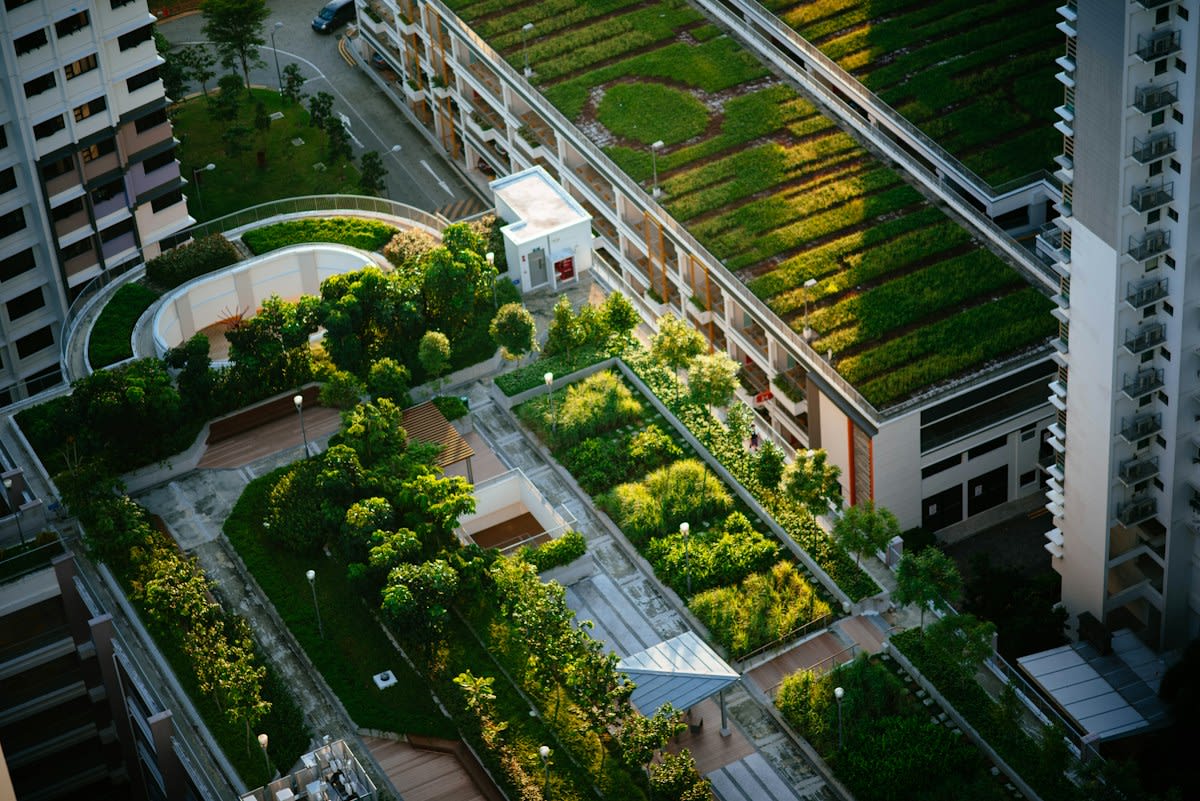
The physics of altitude cannot be ignored. Spatial heterogeneity and nonlinear threshold effects mean that a biophilic strategy that works in a coastal city will fail in a high-altitude urban center (Source: MDPI, 2026). The weight of the atmosphere and the local topographic context change how land surface temperature (LST) responds to vegetation.
"Understanding how urban morphology affects land surface temperature (LST) across altitudinal and topographic contexts is vital for urban heat island mitigation."— Xiaoyu Hu, Researcher at MDPI
This insight shifts the focus from quantity to placement. We are no longer asking how many trees to plant, but where the morphology allows them to actually function as thermal insulators. It is a shift from landscaping to thermal engineering.
The Water-Carbon Trade-off
Transpiration is a double-edged sword. It is the primary driver of cooling, but it requires a constant supply of water. In water-limited systems, the demand for moisture can lead to a mechanical failure of the ecosystem. Increased transpiration can reduce the water available for downstream use, creating a conflict between urban cooling and regional water security (Source: Frontiers, 2026).
There is a hidden web of dependencies here. Transpiration is coupled to carbon dioxide uptake through stomatal regulation (Source: Frontiers, 2026). If you push a plant to cool a city in a drought, the plant may close its stomata to survive. When that happens, the cooling stops. The carbon sequestration stops. The plant becomes a liability.
I have seen this play out in the field. There is a constant friction between the 'green-washing' architects who want lush, tropical canopies for the aesthetic and the site engineers who know the water table cannot support them. The architects push for high-LAI species to hit certification targets, while the engineers warn that the plants will either die or deplete the local aquifer. This dispute is rarely settled with data; it is usually settled by who has the bigger budget until the plants inevitably brown.
Common Pitfalls in Biophilic Integration
- Ignoring the LAI Threshold: Planting too densely, which blocks wind corridors and traps nighttime heat.
- Neglecting Topography: Applying sea-level cooling strategies to high-altitude cities where LST behaves differently (Source: MDPI, 2026).
- Overestimating Water Yield: Implementing high-transpiration species in arid zones without a recycled water source (Source: Frontiers, 2026).
- Ignoring Surface Albedo: Planting over dark, high-heat-capacity surfaces without ensuring the canopy is thick enough to fully shade the ground (Source: Preprints, 2026).
Fact-Check & Accuracy Note
The data is grounded in a systematic review of 164 peer-reviewed English studies regarding climate adaptation (Source: MDPI, 2026) and a global meta-analysis of 98 sites across five continents (Source: Preprints, 2026). The primary academic debate centers on the 'nonlinear' nature of the Leaf Area Index—specifically, at what exact point additional foliage stops cooling and starts obstructing ventilation.
Editorial Note
This guide prioritizes thermal performance over aesthetic appeal. In professional practice, the pressure to 'green' a project often overrides the hydrological data. Always prioritize the water budget over the render.