
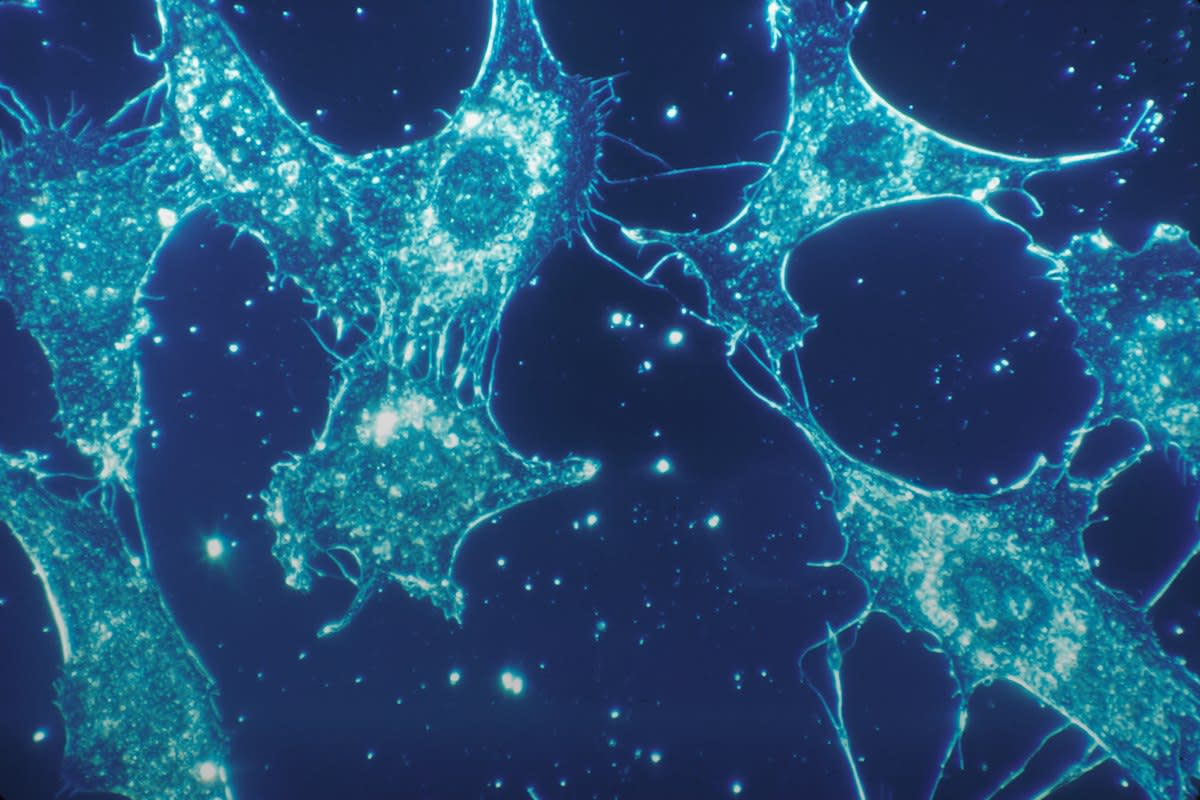
Senescent cells do not die quietly. They enter a state of permanent growth arrest but remain metabolically hyperactive. They pump out a mixture of pro-inflammatory cytokines, chemokines, and proteases known as the Senescence-Associated Secretory Phenotype (SASP). The mainstream narrative claims this secretion is a signal for immune clearance. In reality, it acts as a biological pollutant. It poisons the local environment. It forces neighboring healthy cells into senescence. This is the so-called contagion or bystander effect (Source: Nature, 2016).
The Contagion Narrative
The theory is seductive. It suggests aging is a communicable disease at the cellular level. One cell fails. It secretes IL-6 and IL-8. The surrounding cells react to this stress by triggering their own p16INK4a pathways. Suddenly, a localized failure becomes a systemic collapse. Researchers in hubs like Singapore's Biopolis have spent years mapping these paracrine signals. They frame it as a domino effect. If you stop the first domino, you stop the clock. It turns aging into a linear problem with a discrete target (Source: Cell, 2019).
This linear framing is a curated lie. It ignores the systemic context. Cells do not become senescent in a vacuum. They respond to genomic instability, telomere attrition, and mitochondrial dysfunction. The SASP is a symptom of a cell that has already lost the war. To claim the SASP contagion is the primary cause of aging is to mistake the smoke for the fire. It simplifies a chaotic, multi-dimensional failure into a neat package that can be targeted by a drug.
| SASP Marker | Mainstream Interpretation | Analyst Critique | Systemic Impact |
|---|---|---|---|
| IL-6 | Driver of systemic inflammation | Non-specific noise in stress response | High |
| p16INK4a | Gold standard marker of aging | Correlation does not equal causation | Medium |
| MMPs | Direct cause of tissue degradation | Secondary response to extracellular matrix failure | High |
| IL-8 | Recruits neutrophils for clearance | Chronic presence indicates immune failure, not cause | Medium |
The financial incentive to maintain the contagion narrative is massive. Senolytics—drugs designed to selectively kill senescent cells—are the new frontier for biotech venture capital. If aging is a contagion of 'zombie cells,' then the solution is a chemical purge. This creates a clean investment thesis. Target the cell. Clear the SASP. Reverse the age. It is a far more marketable story than the grim reality of systemic entropy and thermodynamic decay.
"The SASP is a double-edged sword. While it can facilitate wound healing and tumor suppression in the short term, its chronic persistence in old age creates a pro-inflammatory environment that undermines tissue homeostasis."— Judith Campisi, Professor of Medicine at Wake Forest School of Medicine
Ground-Level Friction
Walk into any high-throughput screening lab in Seoul or Boston and you will find the same frustration. The data is messy. In vitro, SASP contagion looks like a textbook example of paracrine signaling. In vivo, it is a disaster. Senolytics that clear p16-positive cells in mice often fail to show meaningful longevity gains in humans. The friction lies in the biological noise. We can kill the zombie cells, but the tissue often fails to regenerate. The environment remains toxic even after the source of the SASP is gone.
There is a vicious political cycle in geroscience. Funding follows the most 'actionable' theory. The contagion model is actionable. The theory that aging is an emergent property of systemic metabolic failure is not. It is too complex for a quarterly earnings call. Consequently, researchers are pressured to overstate the role of the bystander effect. They ignore the data showing that senescence can occur spontaneously across multiple tissues without a prior SASP trigger (Source: The Lancet Healthy Longevity, 2021).
The Systemic Failure
The real driver is not the contagion, but the failure of the immune system to recognize and clear these cells. In a young organism, the SASP is a flare gun. It tells the immune system to come and clean up the damage. Aging is the process of the immune system becoming deaf to that signal. The accumulation of senescent cells is a failure of surveillance, not a viral-like spread. The bystander effect is merely the secondary fallout of a broken waste-management system (Source: Nature Reviews Molecular Cell Biology, 2020).
We see this in the failure of early-stage senolytic trials. Clearing the cells provides a temporary dip in inflammation. But the baseline returns. Why? Because the underlying drivers—oxidative stress and mitochondrial decay—remain untouched. The cells just become senescent again. The contagion is a loop, not a line. By focusing on the SASP, we are treating the symptom while the pathology continues to accelerate in the background.
True biological aging is a distributed failure. It happens in the epigenome, the proteome, and the microbiome simultaneously. The SASP contagion is one small piece of the puzzle, elevated to the status of a primary cause because it fits the pharmaceutical model of 'one target, one drug.' It is a reductionist fantasy that ignores the holistic collapse of biological integrity.
Fact-Check & Accuracy Note
While the SASP contagion effect is a documented biological phenomenon, attributing the entirety of human aging to this 'bystander effect' is an oversimplification. Current evidence suggests that SASP is a secondary amplifier of aging rather than its primary initiator. Most senolytic interventions show promise in reducing specific pathologies rather than reversing systemic biological age.