Your brain is a magnificent processor but a terrible filing cabinet. When you encounter a complex problem—a recursive loop where every solution seems to trigger the original problem—your working memory becomes saturated. This is the cognitive loop. You feel the mental friction, the repetitive circling of the same three variables, and the inevitable exhaustion that follows. Most people try to think their way out of this state, which is like trying to use a hammer to fix a hammer. The only way to break the cycle is to move the processing from the internal biological architecture to an external spatial architecture.
Spatial literacy is not about artistic ability or the capacity to draw a pretty diagram. It is the strategic ability to translate abstract cognitive loads into physical distance, direction, and relationship. By externalizing the loop, you stop fighting the recursive nature of the thought and start observing it as a geometric object. Once a problem has a shape, it can be dismantled. This protocol provides the exact framework for shifting from mental rumination to spatial analysis, allowing you to identify the precise point where the loop breaks.
Prerequisites
Before beginning the protocol, ensure you have a surface large enough to accommodate your physical movements. The brain associates spatial scale with cognitive importance; a small notebook will constrain your thinking, while a wall-sized whiteboard or a large floor space encourages expansive, non-linear connections.
- A large-format physical canvas (Whiteboard, butcher paper, or a digital infinite canvas like Miro/FigJam).
- High-contrast markers or distinct digital colors to categorize different types of cognitive nodes.
- A timer set for 25-minute sprints to prevent 'mapping fatigue'.
- A clear definition of the 'Loop'—the specific recurring frustration or paradox you are facing.
The Mechanics of Spatial Offloading
Why does external mapping work where internal contemplation fails? The answer lies in the limits of human working memory. Most of us can hold roughly four to seven chunks of information simultaneously. In a complex cognitive loop, the variables often exceed this limit, forcing the brain to drop one piece of data to pick up another. This creates the 'loop'—you remember point A, move to point B, forget point A, return to point A, and repeat. By placing these points on a map, you offload the storage requirement to your environment, freeing your prefrontal cortex to focus entirely on the relationships between the points.
Consider a logistics manager in Nairobi attempting to optimize a fragmented supply chain. If they attempt to solve the bottleneck in their head, they are limited by the number of variables they can consciously track. However, by mapping the physical flow of goods against the temporal flow of payments, the 'loop'—where late payments cause delivery delays, which in turn cause late payments—becomes a visible circle. Once the circle is visible, the manager can stop asking 'Why is this happening?' and start asking 'Where can I cut this line?'
The Step-by-Step Spatial Literacy Protocol
- Identify the Anchor Node: Start by writing the core frustration or the central paradox in the middle of your canvas. Do not use a vague term like 'Stress'; use a specific statement like 'The project is delayed because the client refuses the budget, but the budget is required to finish the project.'
- Dump the Variables: Surround the Anchor Node with every single contributing factor, no matter how small. Use a different color for 'Facts' (things that are true) and 'Assumptions' (things you believe to be true). This prevents your brain from treating a guess as a foundation.
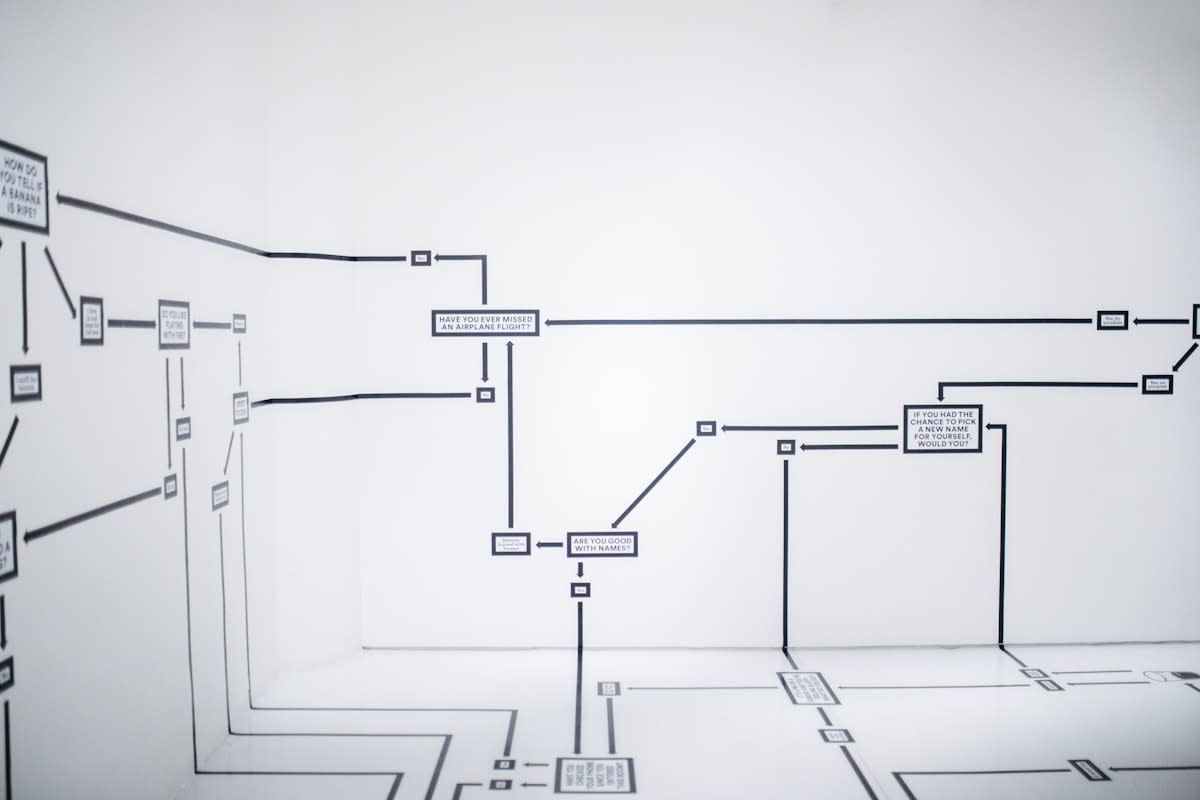
- Map the Vector of Influence: Draw arrows between the nodes. Do not just connect them; indicate the direction of the influence. Does Node A cause Node B, or does Node B exacerbate Node A? When you see multiple arrows pointing back to the start, you have successfully mapped the cognitive loop.
- Apply Spatial Distance: Physically move the nodes. Place the most urgent variables closer to the center and the distal, less influential variables toward the edges. If a node feels 'heavy' or emotionally charged, move it far to the periphery to isolate its effect on the logic of the system.
- Insert the Disruptor: Look for the 'weak link' in the loop—the point where an assumption can be challenged or a new variable can be introduced. Draw a new node in a contrasting color that breaks the circle. This is your exit strategy.
- Synthesize the Action Path: Trace a new line from your current position, through the disruptor, to a desired outcome. This line is no longer a loop; it is a vector. Convert this visual path into three immediate, concrete actions.
The transition from Step 3 to Step 4 is where most practitioners fail. They treat the map as a static image rather than a dynamic tool. The power of spatial literacy comes from the act of moving the nodes. When you physically shift a variable across a whiteboard, you are signaling to your brain that the relationship is flexible. This physical movement breaks the mental rigidity associated with the loop and opens the door to lateral thinking.
"The moment you stop thinking about the problem and start looking at the problem, the loop loses its power. Distance is the primary cure for cognitive obsession."— Master Practitioner of Spatial Systems
Let's apply this to a software architect in Tokyo designing a system with conflicting requirements. The loop is the 'Performance vs. Security' paradox. By mapping these as opposing poles on a canvas and plotting the specific features between them, the architect can see that the loop isn't a binary choice but a gradient. The spatial representation reveals 'safe zones' where both requirements are met, which were previously invisible when the architect was merely oscillating between the two ideas in their mind.

Common Pitfalls and How to Avoid Them
The most common error is the 'Complexity Trap.' This occurs when the practitioner spends more time making the map look professional than they do analyzing the loop. Your map should be a tool, not a piece of art. If you find yourself obsessing over the straightness of your lines or the symmetry of your nodes, you have simply traded one cognitive loop for another. Keep the mapping raw, messy, and fast.
Another frequent mistake is the 'Confirmation Bias Loop.' This happens when you only map the variables that support your existing conclusion. To counter this, intentionally create a 'Devil's Advocate' node—a variable that contradicts your primary assumption. Force yourself to draw a vector from this contradictory node to the center of your map. If your system collapses under the weight of one contradictory fact, your loop was built on a foundation of assumptions, not evidence.
| Internal Thinking (The Loop) | Spatial Mapping (The Protocol) |
|---|---|
| Limited by working memory (4-7 items) | Unlimited by canvas size |
| Recursive and repetitive | Linear and directional |
| Emotionally charged and overwhelming | Detached and analytical |
| Hidden contradictions | Visible gaps and paradoxes |
Finally, avoid the 'Static Map Syndrome.' A map is a snapshot of your understanding at a specific moment. As you implement the disruptor and take action, the system will change. The loop may break, but new, smaller loops will emerge. The Master Practitioner returns to the canvas every week to update the vectors, prune dead nodes, and ensure the path to the outcome remains clear. Spatial literacy is a practice of constant iteration, not a one-time event.