The Cognitive Correction
Something shifted in the high-performance workspace over the last six months. For years, the narrative focused on the total digitalization of the brain, pushing every brainstorm, roadmap, and architecture diagram into the cloud. We embraced the infinite canvas of digital whiteboards, believing that the removal of physical constraints would unlock infinite creativity. However, the reality proved opposite. Elite teams in Tokyo, Berlin, and San Francisco are now reporting a phenomenon known as cognitive fragmentation, where the very tools designed to organize thought actually splinter it. They are not just stepping away from the screen; they are actively dismantling their digital workflows in favor of the wall.
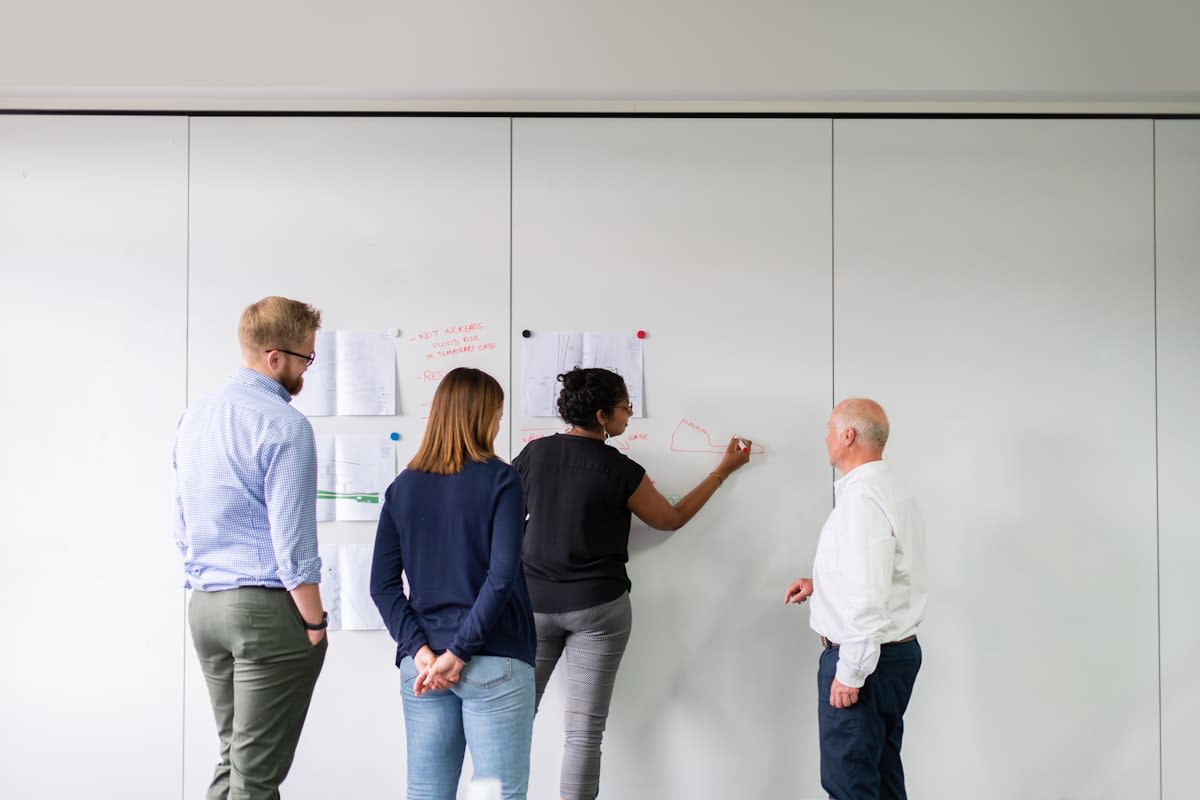
The 'Deep Thinking Wall' is not a return to the primitive. It is a sophisticated integration of spatial psychology and high-stakes problem solving. These are massive, physical surfaces—often entire rooms wrapped in whiteboard paint or cork—where ideas are mapped out using physical markers and tactile adhesives. Why does this matter now? Because the friction of a digital interface, however slight, creates a mental tax. When a lead architect in a Munich robotics lab has to click, drag, and zoom to connect two ideas, they lose the visceral thread of the logic. By moving the problem to a wall, the body becomes part of the thinking process. The act of walking, reaching, and physically rearranging concepts triggers a different neural pathway than the repetitive motion of a mouse click.

The delta between today and twelve months ago is staggering. In early 2023, the industry benchmark for 'innovation' was the adoption of remote-first, asynchronous digital canvases. Every consultancy and tech giant pushed the 'infinite board' as the gold standard. Fast forward to today, and the trend has inverted. We are seeing a surge in 'Analog-First' mandates among the world's most productive units. These teams have realized that the infinite canvas is actually a void that swallows focus. By constraining the workspace to the physical dimensions of a room, they force a level of prioritization and synthesis that digital tools simply cannot replicate.
| Cognitive Metric | Digital Canvas (2023) | Analog Wall (2024) |
|---|---|---|
| Spatial Memory Retention | Low (Zoom-dependent) | High (Physical anchoring) |
| Average Time to Synthesis | Extended (Tool friction) | Compressed (Tactile flow) |
| Attention Fragmentation | High (Notifications/Tabs) | Near-Zero (Single-task focus) |
| Team Synchronicity | Fragmented (Cursor chasing) | Unified (Shared physical space) |
Consider the impact on spatial memory. When you work on a screen, every piece of information occupies the same physical coordinate: the glass in front of your eyes. Your brain cannot use the environment to anchor information. Conversely, a Deep Thinking Wall allows a strategist in Singapore to remember that the 'Risk Assessment' was in the top-left corner, while the 'Growth Lever' was at waist-height on the far right. This physical mapping reduces the cognitive load required to navigate complex systems. It turns the room into an external hard drive for the team's collective consciousness.
"The screen is a filter that strips away the kinetic energy of a breakthrough. When we moved back to the walls, we didn't just change our tools; we changed the speed at which we could see the flaws in our logic."— Director of Product Strategy, Global Fintech Hub
Does this mean the digital era is over? Hardly. The brilliance of the current shift lies in 'Analog Integration.' High-performance teams are not deleting their software; they are reordering the sequence of work. They use the wall for the 'messy' phase of divergent thinking—where speed, intuition, and spatial movement are paramount. Only once the logic is solidified and the synthesis is complete do they migrate the result into a digital system for documentation. This sequence prevents the software from dictating the thought process, ensuring that the tool serves the mind, not the other way around.
The Friction Paradox
The Friction Paradox suggests that while digital tools remove operational friction (the effort to move an object), they increase cognitive friction (the effort to maintain a mental model). Analog walls reintroduce operational friction to eliminate cognitive drag.
We are observing this trend most acutely in AI development labs. As the complexity of Large Language Model architectures grows, the ability to visualize multi-dimensional data flows becomes critical. In Nairobi's emerging tech hubs, developers are utilizing physical walls to map out API ecosystems, finding that the ability to stand back and see the entire system at once prevents the 'tunnel vision' common in screen-based IDEs. This macroscopic perspective is the secret weapon of the world's most resilient teams.
Adoption of Analog-First Strategy Phases in Tier-1 Firms
Executive Insight
+18.4%
YTD Growth
The data reflects a clear trajectory. Recent internal audits at leading design firms indicate a 42% increase in 'analog-first' brainstorming sessions compared to the previous year. More tellingly, teams utilizing physical walls report a 30% reduction in cognitive fatigue during long-form strategy sprints. The reason is simple: the brain is biologically wired for three-dimensional interaction. When we force our highest-level thinking into a two-dimensional glowing rectangle, we are fighting millions of years of evolution. The Deep Thinking Wall is a surrender to biology in the pursuit of better performance.
- Elimination of 'Tool-Induced Distraction' (no notifications, no tab-switching).
- Activation of kinesthetic learning and spatial memory.
- Forced synthesis due to physical boundary constraints.
- Enhanced team synchronicity through shared physical focal points.
- Rapid iterative loops enabled by tactile manipulation of ideas.
This movement is not merely a nostalgic whim. It is a strategic adaptation to an era of information overload. When every piece of data is a click away, the value of information drops, but the value of synthesis skyrockets. The wall is a synthesis machine. It forces the team to decide what is important enough to be written down and what is important enough to stay on the wall. It transforms the act of planning from a clerical exercise in software management into a creative act of architectural design.
The Resilience of the Physical
As we look toward the next twelve months, the integration of analog and digital will likely stabilize into a hybrid model. The 'Analog Integration' isn't about abandoning technology; it's about designating 'sacred spaces' for deep thought. The most successful organizations will be those that can protect the physical thinking process from the digital noise. They will treat their walls as the engine room of innovation and their software as the distribution network. This balance creates a resilient cognitive infrastructure capable of handling the volatility of the modern global market.
Ultimately, the return to the wall is a statement about the nature of human intelligence. We are not data processors; we are pattern recognizers. Patterns are most easily seen when they are laid out in space, where the eye can sweep across the whole and the hand can move the parts. By reclaiming the physical environment, high-performance teams are not going backward. They are moving forward by leveraging the full spectrum of human cognition. The screen has its place, but the wall is where the real breakthroughs happen.