
The Great Pivot: From Prototype to Protocol
Twelve months ago, the global conversation surrounding Brain-Computer Interfaces (BCIs) was dominated by the sheer possibility of the technology. We spoke in hypotheticals about telepathic communication and the theoretical limits of bandwidth. This month, that narrative has fundamentally shifted. The industry has pivoted from the 'proof of concept' phase to the 'clinical scalability' phase. We are no longer asking if we can merge silicon with the nervous system, but how we can do it without triggering a chronic immune response that rejects the hardware. This transition marks the end of the era of the 'heroic' single-patient case study and the beginning of standardized medical protocols.
The urgency is palpable. Across labs in Zurich, San Francisco, and Tokyo, the race is no longer just about electrode count, but about bio-compatibility. The delta between last year's capabilities and today's is most visible in the movement toward endovascular delivery. Instead of drilling into the skull—a process that carries significant risk—new systems are being threaded through the jugular vein to reach the motor cortex. This shift reduces surgical trauma and accelerates the timeline for patient adoption, moving the technology out of the realm of extreme surgery and into the territory of interventional radiology.
"The goal is no longer just to restore a lost function, but to create a seamless, bidirectional flow of information that the brain accepts as its own native language."— Lead Neuro-Engineer, Global Bio-Electronics Initiative
The Architecture of Integration: Threads vs. Stents
Two competing philosophies now dominate the landscape. On one side, we have the high-bandwidth, invasive approach. This method utilizes ultra-thin, flexible threads implanted directly into the brain tissue via robotic precision. The advantage is clear: unprecedented resolution. By placing electrodes in direct contact with neurons, these systems can decode complex intentions with startling accuracy. However, the biological cost is high. The brain is an aggressive environment; it treats foreign objects as invaders, wrapping them in glial scars that eventually insulate the electrode and kill the signal.
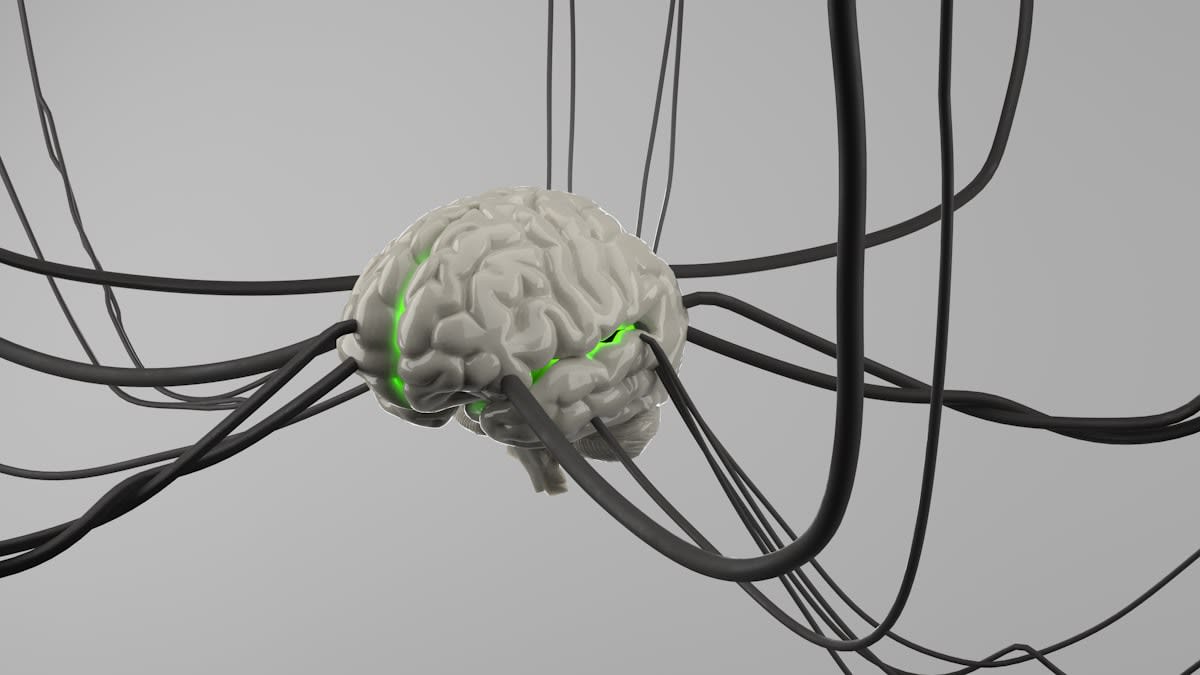
Contrast this with the endovascular approach, where a stent-like electrode is placed within a blood vessel adjacent to the motor cortex. It is the difference between a surgical strike and a strategic placement. While the signal is filtered through the vessel wall—reducing the raw data rate—the safety profile is vastly superior. This is where the real-world adoption curve is steepest. When a procedure can be performed in a catheterization lab rather than a neurosurgical theater, the addressable market expands from a few thousand extreme cases to millions of patients with paralysis or severe neurological decay.
The Bio-Compatibility Wall
The 'Glial Scar' is the primary enemy of bio-electronics. When the body detects a rigid silicon probe, astrocytes and microglia form a dense sheath around it. This biological wall increases electrical impedance, eventually rendering the device deaf to the neurons it was meant to monitor.
To combat this, material science is stepping in with conductive polymers and hydrogel coatings that mimic the mechanical properties of brain tissue. We are seeing a shift toward 'soft electronics' that flex and move with the brain's natural pulsations. This isn't just a technical upgrade; it is a fundamental reimagining of the interface. By matching the Young's modulus of the hardware to that of the grey matter, engineers are tricking the immune system into ignoring the implant, extending the device's functional lifespan from months to potentially decades.
Global Hubs and the Geopolitics of Cognition
The race is not confined to a single corridor. While the United States leads in venture-backed, high-profile startups, Europe—particularly Switzerland and Germany—is dominating the integration of BCIs with advanced prosthetic limbs. In these regions, the focus is on the closed-loop system: not just sending a command from the brain to a hand, but sending sensory feedback from the fingertips back to the somatosensory cortex. This bidirectional flow is what transforms a tool into a limb.
| Approach | Invasiveness | Bandwidth | Primary Use Case | Regulatory Path |
|---|---|---|---|---|
| Endovascular Stent | Low | Moderate | Communication/Basic Control | Fast-Track (Medical) |
| Intracortical Threads | High | Ultra-High | Complex Motor Control | Rigorous Clinical Trial |
| Non-Invasive EEG/fNIRS | Zero | Low | Wellness/Basic Gaming | Consumer Grade |
Meanwhile, East Asian hubs are pivoting toward the intersection of BCIs and rehabilitation robotics. In Japan and South Korea, the emphasis is on augmenting the physical recovery of stroke patients through synchronized neural stimulation and exoskeleton movement. They are treating the BCI not as a permanent replacement, but as a bridge to help the biological nervous system rewire itself. This approach views bio-electronics as a catalyst for natural healing rather than a permanent synthetic overlay.
This fragmented global landscape creates a fascinating tension. The US pushes for the 'super-human' ceiling—maximizing bandwidth and cognitive expansion—while Europe and Asia focus on the 'human-recovery' floor—maximizing safety, rehabilitation, and quality of life. The eventual winner will likely be the system that can bridge these two goals: a device that is safe enough for general medical use but powerful enough to offer meaningful cognitive enhancement.
The Timeline: When the Living Network Goes Mainstream
Predicting the adoption curve requires looking at the regulatory delta. Over the last 24 months, the FDA and EMA have signaled a newfound openness to 'Breakthrough Device' designations for BCIs. This has slashed the time required for early-stage human trials. We are currently seeing a surge in patient enrollment for devices targeting ALS and spinal cord injuries. The immediate future—the next 2 to 5 years—will be defined by these medical necessities. The technology will be proven in the most desperate circumstances first.
Projected BCI Market Integration (2024-2030)
Executive Insight
+18.4%
YTD Growth
The transition to the consumer market is a more complex beast. For a healthy person to accept a neural implant, the value proposition must outweigh the surgical risk. We are unlikely to see 'brain-chips' for the general public in the next decade. Instead, we will see 'hybrid' systems: a minimally invasive implant that pairs with a high-performance wearable. This hybrid model allows for the precision of internal sensing with the safety of external processing, creating a tiered entry point for the general population.
The real tipping point occurs when the bandwidth of these interfaces exceeds the bandwidth of our current digital tools. Typing on a glass screen is a bottleneck; speaking into a microphone is a slight improvement. When a bio-electronic interface allows a user to transfer a complex thought or a visual image in milliseconds, the economic incentive for adoption will become irresistible. We are talking about a shift in human productivity that dwarfs the invention of the personal computer.
Resilience, Ethics, and the New Human Baseline
As we merge these systems, we must confront the reality of 'neural sovereignty.' If a company owns the hardware in your motor cortex, who owns the data generated by your intentions? The industry is currently ignoring this in favor of technical milestones, but the collision is inevitable. We are moving toward a world where 'cognitive liberty' becomes a legal necessity. The ability to disconnect, to encrypt one's thoughts, and to prevent the algorithmic manipulation of neural pathways will be the defining civil rights struggle of the mid-century.
Yet, the opportunity for resilience is staggering. We are looking at the potential to eradicate the concept of 'permanent' paralysis. We are looking at the ability to treat refractory depression by precisely modulating the circuits of the limbic system in real-time. This is not about creating cyborgs; it is about expanding the definition of what it means to be a functioning human being. The merge is not a replacement of the biological, but an augmentation of it.
The living network is no longer a science fiction trope. It is a nascent industrial sector. Those who view it through the lens of fear miss the broader trajectory: we have always integrated with our tools, from the first flint knife to the smartphone in our pockets. The only difference now is that the tool is moving inside the skin. The convergence is happening. The only question remaining is how we will govern the mind once it is networked.