
The Payload Efficiency Mandate
Orbital Transfer Vehicle (OTV) efficiency is a zero-sum game of mass versus delta-v. Every kilogram of dead weight in a satellite payload degrades the vehicle's ability to reach target orbits or increases the propellant requirement, which in turn reduces the total payload capacity. The industry currently struggles with a hardware-first mentality that leads to costly failures. On July 16, 2026, SpaceX experienced this volatility when Starship Flight 13 was aborted due to engine ignition failures. This event, involving the upgraded V3 vehicle, highlights the fragility of relying solely on iterative physical testing. To maximize efficiency, the focus must move from the vehicle's raw power to the payload's lean configuration.
Why do we continue to launch oversized batteries and redundant structural supports? The answer lies in a lack of pre-deployment validation. When operators cannot predict exactly how a payload will behave in a specific orbital regime, they over-engineer. This over-engineering is a tax on OTV efficiency. By stripping away the safety margins that are born of ignorance, operators can significantly increase the number of satellites delivered per launch. The goal is a payload that is precisely tuned to its mission, leaving nothing to chance and nothing wasted.
The Cost of Hardware Iteration
The failure of the Super Heavy booster to perform a controlled splashdown during Flight 12, coupled with the loss of an upper-stage engine, proves that hardware iteration alone is too slow and too expensive for rapid constellation scaling.
Prerequisites for OTV Optimization
Before attempting to optimize an OTV manifest, a hub must possess specific technical capabilities. You cannot optimize what you cannot simulate. The first requirement is a high-fidelity virtualization environment. On July 14, 2026, Antaris established Aeonyx specifically to address this gap, creating a platform that virtualizes all-domain missions in a common software environment. This allows operators to evaluate architectures and validate operational concepts before any hardware is manufactured. Without this, you are simply guessing at the mass-to-orbit ratio.
- Mission Virtualization Software: A common environment to simulate mission outcomes and asset contributions.
- Power Beaming Receivers: Hardware capable of accepting electrical power transmitted from orbit to reduce onboard battery mass.
- Terrestrial Integration Nodes: Localized offices and field operations to ensure payload data has a viable ground endpoint.
- V3-Class Heavy Lift Access: Capability to handle larger, optimized payloads with high-cadence launch windows.
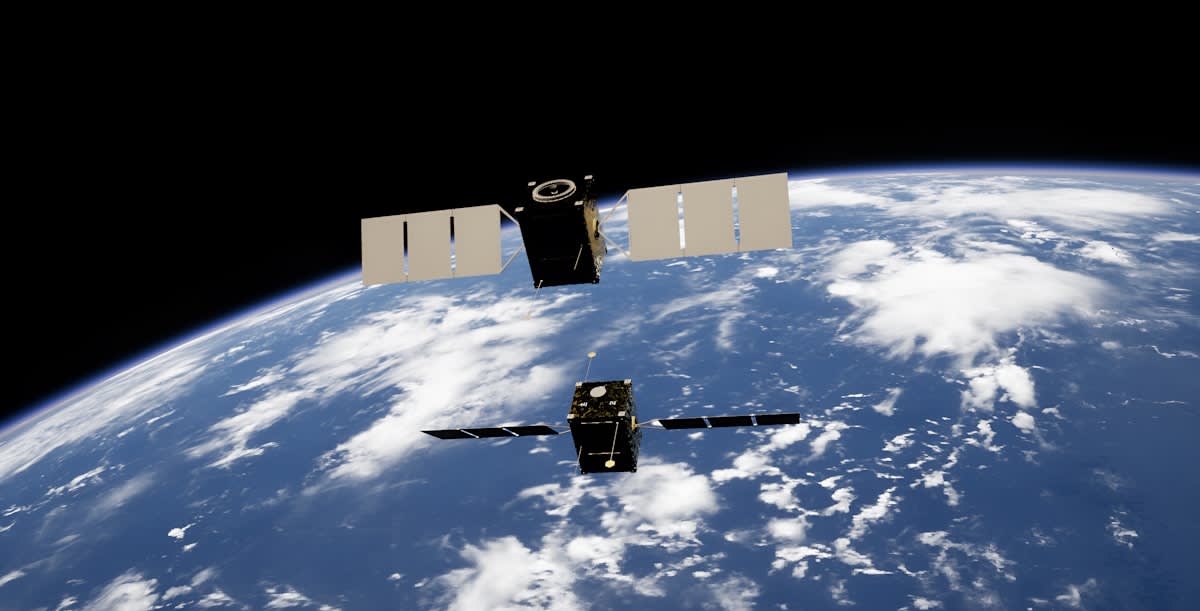
Execution Steps for Payload Minimization
Reducing payload mass is not about cutting corners; it is about decoupling functions. The most significant mass driver in any satellite is the power system. The Defense Innovation Unit (DIU) is currently pushing for a commercial path to deliver electrical power from orbit, with proposals due by July 22, 2026. This 'multi-orbit utility' concept allows for the transmission of energy to satellites in low, medium, and geosynchronous orbits. By removing the need for massive solar arrays and heavy chemical batteries, the payload becomes a lean sensor or communications node.
- Map Mission Outcomes via Virtualization: Use a platform like Aeonyx to identify the minimum hardware required to achieve the mission goal. Eliminate any component that does not directly contribute to a validated outcome.
- Decouple Power Requirements: Integrate power beaming receivers. Instead of carrying 100kg of batteries, design the payload to receive energy from an orbital power hub, as proposed by the DIU.
- Optimize Mass Distribution: Align the payload center of gravity with the OTV's thrust vector to minimize the need for corrective RCS (Reaction Control System) burns, which waste propellant.
- Establish Terrestrial Hand-off Points: Coordinate with local partners to ensure ground-segment efficiency. Follow the Amazon Leo and Herotel model by establishing local offices (e.g., 120 local offices) to handle the 'last mile' of data delivery, reducing the need for satellites to carry high-power, long-range transmitters.
The integration of these steps transforms the OTV from a simple taxi into a precision delivery system. When the payload is virtualized and powered externally, the OTV's efficiency is no longer limited by the satellite's bulk. This allows for 'batching'—the ability to launch dozens of lean satellites in a single flight, drastically lowering the cost per unit. The Amazon Leo approach in South Africa, covering 550 towns, shows that the value is in the network density, which is only achievable through high-efficiency OTV deployment.

Quantifying the Efficiency Gain
To understand the impact of these optimizations, one must look at the delta between traditional deployment and virtualized, power-decoupled deployment. Traditional payloads are often 30-40% 'overhead'—mass that exists only to support the primary instrument. By implementing the DIU's power beaming and Aeonyx's virtualization, that overhead can be slashed. This directly translates to an increase in the OTV's orbital reach or a reduction in the number of launches required to complete a constellation.
| Metric | Traditional Payload | Optimized Payload (Virtualized/Beamed) |
|---|---|---|
| Power System Mass | High (Batteries/Panels) | Low (Receivers only) |
| Validation Method | Physical Iteration | All-Domain Virtualization |
| OTV Propellant Waste | Moderate (due to mass) | Minimal (optimized mass) |
| Deployment Risk | High (Hardware failures) | Low (Pre-validated concepts) |
The data from the Amazon Leo and Herotel partnership illustrates the scale of this efficiency. By deploying a LEO network that supports 550 towns through a localized infrastructure of 120 offices, the operational efficiency is pushed to the edge. This terrestrial agility must be matched by orbital agility. If the OTV can deliver lean payloads more frequently, the network can evolve in real-time, replacing obsolete nodes without the massive capital expenditure of a traditional heavy-lift mission.
"The ability to understand how assets contribute to mission success and identify opportunities to improve performance without acquiring additional hardware is the only way to scale orbital infrastructure."— Antaris/Aeonyx Strategic Objective
Common Pitfalls in OTV Optimization
The most common error is the 'Hardware Trap'—the belief that more testing of the physical vehicle will solve efficiency problems. As seen with the Starship V3, even the most advanced vehicles can suffer from engine failures that abort entire missions. The failure is not in the engine, but in the reliance on physical trials for validation. Practitioners often skip the virtualization phase, leading to payloads that are either too heavy for the OTV's optimal fuel curve or too fragile for the launch environment.
Another frequent mistake is ignoring the terrestrial link. A high-efficiency OTV launch is useless if the payload lacks a localized ground segment. The Amazon Leo model proves that the satellite is only half of the equation. Without the 120 local offices and the fiber/fixed wireless integration provided by partners like Herotel, the orbital efficiency is wasted on a broken data chain. Optimization must be end-to-end, from the virtualized design to the local installation office.
- Avoid 'Over-Testing' Hardware: Shift validation to virtualization platforms to avoid the Flight 13 scenario.
- Stop Over-Engineering Power: Move toward the DIU power beaming model instead of adding battery capacity.
- Don't Neglect the Ground Segment: Ensure terrestrial nodes are ready before the OTV reaches orbit.