The Collapse of Visual Trust
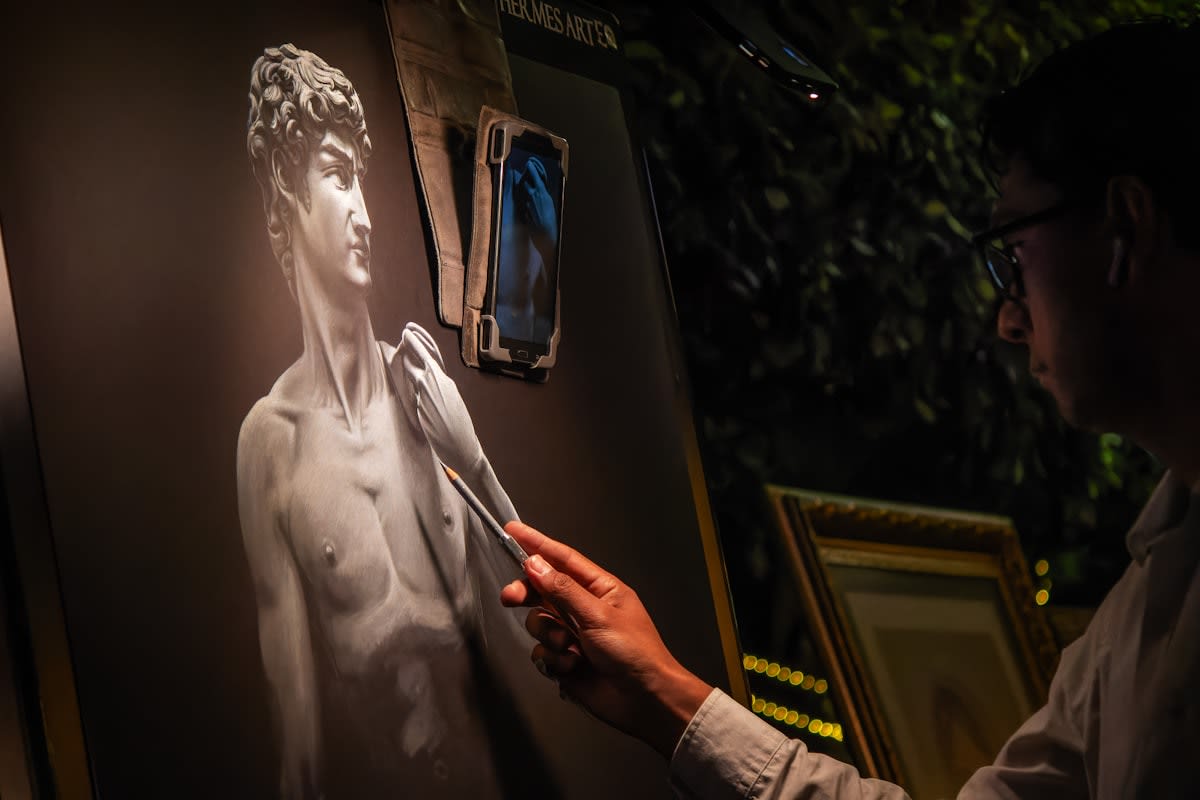
The human eye is no longer a viable tool for authentication. For centuries, the connoisseur's gaze—the ability to detect a brushstroke's hesitation or a pigment's age—served as the primary defense against forgery. Generative AI has effectively neutralized this biological advantage. When a latent diffusion model can synthesize a work that is mathematically indistinguishable from an artist's stylistic signature, the concept of a fake shifts from a visible imitation to a systemic identity theft. We are seeing this play out in high-velocity digital art hubs from Seoul to Mexico City, where the volume of AI-generated 'originals' is beginning to dilute the market value of human-authored digital works.
This is not a crisis of aesthetics, but a crisis of provenance. Provenance is the documented history of an object's ownership and origin. In the analog world, this was a paper trail of gallery receipts and exhibition catalogs. In the digital realm, we relied on file metadata—EXIF data and timestamps—which are trivially easy to manipulate. If the proof of origin is as editable as the art itself, the art has no objective value. To secure digital art, we must move the proof of authenticity outside the image file and into a cryptographic layer that is immutable and verifiable by third parties without requiring the artist's presence.
Technical Prerequisites
To implement this security stack, you will need a hardware security module (HSM) or a cold-storage wallet for private key management, a C2PA-compliant image editor, and access to a Layer 1 or Layer 2 blockchain for timestamp anchoring. Understanding the difference between a file's checksum and its metadata is a non-negotiable prerequisite.
The Five-Step Provenance Protocol
- Inject C2PA Content Credentials at the point of creation.
- Generate a unique cryptographic hash (SHA-256) of the final render.
- Anchor the hash to a decentralized ledger for immutable timestamping.
- Embed steganographic watermarks to link the visual to the record.
- Establish a multi-signature governance chain for ownership transfers.
Step one requires the adoption of the Coalition for Content Provenance and Authenticity (C2PA) standard. Unlike traditional metadata, C2PA creates a manifest that is cryptographically bound to the image. Every time the file is edited, the manifest records the change, the tool used, and the identity of the editor. This creates a verifiable 'audit trail' of the artwork's evolution. If a forger attempts to modify a C2PA-protected file, the cryptographic seal is broken, immediately alerting any viewer that the provenance has been compromised. This transforms the image from a static grid of pixels into a living document of its own creation.
Once the work is finalized, the artist must generate a SHA-256 hash. A hash function takes the entire dataset of the image and compresses it into a unique 64-character string. Even a single pixel change—invisible to the human eye—will result in a completely different hash. This string serves as the digital fingerprint of the artwork. By separating the fingerprint (the hash) from the artwork (the file), the artist can prove they possessed the exact version of the file at a specific point in time without having to reveal the high-resolution file itself to the public.
The third step involves anchoring this hash to a blockchain. While NFTs are often conflated with provenance, the NFT is merely a pointer. True provenance requires the hash of the art to be embedded in the transaction data of a Layer 1 blockchain like Ethereum or a high-throughput Layer 2 solution. This provides a globally synchronized timestamp. If an AI forger creates a 'lost masterpiece' today and claims it was made in 2021, they cannot retroactively insert a hash into a 2021 block. The blockchain acts as a mathematical notary that cannot be bribed or edited.
| Method | Forgery Resistance | Verification Speed | Permanence |
|---|---|---|---|
| EXIF Metadata | Low | Instant | Fragile |
| C2PA Manifests | High | Fast | Moderate |
| Blockchain Anchoring | Absolute | Moderate | Permanent |
| Visual Watermarks | Negligible | Instant | Low |
To bridge the gap between the digital record and the visual experience, artists should employ steganographic watermarking. Unlike visible logos, steganography hides data within the noise of the image pixels. This data should contain a URI pointing directly to the blockchain record. While AI can strip some watermarks, advanced frequency-domain embedding makes it significantly harder to remove without destroying the image quality. This ensures that even if a file is screenshotted or compressed, a trace of its origin remains embedded in the visual data.
The final step is the implementation of multi-signature (multi-sig) governance. Provenance is not a static event but a chain of custody. When a piece of art moves from the artist to a gallery in Lagos and then to a collector in Tokyo, each transfer should be signed by both the sender and the receiver using their private keys. This eliminates the 'single point of failure' where a stolen password could allow a forger to transfer ownership of a digital asset. A multi-sig requirement ensures that ownership changes are mutually authenticated and permanently recorded.
Common Pitfalls in Digital Authentication
- Relying on centralized databases for provenance records, which are vulnerable to hacking and administrative deletion.
- Using visual watermarks as the sole proof of origin, as AI-powered in-painting can remove them in seconds.
- Storing private keys on cloud-connected devices, exposing the 'root of trust' to phishing attacks.
- Confusing the NFT token with the artwork itself, leading to 'broken links' where the token exists but the art is hosted on a dead server.
- Ignoring the 'Oracle Problem'—the risk that the initial data entered into the blockchain was fraudulent to begin with.
The most dangerous fallacy is the belief that a high resolution file is inherently more authentic. In the AI era, resolution is a commodity. The only thing that retains value is the verifiable link between the creator's identity and the specific arrangement of pixels. By treating digital art as a series of cryptographic claims rather than a visual object, we can build a market that is resilient to the noise of generative synthesis. The shift from 'looking' to 'verifying' is the only path forward for the digital arts economy.