Sainik School hosts motivational talk on globe circumnavigation and Everest expedition
Source Entity
India Latest News: Top National Headlines Today & Breaking News | The Hindu
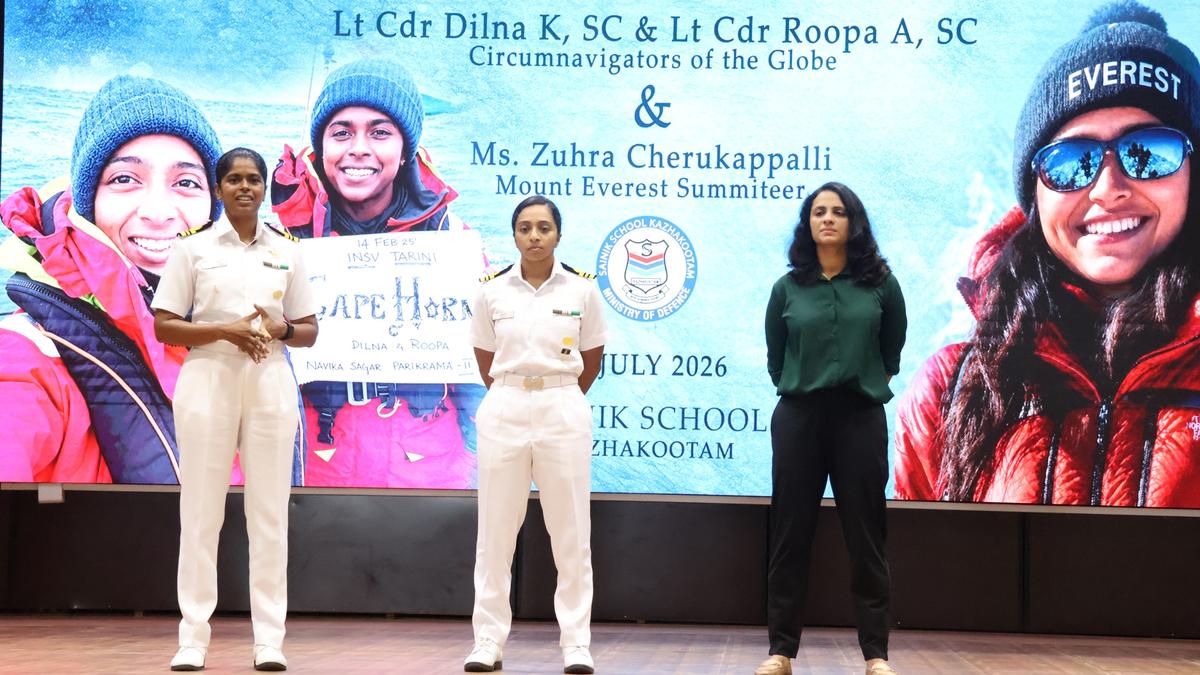
Lieutenant Commanders of the Indian Navy, Dilna K. and Roopa A., who circumnavigated the globe aboard the Indian Naval Sailing Vessel (INSV) Tarini, and Zuhra Cherukappalli, an accomplished mountaineer who scaled Mount Everest, led the motivational lecture and interactive session ‘Talk on Circumnavigation of the Globe and Mount Everest Expedition’
Empowering the Next Generation: Naval and Mountaineering Legends Inspire Sainik School Cadets
In a powerful intersection of military discipline and extreme human endurance, a Sainik School recently hosted a high-profile motivational session titled ‘Talk on Circumnavigation of the Globe and Mount Everest Expedition.’ The event featured three extraordinary women: Lieutenant Commanders Dilna K. and Roopa A. of the Indian Navy, and the accomplished mountaineer Zuhra Cherukappalli. By bringing together individuals who have conquered both the depths of the oceans and the highest peaks on Earth, the institution provided its cadets with a rare opportunity to understand the practical application of resilience, strategic planning, and mental fortitude.
The Odyssey of INSV Tarini: Breaking Naval Barriers
The presence of Lt Cdr Dilna K. and Lt Cdr Roopa A. brings the storied legacy of the Navika Sagar Parikrama to the forefront. The circumnavigation of the globe aboard the Indian Naval Sailing Vessel (INSV) Tarini was not merely a nautical feat but a strategic demonstration of the Indian Navy's capability and the growing role of women in combat-support and exploratory roles. Sailing across vast, unpredictable oceans requires more than just technical skill; it demands a level of psychological endurance that is critical for any future military officer. For the cadets, hearing first-hand accounts of navigating treacherous waters and managing isolation serves as a living lesson in leadership and crisis management.
Scaling the Summit: The Psychology of High-Altitude Mountaineering
Complementing the maritime perspective was the experience of Zuhra Cherukappalli, whose successful ascent of Mount Everest represents the pinnacle of terrestrial endurance. Scaling the world's highest peak involves battling extreme hypoxia, volatile weather, and the constant threat of altitude sickness. Cherukappalli's contribution to the session likely emphasized the importance of incremental goal setting and the ability to maintain focus under extreme physical distress. This narrative of 'climbing' serves as a potent metaphor for the cadets' own academic and physical journeys toward joining the Armed Forces, where the 'summit' is the successful completion of rigorous officer training.
The Strategic Importance of Sainik Schools
Sainik Schools play a pivotal role in the Indian educational landscape, specifically designed to prepare students for entry into the National Defence Academy (NDA). In such an environment, theoretical knowledge of bravery is insufficient; cadets require visceral, real-world examples of courage. By hosting these speakers, the school bridges the gap between classroom discipline and real-world application. The interactive nature of the session allows cadets to move beyond the 'what' of these achievements and delve into the 'how,' understanding the failures, setbacks, and rigorous training schedules that precede such historic milestones.
A Catalyst for Women's Empowerment in the Armed Forces
Beyond the motivational aspect, this event carries significant weight regarding the evolving gender dynamics within the Indian military. Having two female naval officers and a female mountaineer lead the session sends a clear message to all cadets—regardless of gender—that the frontiers of exploration and defense are open to those with the will to conquer them. This aligns with the broader national trend of integrating women into more diverse roles within the Indian Armed Forces, fostering a culture of meritocracy and equal opportunity that will define the future of India's security apparatus.
Future Trends in Leadership Training
Looking ahead, it is likely that military preparatory institutions will move further toward 'experiential mentorship.' The traditional lecture format is being replaced by interactions with 'practitioners of endurance.' As the Indian Navy and Army continue to push the boundaries of exploration and strategic reach, the integration of such explorers into the curriculum will become essential. We can expect to see more curated interactions where the focus shifts from the glory of the achievement to the science of the preparation, ensuring that future officers are mentally equipped for the complexities of 21st-century warfare and diplomacy.
Conclusion
The motivational talk at the Sainik School was more than a simple guest lecture; it was a strategic exercise in character building. By synthesizing the experiences of the INSV Tarini voyage and the Everest expedition, the session provided a comprehensive blueprint for success: a combination of technical expertise, unwavering persistence, and the courage to venture into the unknown. For the cadets, these speakers represent the tangible realization of the values the Sainik School instills, leaving them inspired to pursue excellence in their own future service to the nation.
Verification Required?