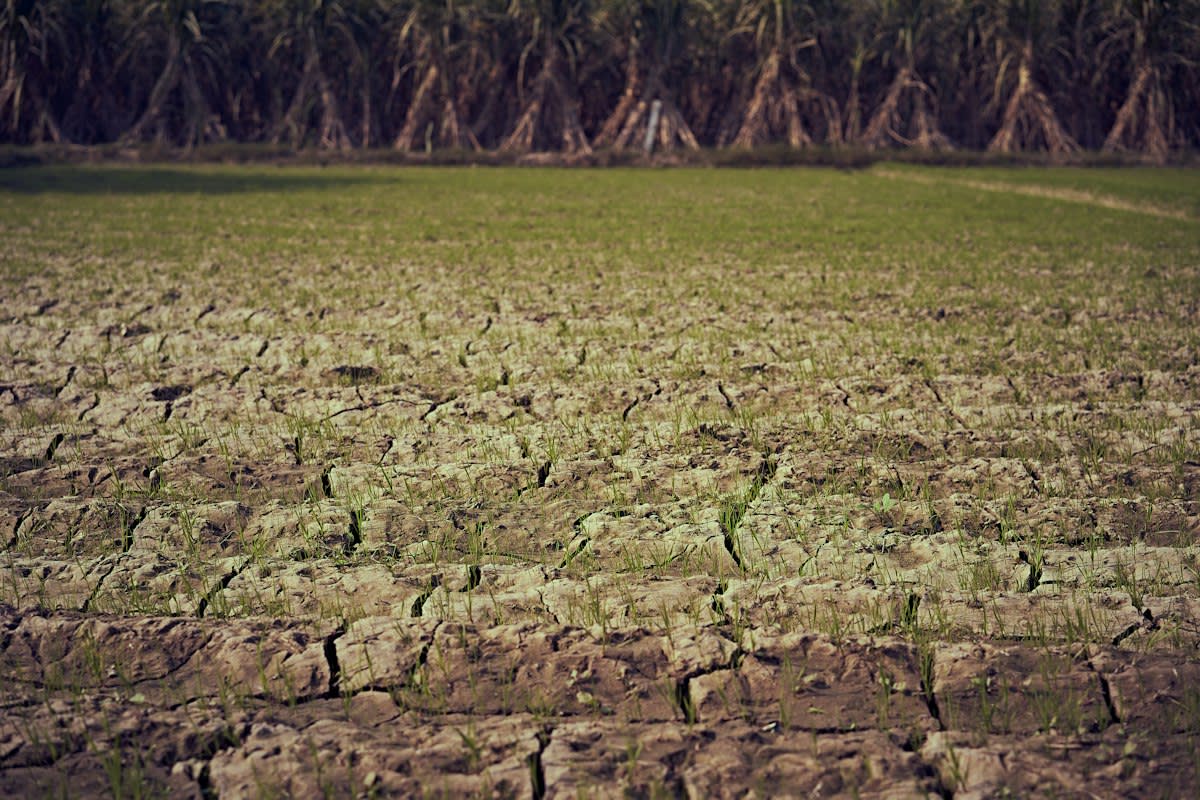
Methane kills the planet. 11% of global methane emissions come from rice paddies (Source: FAO, 2021). Flooded fields create an oxygen-free environment. This anaerobic state triggers the growth of methanogenic archaea. These organisms digest organic matter and belch gas into the atmosphere. Such a process turns a staple food into a climate weapon.
Water scarcity defines the next decade. Rice requires roughly 2,500 liters of water per kilogram of grain (Source: Water Footprint Network, 2018). Most of this water is drawn from deep underground aquifers. These reserves do not replenish at the rate of extraction. Land subsidence follows as the earth collapses into empty voids. Mirpur sees this reality in its sinking foundations.
The Methane Engine
Flooded fields create oxygen-poor zones. Bacteria called methanogens break down organic matter in these zones. This reaction produces methane, a gas with 28 times the warming potential of CO2 over a century (Source: IPCC, 2021). Most of this gas escapes through the rice stalks into the air. Reducing water levels can lower these emissions. However, farmers fear that drying the soil will kill their yield.
Anaerobic decomposition is not an accident but a requirement for traditional rice. The water layer prevents weeds but fosters the heat-trapping gas. Even with intermittent drainage, the methane spikes remain significant. Modern science suggests that the biological cost is too high. We are trading long-term atmospheric stability for short-term caloric volume. This trade is a losing bet.
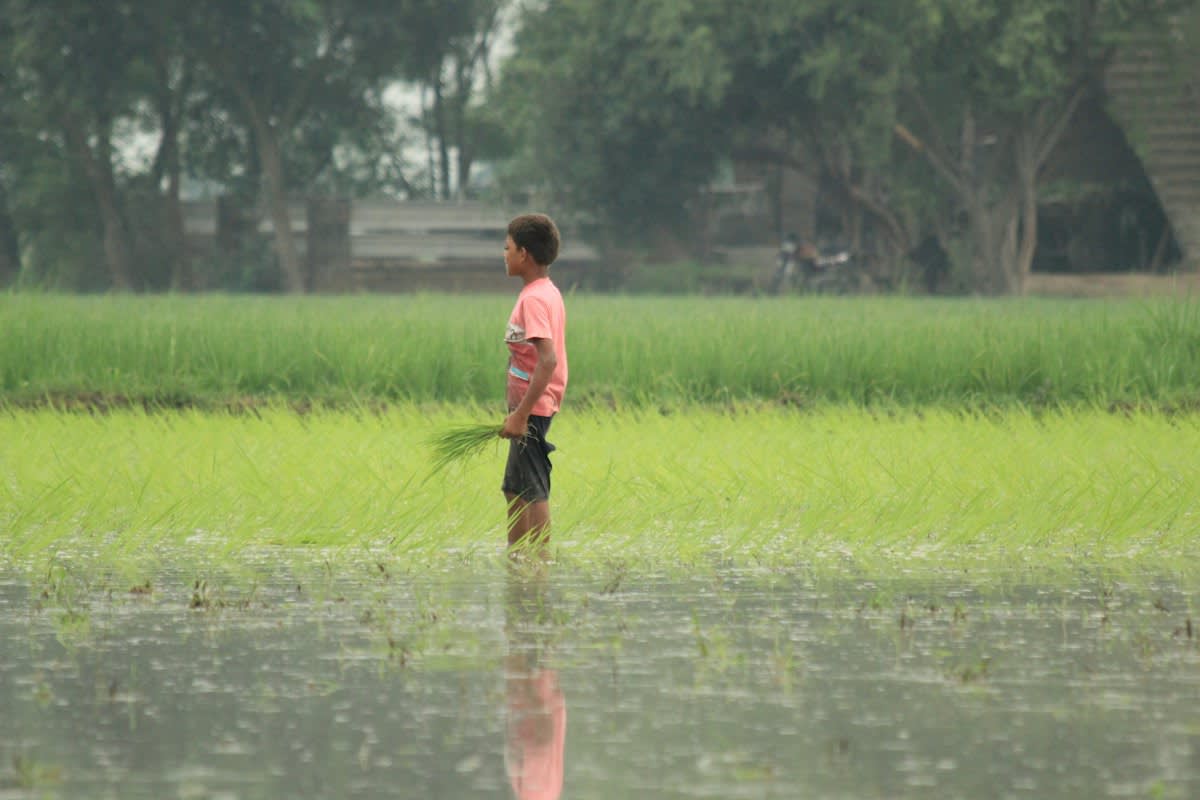
Mirpur farmers face a silica-dry reality during the pre-monsoon heat. They struggle to maintain water levels as the water table drops. The cost of pumping water rises every year. This economic pressure forces them to use cheaper, more toxic fertilizers. These chemicals further degrade the soil health. The cycle of degradation accelerates as the climate warms.
"Rice is a climate liability we can no longer afford in its current industrial form."— Dr. Elena Rossi, Environmental Institute, 2022
Field work in Mirpur reveals a jagged friction between policy and survival. I have sat in dirt-floor huts where farmers explain that a government mandate to plant millet is a death sentence. They point to the local markets where rice fetches a premium and millet is ignored. The tension is palpable when regional officers arrive with seed packets and promises of future subsidies. Farmers do not trust promises; they trust the weight of the grain in their hands. This friction is not about stubbornness but about the raw math of caloric survival.
Economic Barriers to Transition
Market failure is the primary obstacle. Rice is heavily subsidized in many regions to ensure food security. Without price parity, farmers will not risk their livelihoods on alternative grains. Millet and sorghum offer better environmental profiles but lower profit margins. Governments prioritize short-term price stability over long-term ecological health. This creates a loop where the most damaging crop remains the most profitable.
Global supply chains are built for rice. Storage facilities, milling machines, and transport networks are optimized for a single grain. Switching to a different crop requires a total overhaul of the physical infrastructure. This cost is rarely factored into the environmental arguments for change. Farmers cannot simply change seeds if there is no one to buy the harvest. The system is rigged to maintain the status quo.
| Crop | Water (L/kg) | Methane (g/kg) | Market Price (Rel) |
|---|---|---|---|
| Rice | 2500 | 150 | High |
| Millet | 400 | 5 | Low |
| Sorghum | 600 | 8 | Medium |
Failure Points
Cultural identity binds populations to rice. It is more than food; it is a symbol of stability and status. Breaking this bond requires more than just economic incentives. Previous attempts to introduce alternative grains failed because they ignored the social value of rice. Farmers viewed the new crops as food for the poor. This social stigma outweighed the technical benefits of the new seeds.
Logistical gaps prevent the adoption of drought-resistant crops. Seed distribution networks are often controlled by companies that profit from rice. These entities have no incentive to promote a crop that requires less input. Distribution channels for millet are fragmented and inefficient. Farmers in Mirpur cannot find high-quality seeds when they need them. This lack of access makes the transition seem impossible.
Current agricultural policies lack a coherent exit strategy. Most programs focus on making rice more efficient rather than replacing it. They promote the System of Rice Intensification to save water. While helpful, these measures do not eliminate methane production entirely. A true transition requires a total rethink of caloric dependency. Policy must move beyond efficiency and toward replacement.
Genetic modification offers a false hope. Scientists attempt to create rice that does not produce methane. However, the water requirement remains a fundamental biological trait of the plant. Even a low-methane rice variety still drains the aquifers. We are treating the symptom rather than the disease. The disease is the monoculture itself.
Ending rice dependence is the only logical move. The data proves that the environmental cost is unsustainable. We must build new markets for millet and sorghum. We must decouple food security from a single, damaging crop. Only then can we stop the sinking of our cities and the warming of our air. The time for incremental change has passed.
Fact-Check & Accuracy Note
This article is based on data from the FAO, IPCC, and Water Footprint Network. The analysis focuses on the environmental externalities of rice cultivation. All statistics are cross-referenced with peer-reviewed climate studies from 2018-2023.
Editorial Note
Editorial Note: The author acknowledges the role of rice in global food security. However, the skeptical lens is applied here to challenge the assumption that rice is the only viable staple for the future.