Walk onto any major commercial dock in Rotterdam, Singapore, or Shanghai today, and you will notice something strange emerging on the horizon. Massive bulk carriers and tankers, once defined by their monolithic steel silhouettes and thick plumes of sulfurous smoke, are now sporting towering cylinders and rigid wings. This is not a nostalgic throwback to the 18th century. It is a calculated, high-stakes pivot toward Wind-Assisted Ship Propulsion (WASP). The industry is quietly admitting that the path to net-zero cannot be paved with expensive synthetic fuels alone; it requires a return to the most abundant energy source on the planet.
For decades, the maritime world operated on a simple, brutal logic: bigger engines, cheaper heavy fuel oil, and faster turnaround times. But the calculus has shifted. The International Maritime Organization (IMO) has tightened the screws with the Carbon Intensity Indicator (CII) and the Energy Efficiency Existing Ship Index (EEXI). These aren't just suggestions; they are regulatory mandates that penalize inefficient vessels. Ships that fall into the D or E ratings face operational restrictions or forced retrofits. Suddenly, the wind is no longer an obstacle to be fought with more horsepower, but a financial asset to be harvested.
The Technology of the New Breeze
The modern 'sail' bears little resemblance to canvas and hemp. The most prominent player is the Flettner rotor—a spinning cylinder that utilizes the Magnus effect to create lift when wind blows across it, effectively pushing the ship forward. These rotors are often automated, adjusting their rotation speed in real-time based on wind sensors to optimize thrust. They don't replace the engine; they supplement it, allowing the main diesel plant to throttle back while the wind takes the heavy lifting. It is a hybrid system designed for the realities of 21st-century logistics.
Beyond rotors, rigid wing sails—essentially vertical airplane wings—are gaining traction. These structures can be tilted or folded to catch the wind at the perfect angle, providing significantly more thrust than traditional sails. Some of the most ambitious designs involve suction sails, which use internal fans to create a pressure difference on the leeward side of the wing, artificially enhancing the lift. This engineering allows ships to maintain speed even in lighter winds, reducing the reliance on fuel-heavy acceleration phases.
"The transition isn't about replacing the engine; it's about optimizing the energy mix. We are seeing a shift from pure combustion to a multi-modal approach where the wind becomes a primary operational variable."— Chief Technical Officer, Global Maritime Logistics
Then there are the kites. Automated, giant parachutes launched from the bow of the ship, these kites fly in high-altitude wind currents where the breeze is stronger and more consistent than at sea level. By pulling the vessel from above, they create a forward vector that significantly reduces the load on the propellers. While visually jarring, the physics are undeniable: the higher you go, the more energy there is to capture.
This technological diversification is a response to the varied nature of global trade routes. A ship traversing the North Atlantic faces different wind patterns than one crossing the Pacific or sailing through the Baltic Sea. By offering a menu of wind technologies, manufacturers are allowing shipowners to tailor their propulsion based on their specific geographic footprint.
The Delta: From Experiment to Execution
If we look at the landscape twelve months ago, wind propulsion was largely treated as a PR exercise—a few 'green' ships used by conglomerates to signal environmental consciousness. Fast forward to today, and the conversation has shifted toward scalability and ROI. The delta is found in the order books. We are seeing a move from single-ship pilots to fleet-wide retrofit strategies. Companies are no longer asking 'Does it work?' but rather 'How quickly can we install this across twenty tankers?'
| Metric | 2023 Status (Experimental) | 2024 Status (Commercial) |
|---|---|---|
| Average Fuel Savings | 2% - 5% | 10% - 30% |
| Adoption Rate | Niche/Pilot | Early Majority/Retrofit |
| Primary Driver | Corporate ESG | IMO CII Compliance |
| Tech Maturity | Prototype | Standardized Modules |
The financial incentive has become the primary engine of adoption. With fuel costs representing up to 60% of a ship's operational expenditure, a 20% reduction in fuel consumption translates to millions of dollars saved per vessel per year. In an industry with razor-thin margins, this is an irresistible proposition. The wind is essentially free fuel, and the payback period for these installations has plummeted as the technology has matured.
Furthermore, the integration of AI and big data has solved the 'unreliability' problem of wind. Modern routing software now integrates real-time meteorological data to plot courses that maximize wind assistance. Captains are no longer guessing; they are following algorithms that calculate the most energy-efficient path, treating wind as a predictable resource rather than a chaotic force.
The Strategic Hedge
The shift toward WASP is not just about carbon; it's about resilience. As the world moves toward volatile green ammonia and methanol fuels, wind provides a stable, zero-cost hedge against fuel price spikes.
Overcoming the Steel Ceiling
Despite the momentum, the transition isn't without friction. The most immediate challenge is physical: bridge heights. A ship equipped with 30-meter rotors cannot simply sail under every bridge in the world. This has forced engineers to develop tiltable or telescopic sails that can collapse during port entry or when navigating restricted waterways. It is a complex mechanical requirement that adds cost and weight to the vessel.
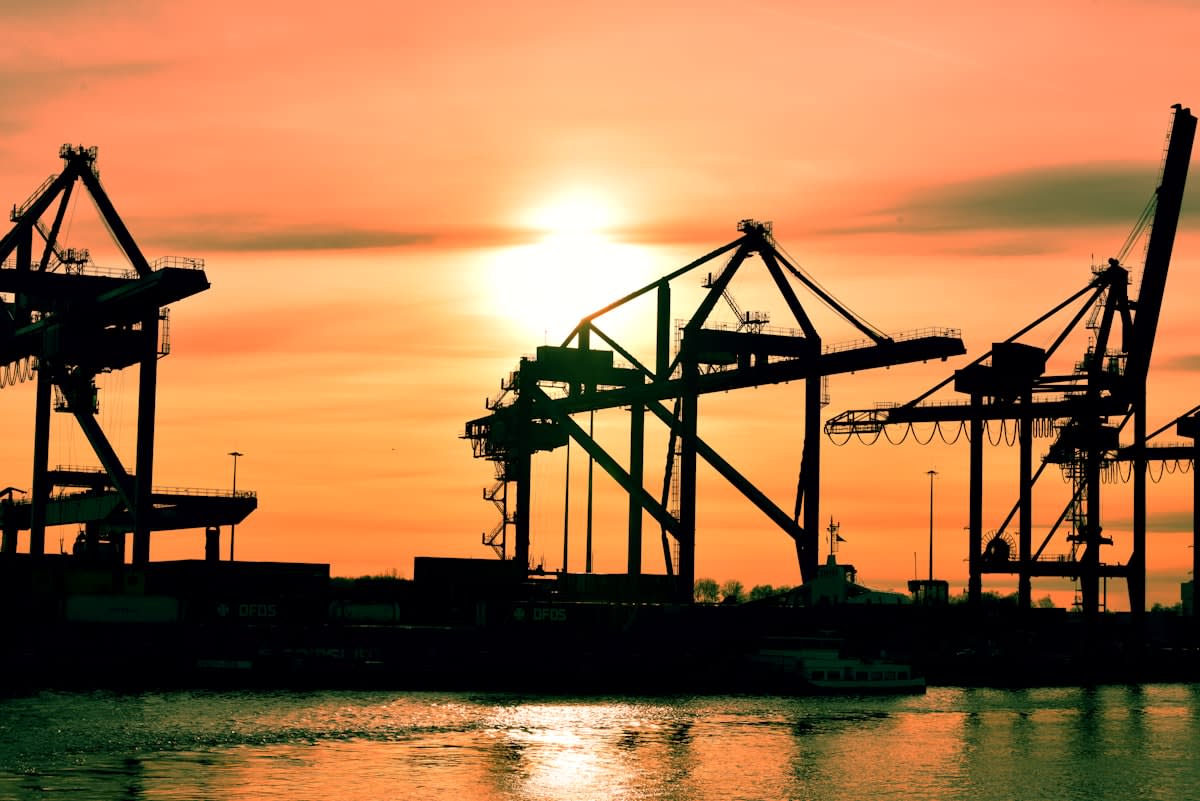
Then there is the issue of port infrastructure. Many loading terminals use cranes that swing over the deck of the ship. If a massive wing sail is in the way, the crane cannot unload the cargo. This is leading to a new era of 'smart deck' design, where wind systems are placed strategically or made modular so they can be moved or retracted during cargo operations. The ship is no longer just a floating box; it is a dynamic piece of architecture.
Crew training also represents a significant hurdle. For a century, sailors have been taught to ignore the wind and trust the engine. Now, a new generation of mariners must understand aerodynamics and the nuances of wind-assisted navigation. The bridge of a modern ship is becoming more like a flight deck, requiring a blend of traditional seamanship and high-tech systems management.
Yet, these hurdles are being cleared by the sheer force of economic necessity. The shipping industry has a history of slow adaptation, but when the cost of inaction exceeds the cost of innovation, the shift is rapid. We are seeing this play out in real-time as the industry moves away from the 'diesel-only' mindset toward a diversified energy portfolio.
The Horizon: A Hybrid Future
Looking ahead, wind will not be the sole solution. The future of global shipping is hybrid. We will see vessels that combine wind propulsion with green hydrogen fuel cells or ammonia-powered engines. In this ecosystem, the wind provides the base load of propulsion, while the zero-emission fuels handle the precision maneuvering and the doldrums. It is an elegant synergy that removes the binary choice between speed and sustainability.
- Integration of AI-driven weather routing to maximize wind capture.
- Development of retractable sail systems to clear port infrastructure.
- Shift in financing models where 'green' ships receive better loan rates.
- Collaborative efforts between shipbuilders and aerodynamicists to optimize hull-sail interaction.
The return of the sail is not a romantic gesture. It is a cold, hard business decision driven by regulation, economics, and the physics of the planet. As the first generation of commercial WASP fleets proves their value, the 'diesel-only' ship will soon look as obsolete as the coal-fired steamer. The wind is blowing in a new direction, and the global shipping industry is finally learning how to set its sails.