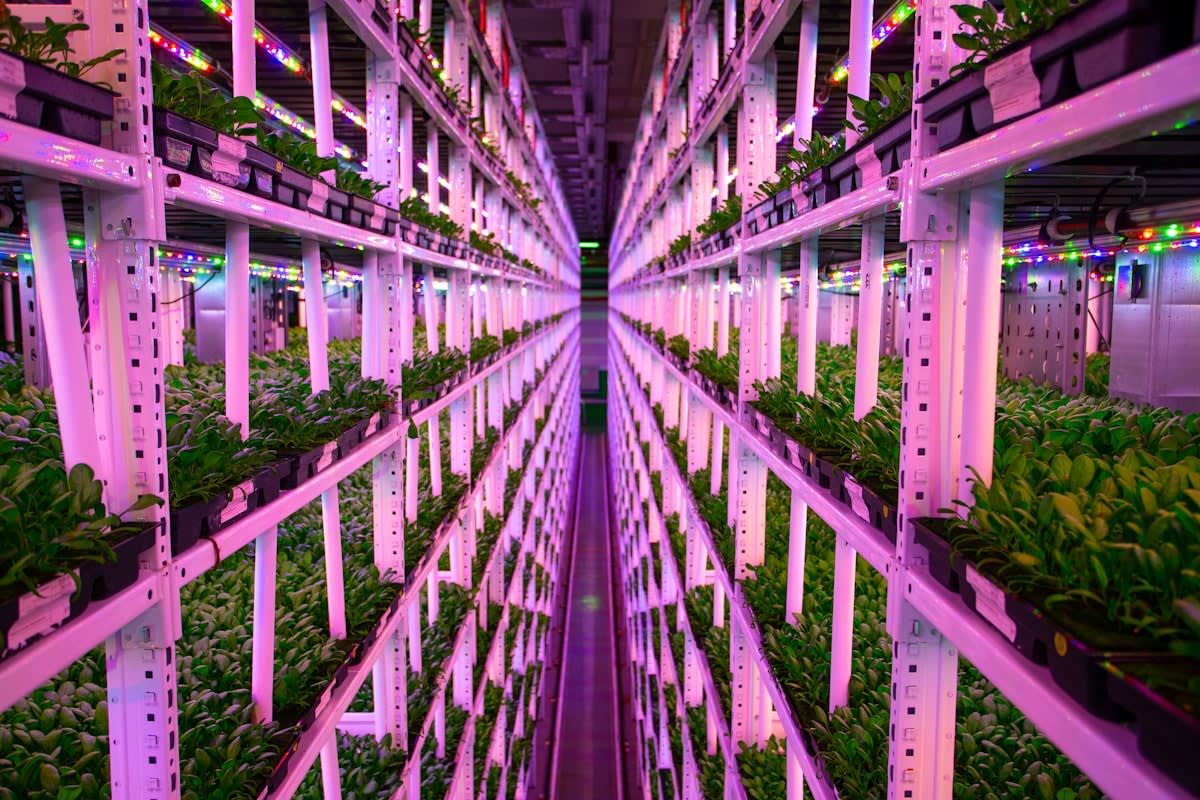
The Great Decoupling: Agriculture Without the Earth
For ten thousand years, the fundamental equation of human survival has been land plus labor equals food. That equation is currently being dismantled. We are entering the era of the Dark Farm—fully autonomous indoor environments where crops grow in a vacuum of human intervention, guided by algorithms and fed by precision nutrient delivery systems. This isn't just about vertical stacks of lettuce in a city center; it is a systemic shift where the biological requirements of a plant are decoupled from the geographic and climatic constraints of the land. Why rely on a predictable rainy season when you can program the weather into a software update?
The scale of this transition is staggering. The indoor farming market, which stood at approximately $42 billion in 2025, is on a trajectory to double in value, approaching $86 billion by 2032 (Source: Strategic Market Research, 2026). This growth is not a slow climb but a structural surge, characterized by a compound annual growth rate (CAGR) of nearly 11 percent. We are seeing a migration of capital away from traditional acreage and toward controlled-environment agriculture (CEA), where the primary risks are energy costs and software bugs rather than droughts or locusts.
| Segment | 2025 Market Value | Market Share (%) | Projected Growth (CAGR) |
|---|---|---|---|
| Hydroponics | $21 Billion | 50% | Not Specified |
| Leafy Greens | $17 Billion | 40% | Not Specified |
| Vertical Farming | $12.6 Billion | 30% | 11% |
While the numbers look impressive on a spreadsheet, the real story lies in the diversification of what we can actually grow. For years, the industry was mocked as a 'lettuce factory' because leafy greens dominated the revenue streams, accounting for roughly 40 percent of the market in 2025 (Source: Strategic Market Research, 2026). But the narrative is shifting. The integration of high-fidelity AI and robotics is allowing the Dark Farm to move beyond simple greens into complex fruiting crops and high-value pharmaceuticals, effectively turning the farm into a bioreactor.
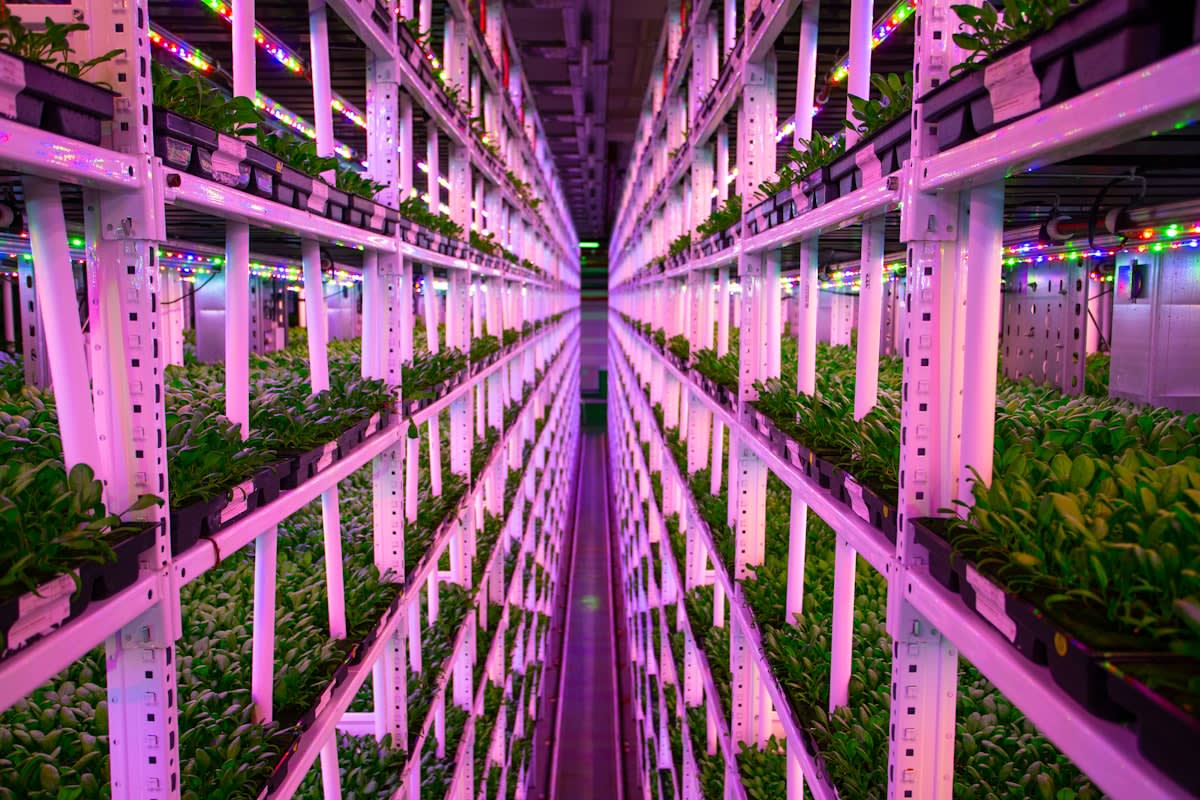
This evolution is being supercharged by a massive influx of artificial intelligence. The AI in agriculture market is not just growing; it is exploding. Estimated at $4.30 billion in 2025, it is projected to skyrocket to $35.48 billion by 2035, maintaining a blistering CAGR of 23.5% (Source: EIN News, 2026). This isn't just about better sensors; it is about the transition from reactive farming to predictive orchestration. We are moving from a world where a farmer notices a pest infestation to a world where an AI predicts the infestation 48 hours before it happens and deploys a robotic countermeasure autonomously.
"Anyone not adopting AI in the next six months or one year is further delaying the optimisation of their work."— Kunal Singhal, Managing Director at Eazy Business Solutions
The urgency expressed by industry leaders like Singhal highlights a widening digital divide in global food production. In regions like North America, which commanded 38% of the AI in agriculture market in 2025, the focus is on large-scale commodity farming and a mature precision-agriculture ecosystem (Source: EIN News, 2026). However, the real volatility—and opportunity—is in the Asia-Pacific region. With a projected CAGR of 28.2%, APAC is the fastest-growing market for AI adoption, driven by aggressive digital farming initiatives (Source: EIN News, 2026). This suggests a leapfrog effect where developing agricultural economies skip the 'mechanized tractor' phase and move straight to the 'autonomous swarm' phase.
But what does this actually look like when the boots hit the ground—or rather, when the wheels hit the dirt? If you walk into a modern autonomous operation, you won't see a farmer with a clipboard. You'll see a fleet of robots operating in a choreographed dance. The debate among practitioners has shifted from 'can this work?' to 'how do we manage the fleet?' There is a visceral tension on the ground between the old-school agronomists, who trust their senses and the smell of the soil, and the software engineers who trust the telemetry. The friction occurs when a sensor fails in a muddy field, and the 'perfect' algorithm meets the chaos of biology. The real winners aren't the ones with the best AI, but those who can build 'ruggedized' tech that survives a rainstorm.
Take the case of TRIC Robotics. They have successfully scaled from half-acre trials to managing over 1,500 acres of commercial strawberries using a fleet of 15 autonomous robots (Source: AgFunderNews, 2026). These machines don't use chemicals; they use UV-C light and bug vacuums to tackle fungal pathogens. This is a critical pivot. By replacing chemical fungicides with light-based interventions, they aren't just automating labor—they are redefining the chemistry of the crop. The 'Robot-as-a-Service' (RaaS) model is the engine here, allowing farmers to access cutting-edge tech without the crushing capital expenditure of owning the fleet.
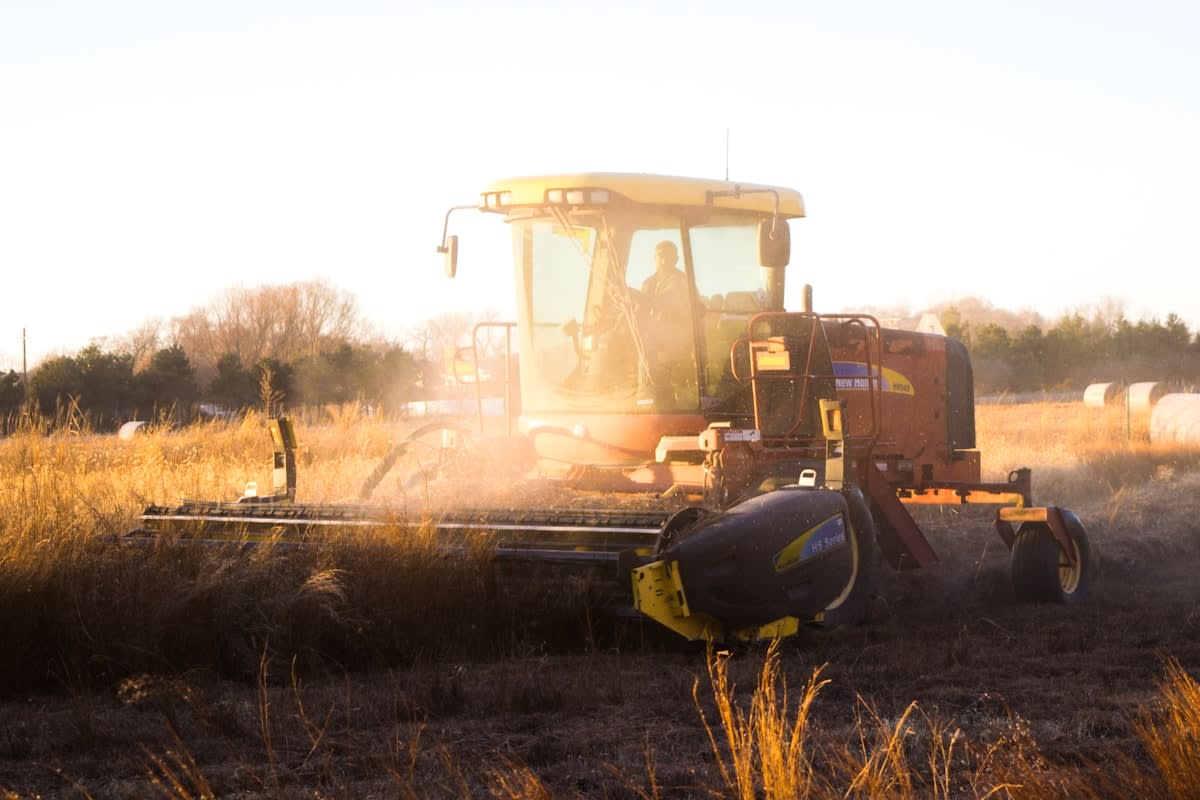
Similarly, Carbon Robotics has crossed the $100 million revenue mark as of March 2026, proving that there is a massive, hungry market for autonomous weeding (Source: AgFunderNews, 2026). Their push into tractor autonomy is the final piece of the puzzle. When the tractor becomes a self-driving platform, the farm ceases to be a place of manual toil and becomes a logistics hub. CEO Paul Mikesell's vision of 30,000 to 40,000 autonomous tractors annually suggests a future where the human role is shifted from operator to supervisor (Source: AgFunderNews, 2026).
This shift toward autonomy is creating a new geopolitical reality. When food production is decoupled from the land, the strategic value of fertile soil diminishes, while the strategic value of energy and chipsets increases. If a city can produce 80% of its calories in 'dark farms' powered by fusion or advanced solar, the traditional supply chain—and the vulnerabilities associated with it—evaporates. We are seeing the birth of 'Food Sovereignty 2.0,' where the ability to feed a population is determined by a nation's compute power and energy grid rather than its rainforests or river valleys.
The transition is not without its hurdles. The energy intensity of indoor farming remains a point of contention, and the initial capital requirements are steep. However, the trajectory is clear. With North America currently holding 40% of the global indoor farming revenue (Source: Strategic Market Research, 2026), the infrastructure for this revolution is already in place. The question is no longer if the Dark Farm will arrive, but how quickly the rest of the global food system can adapt to a world where the land is optional.
Fact-Check & Accuracy Note
Key claims regarding market valuations ($42B to $86B) and segment shares (Hydroponics at 50%) are sourced from Strategic Market Research (2026). AI market projections ($35.48B by 2035) and regional CAGR data for Asia-Pacific (28.2%) are sourced from EIN News (2026). Operational data regarding TRIC Robotics and Carbon Robotics are sourced from AgFunderNews (2026). The primary area of ongoing debate remains the energy-to-calorie efficiency ratio of fully autonomous indoor systems compared to regenerative outdoor farming.
Editorial Note
This report avoids the typical 'crisis' narrative of food scarcity. Instead, it frames the rise of autonomous agriculture as a resilience strategy. The focus is on the technological shift from land-dependence to tech-dependence, highlighting the economic opportunity in the RaaS (Robot-as-a-Service) model.