
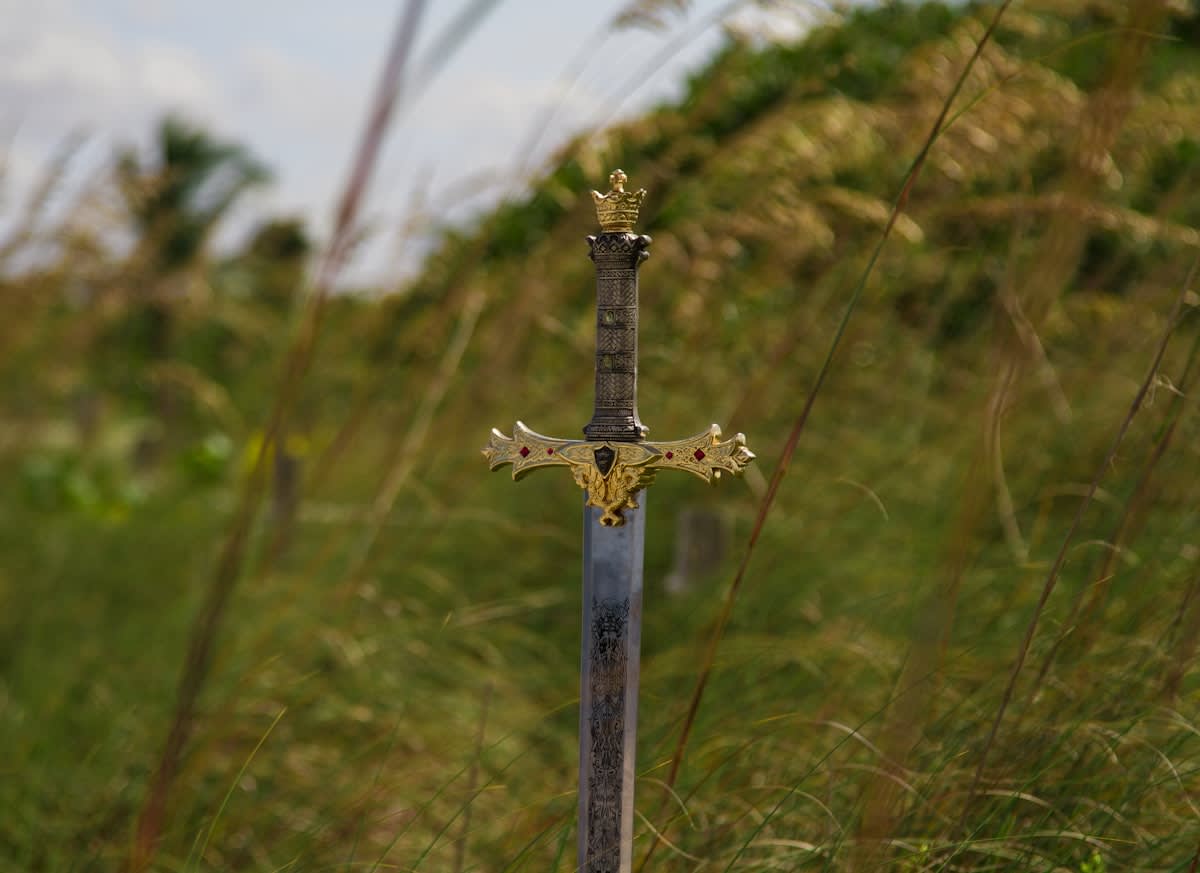
A metal detectorist in the Gdańsk Forest District recently stumbled upon a discovery that defies conventional archaeological expectations. He found a 2,700-year-old bronze sword, not lying flat in the sediment, but standing upright in the ground. This bizarre positioning suggests an intentional act of deposition, a ritualized burial that transforms a weapon into a permanent marker of presence. When the Pomeranian Provincial Heritage Conservator's staff recovered the artifact, they weren't just retrieving a piece of metal; they were uncovering a physical anchor for a history that had been largely silenced by the layers of time and conflict.
Why does the orientation of a piece of bronze matter in the twenty-first century? Because the physicality of the object provides a truth that archives often sanitize. The sword is not a digital record or a translated text; it is a tangible scream from the Bronze Age. In Eastern Europe, where borders have shifted like sand and histories have been rewritten by whoever held the pen, these sudden material eruptions force a confrontation with a past that was never truly gone, only suppressed. The fact that this is not the first Bronze Age sword unearthed in the Gdańsk region indicates a concentrated pocket of ancient complexity that demands a new narrative.
The Materiality of Sovereignty
This local reclamation in Poland mirrors a broader, more aggressive global trend toward the repatriation of stolen heritage. Italy recently returned 27 historical objects to Mexico, including terracotta statues and fossilized fish, following a series of investigations by the Carabinieri Tutela del Patrimonio Culturale. This art hit squad did not simply find these items; they tracked them through six separate investigations to ensure they returned to their origin. The objects, while valued at several tens of thousands of euros, possess a non-monetary utility that far outweighs their market price. They are fragments of a shattered mirror, and returning them is an act of reassembling a national image.
"The return to the Mexican people of precious and unique artefacts, which were previously believed to have been lost, restores a sense of identity to the places from which they had been unlawfully taken."— Carabinieri Tutela del Patrimonio Culturale (TPC)
Is the return of these objects merely a legal formality, or is it a structural realignment of how we view ownership? For decades, the Western museum model operated on the assumption that 'universal' museums were the safest custodians of global history. This logic is now failing. The Mexican case proves that the value of an object is derived not from its preservation in a climate-controlled vault in Rome, but from its relationship to the land and people that created it. When an object returns home, it ceases to be a curiosity and becomes a catalyst for local agency.
This movement toward tangible reclamation extends beyond the return of stolen goods into the active transformation of heritage spaces. In Erbil, the Kurdistan Region is establishing the Araban Cultural District, converting four restored heritage houses into active civic uses. By creating a gallery, a house of manuscripts, and two learning centers, the Kurdistan Center for Arts and Culture (KCAC) is ensuring that history is not a static exhibit but a functional part of the urban workforce. This is the logical conclusion of the reclamation process: taking the object out of the display case and putting it back into the street.
| Reclamation Method | Primary Driver | Key Example |
|---|---|---|
| Repatriation | Ethical/Legal Restitution | Italy to Mexico (27 objects) |
| Archaeological Recovery | Citizen Science/Local Heritage | Gdańsk Bronze Sword |
| Civic Activation | Urban Identity Integration | Araban Cultural District |
The bridge between a sword in a Polish forest and a cultural district in Erbil is the rejection of the 'lost' narrative. For too long, the history of peripheries—whether Eastern Europe or the Kurdistan Region—was framed as a series of losses or absences. We are now seeing a transition toward a narrative of recovery. The use of professional archaeological methods by the Pomeranian Provincial Heritage Conservator to recover the Gdańsk sword ensures that the find is not just a trophy for a collector, but a data point for a nation.
Complexity Born of Expansion
To understand why this physical reclamation is so urgent, one must look at the relationship between population and cultural complexity. Research into early Upper Palaeolithic hunter-gatherers on Paleo-Honshu Island in Japan reveals that a population expansion between 36 and 34 ka triggered a surge in cultural complexity. This expansion allowed groups to create new tools and technologies and, crucially, to share them across different groups. The resulting assemblages were distinctive and widespread, proving that cultural identity is a direct product of interaction and material innovation.
If cultural complexity is driven by the sharing of tools and technologies, then the loss of those tools is a loss of the intellectual history of the people. When a bronze sword is found upright in Poland, or a terracotta statue returns to Mexico, we are not just finding 'art'. We are finding the evidence of the social networks and technological exchanges that allowed those civilizations to survive. The physical object is the only surviving evidence of the shared knowledge that once existed between disparate groups.
This realization has turned archaeology into a tool of resilience. In regions that have suffered systemic erasure, the act of digging becomes an act of defiance. Who decides what is 'significant' history? For years, the decision was made by the curators of the world's largest museums. Now, the decision is being made by the people living on the land. The metal detectorist in Gdańsk is not just a hobbyist; he is an accidental agent of historical recovery, bypassing traditional academic gatekeepers to find a truth buried in the dirt.
The Value Paradox
While the market value of the 27 Mexican artifacts was estimated in the tens of thousands of euros, their cultural value is infinite because they represent the restoration of a severed ancestral link.
The current momentum suggests that we are entering an age of audit. Nations are auditing their soil and their foreign museum holdings to reclaim what was taken or forgotten. This is not a trend toward nationalism, but a trend toward accuracy. A history that is curated by an outsider is a history that is incomplete. By reclaiming the bronze swords of the north and the terracotta of the south, these regions are ensuring that their story is told in their own voice, using their own evidence.
Ultimately, the reclamation of history is a hedge against the instability of the present. In a world of digital ephemeralism, the weight of a 2,700-year-old sword offers a grounding certainty. It proves that a people existed, that they possessed a specific technology, and that they left a mark that could not be erased by time or empire. Eastern Europe, and indeed the global south, are no longer asking for their history back—they are simply taking it.