
The 18th century was the golden age of the secret. In the salons of Paris and the coffeehouses of London, secrecy wasn't just about hiding a crime; it was a social currency, a tool for political maneuvering and intellectual liberation. Fast forward to 2026, and we find ourselves in a mirrored reality. We have spent two decades under the illusion that transparency is the default state of modern existence, yet a systemic shift is occurring. People are no longer asking for privacy through policy or prayer. They are building it into their clothes, their conversations, and their very identities.
This isn't a mere trend in tech-wear or a niche hobby for conspiracy theorists. It is a fundamental adaptation to an environment of total visibility. When the state and corporations can map your face in a crowd or clone your voice from a ten-second clip, the traditional concept of privacy—as a right granted by law—becomes obsolete. Instead, we are seeing the rise of adversarial privacy. This is the art of creating 'noise' to confuse the machine, turning the transparency of the digital age into a weapon of invisibility.
The Architecture of Invisibility
Look at the streets of London. The rollout of Live Facial Recognition (LFR) systems is no longer a pilot program; it is an infrastructure project. Plans to install permanent cameras on Oxford Street and within London Underground stations signify a move toward a persistent surveillance state (Source: Ynetnews, 2026). The public reaction has been visceral. A poll cited by The Guardian revealed that approximately 60% of respondents view this technology as a step toward turning Britain into a surveillance society (Source: The Guardian, 2026). This is where the friction begins.
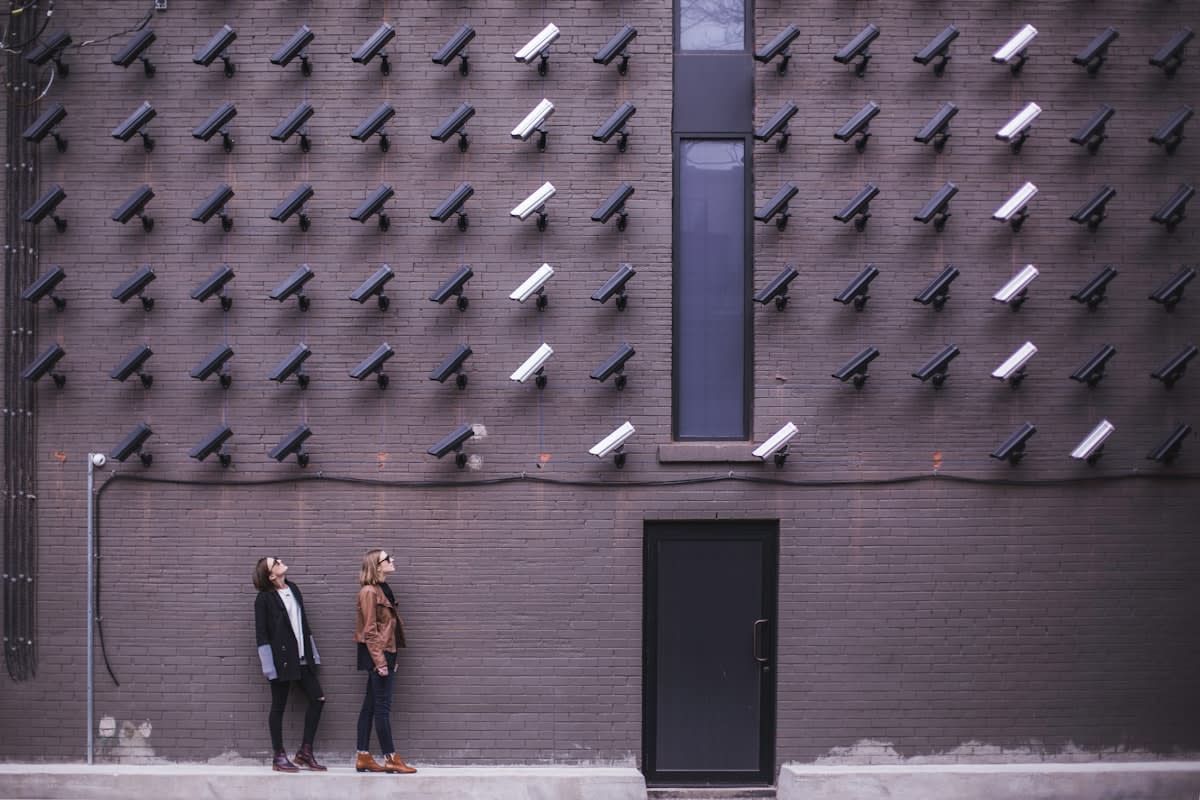
In response, European designers are not protesting with signs; they are protesting with textiles. They are developing adversarial clothing—garments featuring specific prints, infrared lights, and signal-blocking accessories designed to exploit the algorithmic weaknesses of computer vision. By using repeating motifs and shapes that confuse AI, these designers are effectively creating a digital camouflage. It is a return to the masquerade, but instead of hiding from humans, the wearer is hiding from the mathematical patterns that define a face to a machine.
"Anti-surveillance feelings are so widespread that all it would take is for a single celebrity to wear one of these garments to a high-profile event for it to take off."— Designer cited in The Guardian via Ynetnews, 2026
Why does this matter? Because it represents a shift from defensive privacy (asking for consent) to offensive privacy (disrupting the system). We are seeing a global adoption of tactics that treat the environment as a hostile actor. This isn't just about fashion; it is about the reclamation of the public square.
The Erosion of Trust and the Return of the Code
If the face is the primary target of surveillance, the voice is the primary target of fraud. AI voice cloning has evolved from a laboratory curiosity into a personal threat. Bad actors can now take a short clip of audio from a public video or a voicemail and generate a near-perfect imitation of a loved one to stage urgent, frightening calls for money or secrecy (Source: Business Insider, 2026). This is a breach of the most intimate layer of human connection: the recognition of a family member's voice.
The solution being deployed is strikingly archaic: the codeword. Apps like Trust Onion are now providing families with rotating, private codewords—a digital version of a secret handshake. When a suspicious call arrives, the recipient doesn't rely on the sound of the voice; they ask for the code (Source: Business Insider, 2026). This is a profound admission that our senses are no longer reliable indicators of truth in a synthetic world.
| Privacy Era | Core Mechanism | Primary Threat | Defensive Strategy |
|---|---|---|---|
| 18th Century | Social Secrecy | Political Espionage | Private Salons & Ciphers |
| 20th Century | Legal Rights | State Surveillance | Legislative Protection/GDPR |
| 21st Century | Adversarial Design | Algorithmic Totalism | Cloaking, Noise, & Codewords |
This return to codewords is not a step backward, but a necessary adaptation. We are moving toward a world where identity is verified not by who we are, but by what we know. The paradox is that to maintain our most human connections, we must adopt the cold, calculated methods of espionage.
The Internal Sanctuary: Privacy in Health
While the external world battles AI cameras and clones, an internal battle for privacy is playing out in the medical field. The tension between transparency and secrecy is nowhere more evident than in the diagnosis of dementia and Alzheimer's. For many, the early stages of these diseases are marked by a fierce preference for secrecy. This is not about shame, but about preserving the self before the disease erodes the capacity for autonomy (Source: Time Magazine, 2026).
Contrast this with the high-profile transparency of figures like Michael J. Fox, whose foundation has raised over $3 billion for Parkinson's research and whose public testimony boosted federal funding for neurologic research (Source: Time Magazine, 2026). While public transparency can drive systemic progress and funding, the individual's need for a private sanctuary remains paramount. The 'price of privacy' in health is often the loss of immediate support, yet for many, that price is worth paying to maintain a sense of agency.

Whether it is a designer in London using infrared lights to hide from a camera or a patient in New York keeping a diagnosis secret from their social circle, the impulse is the same: a refusal to be fully known by an external system. We are witnessing a global resurgence of the 'private sphere' as a site of resistance.
The Practitioner's Perspective: The Cat-and-Mouse Game
In the field of security and adversarial design, the debate isn't about whether these tools work, but for how long. Practitioners in computer vision are constantly iterating to overcome adversarial patterns. When a designer creates a print that confuses a facial recognition algorithm, the developers respond by training the AI on that specific print, effectively teaching the machine how to see through the camouflage. It is a relentless cycle of action and reaction.
On the ground, the friction is palpable. Security consultants are debating whether 'anti-surveillance fashion' is actually effective or merely 'security theater' that gives users a false sense of safety. Yet, the demand persists. The value is not just in the technical success of the cloak, but in the psychological act of defiance. For the practitioner, the real story is the shift in user behavior: people are now willing to pay a premium for tools that allow them to opt-out of the digital gaze.
This systemic shift suggests that the era of 'passive' privacy—where we trust a company's privacy policy—is dead. We are entering an era of 'active' privacy, where the individual takes responsibility for their own invisibility through technical and social means.
Fact-Check & Accuracy Note
Key claims regarding the expansion of LFR in Britain are sourced from Ynetnews and The Guardian (2026). The 60% public concern statistic is attributed to The Guardian. Data on AI voice cloning and the Trust Onion app is sourced from Business Insider (2026). Medical insights regarding dementia and the Michael J. Fox foundation are sourced from Time Magazine (2026). The debate regarding adversarial fashion's long-term efficacy remains an ongoing point of contention among AI researchers and designers.