2026 Physics Nobel: The science of ‘neutrinos’, ‘ghost’ particles that can reveal universe’s mysteries
Source Entity
Amitabh Sinha
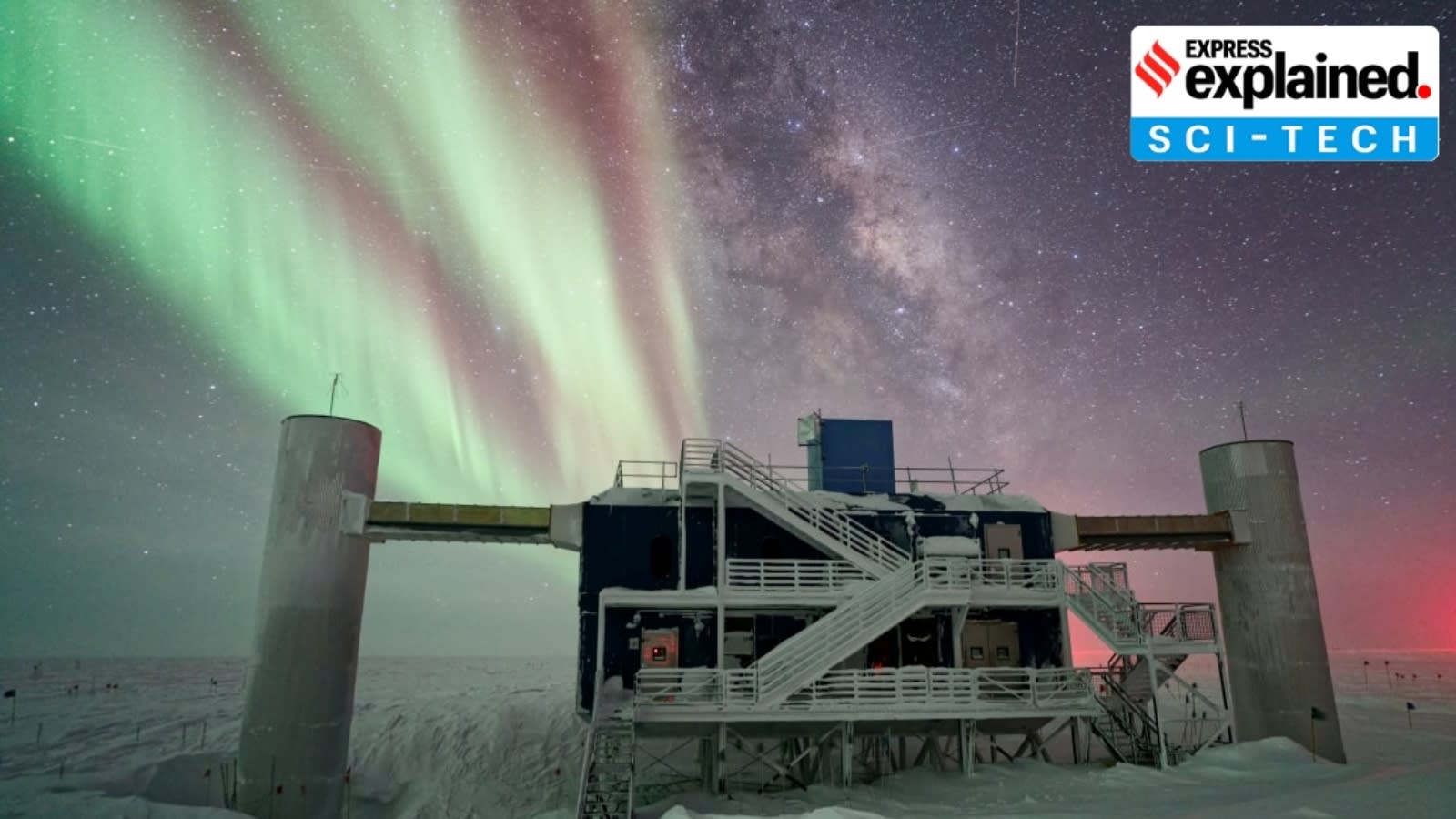
Francis Halzen has been awarded the 2026 Nobel Prize in Physics for his pioneering work with the IceCube Neutrino Observatory in Antarctica. His research successfully turned a cubic kilometer of ice into a telescope to track elusive 'ghost' particles from deep space.
The 2026 Nobel Prize in Physics: Unveiling the Ghost Particles
The 2026 Nobel Prize in Physics has been awarded to Francis Halzen, a Belgian-American physicist based at the University of Wisconsin–Madison, for his monumental contributions to neutrino astronomy. Neutrinos, often referred to as 'ghost particles' due to their extreme difficulty to detect, are among the most abundant sub-atomic particles in the universe, second only to photons. Their unique nature—interacting almost exclusively through the weak nuclear force—allows them to traverse planets, people, and traditional detectors without leaving a trace, making them the ultimate messengers from the most violent regions of our cosmos.
The Challenge of Cosmic Detection
For generations, astronomers relied on light to observe the universe. However, as noted in the research, light is easily blocked by cosmic dust and dense matter. Neutrinos represent a paradigm shift in how we view the heavens. Because they barely interact with matter, they can escape the dense, high-energy environments where they are born—such as the hearts of stars and cataclysmic stellar events—providing a clear, unadulterated window into phenomena that remain invisible to traditional optical telescopes.
Designing the IceCube Observatory
Francis Halzen’s Nobel-winning work centers on the design and implementation of the IceCube facility, an elaborate experimental setup buried deep beneath the Antarctic ice sheets. Converting a cubic kilometer of naturally occurring polar ice into a massive particle detector was a feat of engineering and vision. By instrumenting this vast volume, Halzen created a telescope capable of capturing the faint, rare interactions that occur when a high-energy neutrino occasionally strikes an atom within the ice.
Historical Context and Scientific Significance
The study of neutrinos has long been a subject of Nobel-level inquiry, but Halzen’s specific contribution addresses the long-standing problem of detection. While previous observatories paved the way, IceCube’s scale allowed for the systematic study of astrophysical neutrinos. This success validates the decades-long pursuit of these particles, as Halzen once remarked that this method allows humanity to "see things in the universe you couldn’t see any other way."
Future Implications for Astrophysics
Looking ahead, the recognition of this work signals a new era in multi-messenger astronomy. With the ability to trace neutrinos back to their high-energy sources, researchers are now better positioned to map the most extreme environments in the universe. The IceCube facility serves as a blueprint for future deep-space exploration, demonstrating that the most elusive particles in existence can indeed be harnessed to decode the fundamental mysteries of the cosmos.
Conclusion
The 2026 Nobel Prize for Francis Halzen is a testament to the persistence required in fundamental physics. By transforming the Antarctic landscape into a scientific instrument, Halzen has bridged the gap between theoretical particle physics and observational astronomy, ensuring that the 'ghost' particles that have haunted researchers for decades will now serve as vital beacons for our understanding of the universe.