Adani Defence fires four anti-tank missiles in Pokhran Test Range
Source Entity
India Latest News: Top National Headlines Today & Breaking News | The Hindu
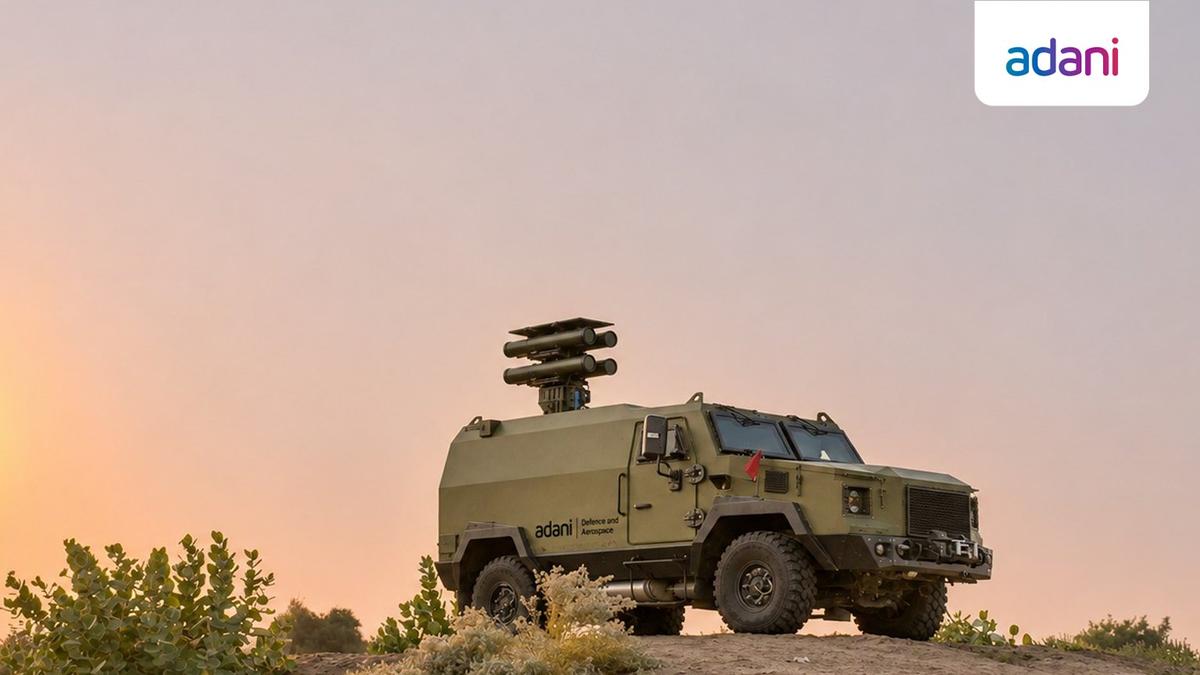
Adani Defence & Aerospace successfully tested its Bagheera AT1 anti-tank missile system at the Pokhran range. The system features an extended 8 km range and demonstrated advanced day-night engagement capabilities for the Indian military.
Breakthrough in Indigenous Defence Capabilities
Adani Defence & Aerospace has marked a significant milestone in India's journey toward defence self-reliance with the successful demonstration of the Bagheera AT1, a vehicle-mounted anti-tank guided missile (ATGM) system. Conducted at the Pokhran Field Firing Ranges in Rajasthan, the No Cost No Commitment (NCNC) trial showcased the system's ability to engage both armoured vehicles and aerial targets. By proving its efficacy in diverse scenarios, the company has positioned itself as a critical player in the domestic defence manufacturing ecosystem.
Technical Superiority and Operational Range
The standout feature of the Bagheera AT1 is its operational range, which reaches up to 8 km. This is a substantial improvement over existing land-based anti-tank missiles, which typically operate within a 4 km radius. By doubling the engagement distance, the system provides Indian ground forces with a significant tactical advantage, allowing them to neutralize threats from a safer distance while maintaining precision. The ability to perform tandem firing along a single beam further enhances its lethality against modern armoured threats.
Rigorous Validation and Multi-Domain Utility
The demonstration held on November 20 was comprehensive, focusing on real-world military requirements. According to the company, the programme successfully validated day and night engagement capabilities, ensuring that the system remains effective regardless of ambient lighting conditions. Furthermore, the successful engagement of an aerial target at an extended range indicates that the Bagheera AT1 possesses a degree of versatility that could potentially address multiple tactical requirements beyond traditional anti-tank warfare.
Strategic Implications for the Indian Army
Witnessed by senior officials from the Indian Army, the Department of Military Affairs, and the Ministry of Defence, the trial serves as a formal evaluation of the system's readiness for induction. The NCNC model allows the government to assess new technology without immediate financial risk, facilitating a transparent evaluation process. As the Indian military continues its modernization drive, integrating advanced, locally-developed systems like the Bagheera AT1 is essential for reducing import dependency and strengthening the nation's strategic autonomy.
Accelerating Indigenous Innovation
The Bagheera AT1 is the product of an intensive 18-month design and development cycle. This rapid development timeline highlights the agility of private sector defence players in India. By leveraging domestic engineering talent, Adani Defence & Aerospace is contributing to the 'Atmanirbhar Bharat' (Self-Reliant India) initiative, which prioritizes the indigenous production of military hardware. This project sets a precedent for how private enterprises can collaborate with the Ministry of Defence to deliver high-tech solutions that meet the specific operational needs of the armed forces.
Future Outlook and Strategic Trends
Looking ahead, the success at Pokhran suggests a growing trend toward high-precision, vehicle-mounted weapon systems in the Indian defence inventory. As modern battlefields become increasingly complex and dominated by advanced armour and drone threats, the demand for versatile systems like the Bagheera AT1 is expected to rise. The successful demonstration not only validates the current design but also paves the way for further iterations and upgrades, ensuring that the Indian Army remains equipped with state-of-the-art technology to address evolving security challenges.
Verification Required?