An Amazon cargo plane crashed at Miami International Airport
Source Entity
Terrence O’Brien
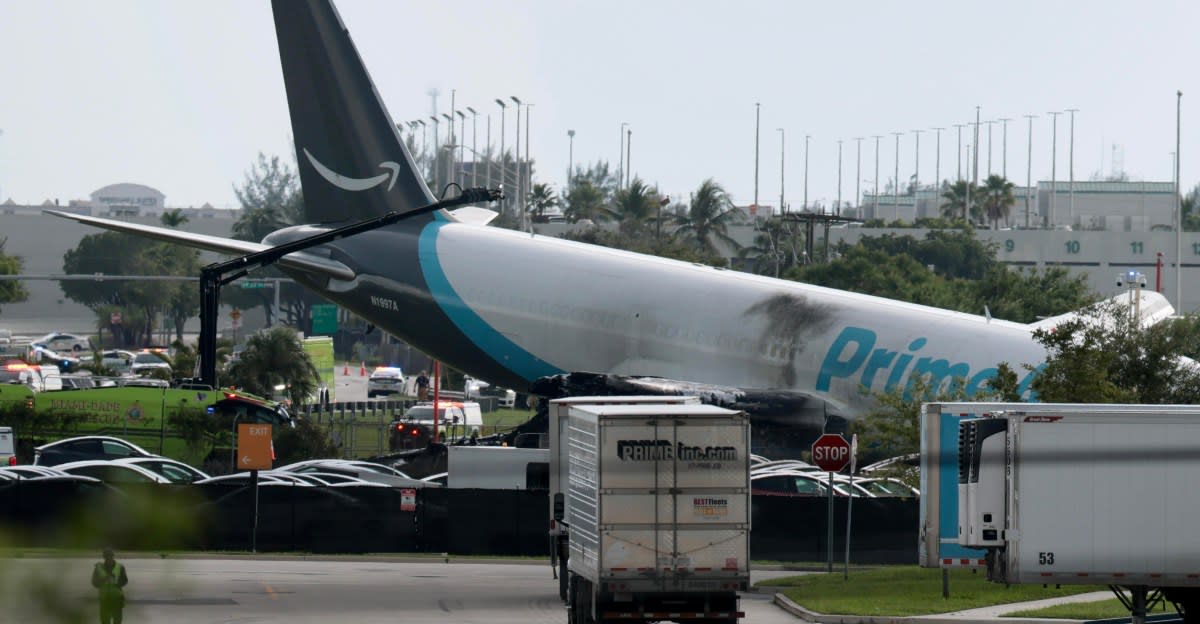
An Amazon Prime Air Boeing 767 cargo plane overran the runway at Miami International Airport after arriving from San Juan on Sunday. The incident, which caused a fire and thick smoke, led to a temporary ground stop and flight disruptions.
Runway Incursion at Miami International Airport
On Sunday, a significant aviation incident occurred at Miami International Airport (MIA) involving an Amazon Prime Air Boeing 767 cargo jet. The aircraft, which had arrived from Luis Munoz Marin International Airport in San Juan, Puerto Rico, reportedly overran the runway at approximately 2:00 p.m. local time. Following the overrun, the plane came to a rest on a road just outside the airport perimeter, with visual evidence confirming a subsequent fire and significant plumes of black smoke.
Immediate Operational Impact and FAA Response
The Federal Aviation Administration (FAA) confirmed the incident, stating that the Boeing 767-300 cargo aircraft failed to remain on the designated runway surface after landing. The immediate consequence of this overrun was the declaration of a ground stop at one of the busiest travel hubs in the United States. This emergency measure was necessary to ensure the safety of other aircraft and ground crews as thick black smoke became visible from across the city, complicating visibility and operational logistics at the airport.
Visual Documentation and Public Alarm
Social media platforms were quickly flooded with footage captured by bystanders and local news outlets, such as NBC 6. These videos provided a stark look at the massive aircraft positioned sideways across a road adjacent to the airport. The sight of a commercial cargo jet off the runway, accompanied by heavy smoke, sparked immediate public concern and widespread discussion regarding the nature of the emergency and the status of those on board.
Aviation Safety and Cargo Logistics
This incident highlights the inherent risks associated with heavy cargo operations, particularly during the landing phase. Boeing 767-300 aircraft are staples of global logistics networks like Amazon Prime Air, known for their capacity to handle high-volume freight. An overrun of this magnitude suggests a failure to decelerate sufficiently within the runway's safety area, an event that triggers rigorous investigation by federal authorities to determine if mechanical failure, pilot error, or environmental factors contributed to the loss of control.
Broader Implications for Air Travel
While the incident was localized to the periphery of the Miami runway, the disruption to flight schedules at MIA serves as a reminder of the fragility of major aviation nodes. As a critical gateway between the mainland United States and the Caribbean, any closure at Miami International Airport creates a cascading effect on regional air traffic. The FAA’s involvement in managing the aftermath underscores the prioritization of safety protocols over operational efficiency in the wake of such emergencies.
Future Outlook and Investigation
Moving forward, the focus will shift to the formal investigation phase, where experts will analyze the flight data recorder and cockpit voice recorder to piece together the final minutes of the flight from San Juan. The industry will be watching closely to see if this event leads to new safety mandates for cargo aircraft operating in high-traffic, urban-adjacent environments. For now, the primary relief remains that the incident, while visually alarming and operationally disruptive, has triggered an immediate and coordinated response to secure the site and maintain airport safety.
Multiple Citing Sources