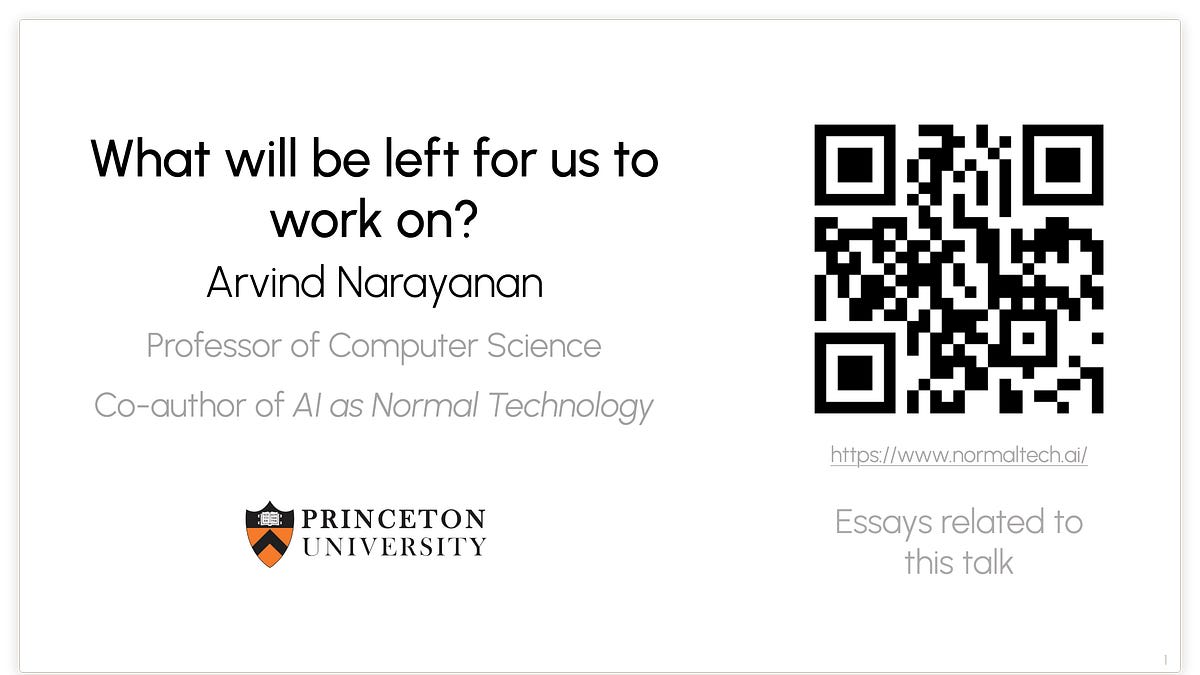
What will be left for us to work on?
Source Entity
Hacker News
<a href="https://news.ycombinator.com/item?id=48901292">Comments</a>
The Existential Crisis of the Knowledge Worker
The headline "What will be left for us to work on?" captures a pervasive sentiment currently rippling through the global technology sector. This inquiry, surfacing in community discussions on platforms like Hacker News, represents more than just a fear of unemployment; it is an existential crisis regarding the value of human intellectual labor. As Large Language Models (LLMs) and AI coding assistants evolve from simple autocomplete tools to agents capable of architecting entire features, the boundary between human creativity and machine execution is blurring. This shift forces a fundamental re-evaluation of what it means to be a 'professional' in the digital age.
The Transition from Syntax to System Design
Historically, a significant portion of a software engineer's value was tied to their mastery of syntax, library knowledge, and the ability to debug complex runtime errors. However, as AI becomes proficient at generating boilerplate code and optimizing algorithms, the 'mechanics' of coding are becoming commoditized. The analytical shift we are witnessing is a move from implementation to orchestration. Future work will likely center on system architecture, security auditing, and the precise definition of requirements. The human role is evolving into that of a 'Reviewer-in-Chief,' where the primary skill is no longer writing the code, but knowing exactly what code needs to exist and verifying its correctness within a larger, complex ecosystem.
Historical Parallels in Automation
To understand this transition, one must look at the history of computing. The move from assembly language to high-level languages like C and Java was once viewed as a threat to the 'real' programmers who understood the hardware. Similarly, the introduction of Integrated Development Environments (IDEs) and cloud computing removed the need for manual memory management and server racking. In each instance, the removal of low-level drudgery did not eliminate the need for engineers; instead, it raised the ceiling of what could be built. The current AI wave is simply the latest iteration of this trend, abstracting the 'writing' phase of software development to allow for more ambitious system-level thinking.
The Economic Paradox of Productivity
From a business perspective, the automation of cognitive tasks creates a productivity paradox. While AI can produce code faster than any human, the demand for software is effectively infinite. As the cost of producing a line of code drops toward zero, the volume of software being integrated into every facet of human life will likely explode. This suggests that while specific tasks are disappearing, the overall demand for technical oversight and product management will increase. The risk, however, lies in the 'entry-level gap,' where junior developers may struggle to find the traditional 'grunt work' roles that historically served as the training ground for becoming senior architects.
Redefining Human Value in the AI Era
As the technical barrier to entry lowers, the 'human' elements of technology—empathy, ethical judgment, and deep domain expertise—become the primary competitive advantages. AI cannot currently navigate the political nuances of a corporate boardroom, nor can it truly understand the emotional pain points of a frustrated end-user. The future of work for the tech professional will likely lean heavily into 'Product Engineering,' where the ability to bridge the gap between a vague human desire and a technical specification is the most valuable skill. The focus shifts from "How do I build this?" to "Should we build this, and why?"
Conclusion: A New Era of Intellectual Labor
In summary, the anxiety expressed in the question "What will be left for us to work on?" is a natural response to a paradigm shift. While the nature of the daily grind is changing, the necessity for human intelligence remains. We are moving toward a future where the 'work' is less about the act of creation and more about the act of curation and direction. For those who can adapt their skill sets from being 'coders' to being 'problem solvers,' the AI era promises a liberation from repetitive tasks and an invitation to tackle more complex, systemic challenges than ever before.