Google’s new SynthID website can identify AI-generated media
Source Entity
Ivan Mehta
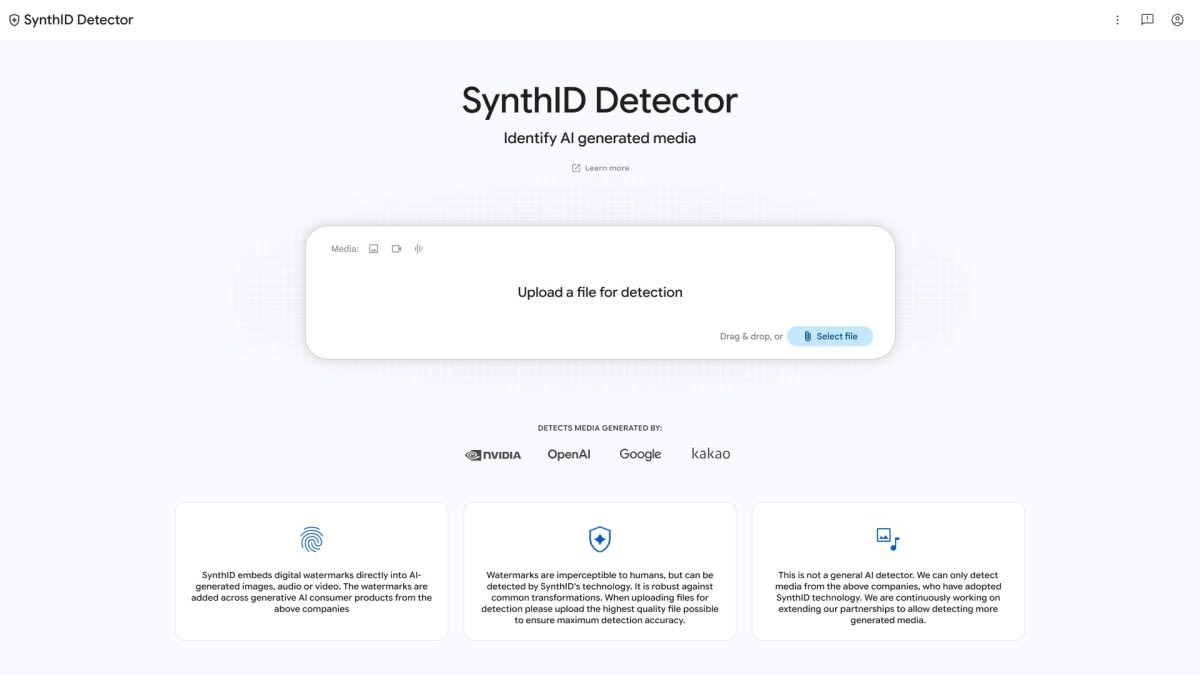
Google has launched a public-facing website allowing users to verify if images, videos, or audio files are AI-generated using its SynthID detection technology. This tool supports a wide array of media formats and detects watermarks from Google’s models and its industry partners.
Google Democratizes AI Verification with New SynthID Tool
Google has officially expanded the accessibility of its SynthID technology, launching a dedicated website that allows the general public to verify the provenance of digital media. By providing a centralized platform to detect invisible watermarks, Google is addressing the growing challenge of identifying AI-generated content in an era where synthetic media is becoming increasingly indistinguishable from reality.
How SynthID Functions
SynthID operates by embedding imperceptible digital signals directly into the structural data of media—pixel patterns in images and videos, and waveforms in audio files. This watermark remains intact even after common edits, such as resizing, color adjustments, or compression. With over 180 billion images and videos already tagged by Gemini, along with 240,000 years of audio, the infrastructure for this detection system is massive in scale, covering models like Nano Banana, Veo, and Lyria.
Expanding Industry Collaboration
While Google initially limited access to this technology to select journalists and researchers at last year’s Google I/O, the shift to a public-facing tool marks a critical step toward industry-wide transparency. The platform now supports watermarks from Google’s various partners, acknowledging that a fragmented approach to AI detection—where each company uses proprietary, closed-off systems—is insufficient to combat the proliferation of synthetic media.
Broad Format Support
To ensure utility for the average user, the new website supports a comprehensive list of file types. For images, it handles everything from standard JPG and PNG files to modern web formats like WEBP and AVIF. For audio and video, the platform accommodates common containers including MP4, MOV, WAV, and MP3, making the detection process friction-free for users who may be dealing with media from a variety of sources.
Broader Implications for Digital Trust
This rollout is a direct response to the ethical and security challenges posed by generative AI. As deepfakes and AI-generated misinformation become more sophisticated, the ability to verify media authenticity is a necessary safeguard for public discourse. By making SynthID accessible, Google is setting a baseline for digital literacy, empowering individuals to distinguish between human-created content and machine-generated outputs.
Future Trends and Limitations
Looking forward, the success of SynthID will depend on its adoption by other AI developers and social media platforms. While this website is a significant milestone, it is only one piece of the puzzle. The future of AI provenance likely involves automated verification embedded directly into social media feeds and web browsers, effectively flagging synthetic content in real-time as users consume it, rather than requiring manual uploads to a verification portal.