India rejects Kashmir references in Turkish President’s UNGA address as ‘unwarranted’
Source Entity
India Latest News: Top National Headlines Today & Breaking News | The Hindu
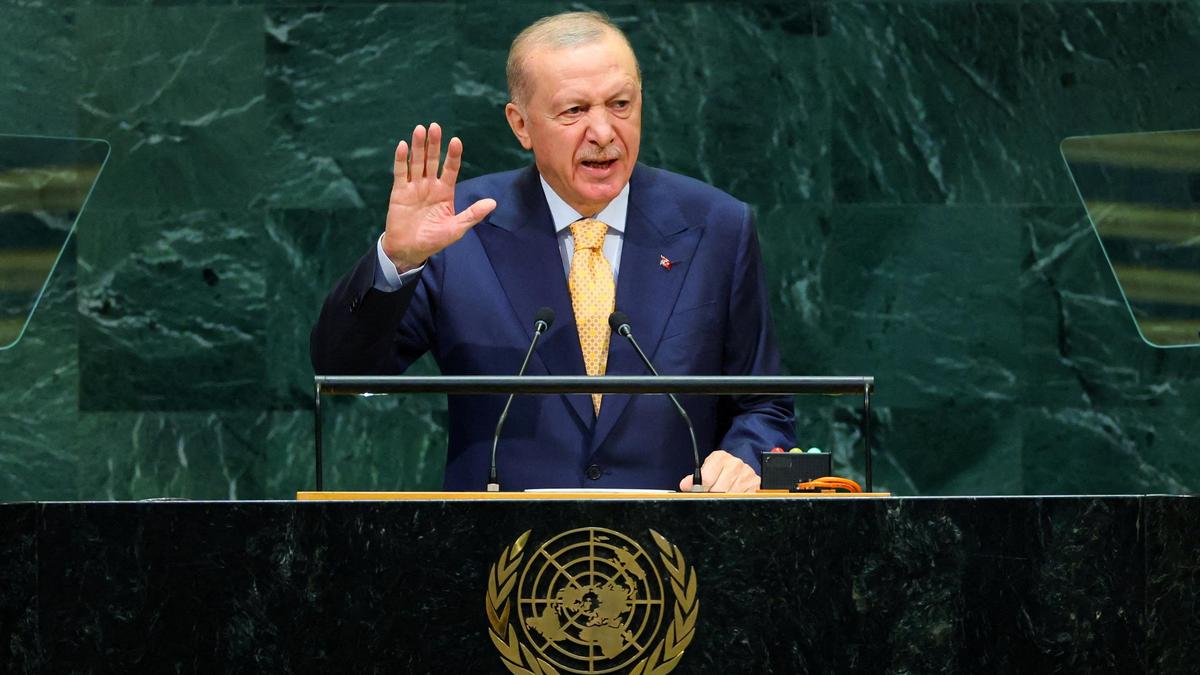
India has formally rejected Turkish President Recep Tayyip Erdogan's comments on Kashmir at the UN General Assembly. The Ministry of External Affairs labeled the remarks as unwarranted, asserting that no external party has the locus standi to comment on India's internal territorial integrity.
India Rejects Turkish Interference at UNGA
In a firm diplomatic response, the Indian Ministry of External Affairs (MEA) has officially rejected remarks made by Turkish President Recep Tayyip Erdogan during his address at the United Nations General Assembly (UNGA). President Erdogan had suggested that disputes in South Asia, specifically mentioning the Kashmir issue, should be resolved through dialogue within the framework of the United Nations. This intervention has been characterized by New Delhi as an "unwarranted reference" to the Union Territory of Jammu and Kashmir.
The Principle of Locus Standi
MEA spokesperson Randhir Jaiswal, during a biweekly media briefing, emphasized that the issue of Kashmir pertains strictly to India's territorial integrity. By using the legal term "locus standi," India is asserting that Turkey—or any other third-party nation—lacks the standing or authority to intervene in matters that are purely domestic. For India, the constitutional status of Jammu and Kashmir is a settled internal matter, and external commentary is viewed as a violation of sovereignty.
Diplomatic Friction and Global Platforms
President Erdogan’s decision to raise the Kashmir issue on the global stage at the UNGA is not an isolated incident, but rather part of a recurring pattern in Turkey's foreign policy rhetoric. By framing the dispute within the UN Charter, Turkey attempts to position itself as a mediator in South Asian affairs. However, India’s consistent policy has been to reject such internationalization, maintaining that all issues related to Jammu and Kashmir are strictly bilateral or internal, precluding any requirement for external mediation.
Implications for India-Turkey Relations
This diplomatic spat highlights the ongoing friction between New Delhi and Ankara. While the two nations maintain economic and trade ties, their geopolitical alignment often diverges. Turkey’s frequent vocal support for Pakistan’s position on Kashmir remains a primary irritant in bilateral relations. India’s swift and public rejection of these remarks serves as a clear signal that New Delhi will continue to prioritize its territorial integrity over the desire for diplomatic pleasantries with nations that challenge its sovereignty.
Future Trends in Sovereignty Assertions
Looking ahead, it is clear that India is increasingly assertive in its "zero-tolerance" policy toward international commentary on its internal affairs. As India continues to leverage its growing influence on the global stage, it is likely to maintain this firm stance, ensuring that the UNGA platform is not utilized by other nations to question its administrative decisions. This episode reaffirms that India’s diplomatic strategy is centered on reinforcing the narrative that Jammu and Kashmir is an integral part of the nation, and the international community’s role is limited to respecting this established reality.
Verification Required?