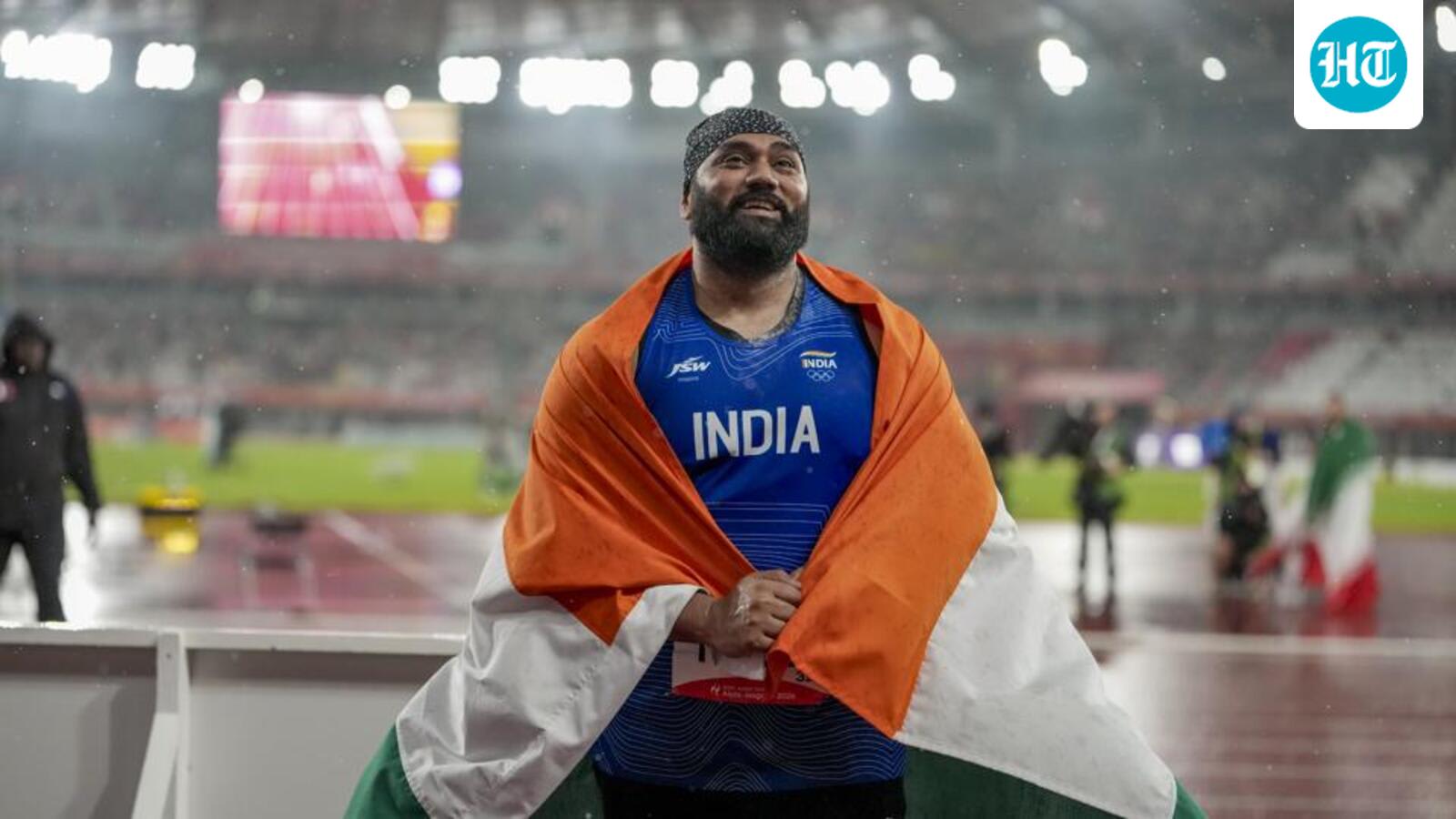
Asian Games: Tajinderpal Toor takes shot put silver, 400m bronze for Prachi
Source Entity
Latest News: Todays Latest News Headlines from India & World | Hindustan Times | Hindustan Times
Indian athletes are excelling at the Asian Games with gold-medal shooting performances and notable track-and-field successes. Meanwhile, Tejaswin Shankar's physical transformation highlights the rigorous preparation required for elite decathlon competition.
A Golden Redemption: Resilience in Asian Games Shooting
The recent triumph of shooters Suruchi Phogat and Kamaljeet Singh at the Asian Games serves as a testament to the psychological resilience required at the highest levels of international competition. Following individual events that left both athletes grappling with the disappointment of unrealized potential, the duo found a unique path to redemption. While Phogat sought recovery through an extensive 13-hour sleep to reset her focus, Singh faced the restlessness of a four-hour night. Despite these contrasting approaches to stress management, their shared commitment allowed them to coalesce into a formidable pair.
Record-Breaking Synergy
Paired together at the eleventh hour for the 10m air pistol mixed team event, Phogat and Singh demonstrated remarkable adaptability. Their combined score of 484.6 points not only secured the gold medal but also established a new Asian Games record. By decisively outpacing the South Korean pair of Choo Gaeun and Hong Suhyeon (478.0) and the Iranian bronze medalists (415.8), the Indian shooters proved that tactical synergy can often override the lack of long-term preparation, provided the individual technical foundations are sound.
The Surge in Indian Athletics
Beyond the shooting range, India’s presence at the regional games has been bolstered by a broader surge in track-and-field performance. The momentum established by Seema Kumari’s bronze medal in the women’s 10,000m event provided the necessary spark for Gulveer Singh to secure a silver medal in the men’s 10,000m final. This cumulative success in endurance events highlights a shift in Indian athletics, where consistent podium finishes are becoming the standard rather than the exception.
The Anatomy of a Decathlete
Perhaps the most compelling narrative of physical evolution is that of Tejaswin Shankar. Transitioning from a specialized high jumper—a discipline that favors a lean frame and a high center of mass—to a decathlete required a complete overhaul of his physiological profile. Under the guidance of strength and conditioning expert Wayne Lombard, Shankar underwent a rigorous transformation over nine years, moving from a 78kg frame to a robust 90kg.
Strategic Physical Transformation
This transformation involved more than just weight gain; it necessitated a fundamental restructuring of muscle mass and aerobic capacity. By decreasing his body fat percentage while increasing functional strength, Shankar adapted his 6’4” frame to meet the diverse demands of ten separate track and field events. His journey from a freshman at Kansas State University to a competitive decathlete underscores the extreme dedication and scientific planning inherent in modern multi-event sports.
Conclusion: A New Era for Indian Sports
The collective achievements of these athletes—whether through the mental fortitude shown by the shooters, the endurance displayed on the track, or the physical discipline of the decathletes—signal a maturing sports ecosystem in India. As these individuals continue to push the boundaries of their respective disciplines, the broader implication is a sustained trajectory of excellence that positions India as a dominant force in future international competitions.
Multiple Citing Sources
Verification Required?