Show HN: 1667, a terminal UI for writing fiction with language models
Source Entity
Hacker News
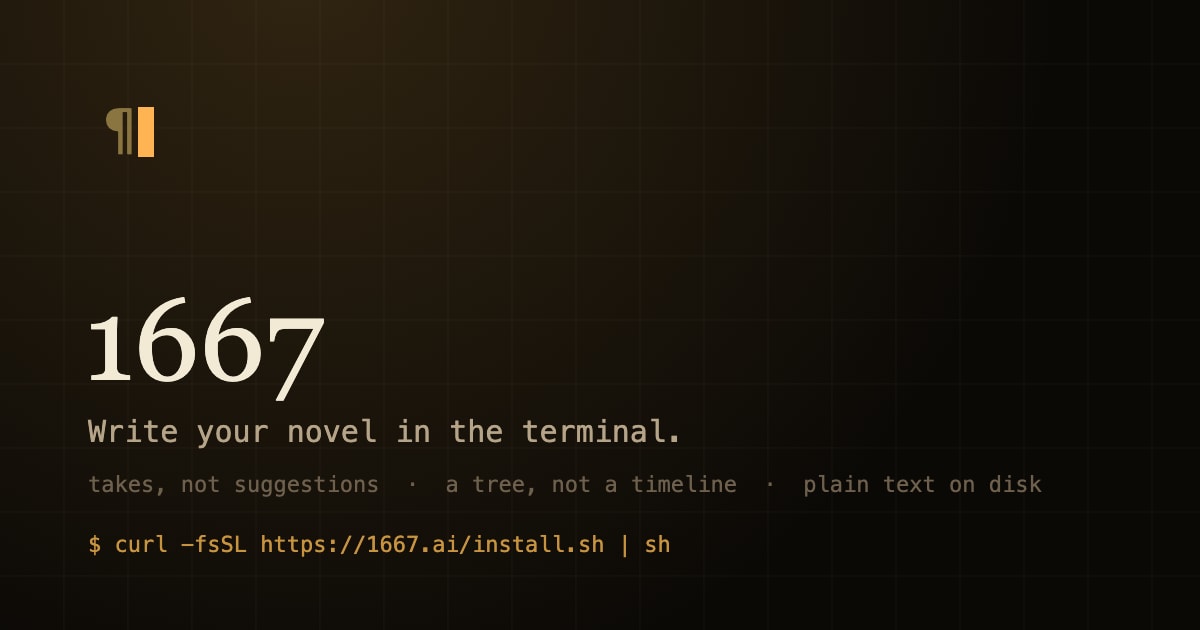
Recent developer community highlights include '1667', a terminal-based interface for AI-assisted fiction writing, and 'Vocal Slice', a privacy-focused tool for editing audio via text selection. Both tools prioritize local processing and specialized workflows for creative professionals.
Innovation in Creative Tooling: A Look at 1667 and Vocal Slice
The recent showcase of specialized software tools on community platforms highlights a growing trend in developer-led innovation: the pursuit of highly focused, privacy-conscious applications for creative workflows. Among these, the project '1667' and 'Vocal Slice' stand out as examples of how developers are rethinking traditional interfaces for writing and audio production.
1667: Reimagining the Writing Interface
1667 presents a unique approach to fiction writing by utilizing a terminal-based user interface (TUI) integrated with language models. By allowing users to navigate through various 'takes' of a story—such as the provided example involving a character named Maren and a mysterious compass—writers can map out narrative paths and explore branching possibilities. This interface moves away from the standard word processor, offering a streamlined environment that keeps the focus on the creative act while leveraging AI to suggest directions, such as the prompt to 'let the unlit lantern answer.'
Vocal Slice: Prioritizing Privacy and Efficiency
In the realm of audio engineering, Vocal Slice addresses a common pain point: the tedious process of manual audio clipping. By allowing users to cut audio simply by selecting corresponding text, the tool bridges the gap between transcriptions and waveform editing. The most critical aspect of this software is its commitment to on-device processing. In an era where cloud-based AI tools often raise data privacy concerns, the fact that a user's audio never leaves their machine is a significant value proposition for content creators and professionals handling sensitive media.
The Shift Toward Local and Specialized Computing
Both 1667 and Vocal Slice underscore a broader movement within the software ecosystem toward 'local-first' applications. By avoiding mandatory account registrations and cloud dependencies, these tools empower creators to maintain full ownership of their work. For 1667, this means a distraction-free writing environment; for Vocal Slice, it ensures that proprietary or personal audio files remain secure. This trend suggests that users are increasingly favoring tools that offer high performance without compromising on data sovereignty.
Future Implications for Creative Workflows
As these tools evolve, we can expect to see a higher demand for interfaces that treat AI not as a separate chatbot, but as an integrated layer within specialized software. The success of these projects on platforms like Show HN suggests that developers are hungry for tools that respect the nuance of creative production. Future iterations of such software will likely focus on even deeper integration, perhaps allowing for more complex multi-modal interactions where text and audio workflows become increasingly indistinguishable.
Conclusion
In summary, 1667 and Vocal Slice represent a sophisticated segment of the software market that prioritizes user agency and specialized utility. By stripping away unnecessary features and focusing on the core mechanics of writing and audio editing, these tools provide efficient, secure, and intuitive environments that cater to the specific needs of modern digital creators.