Denied gratuity for working less than 5 years; court orders payout with 10% interest
Source Entity
TOI BUSINESS DESK
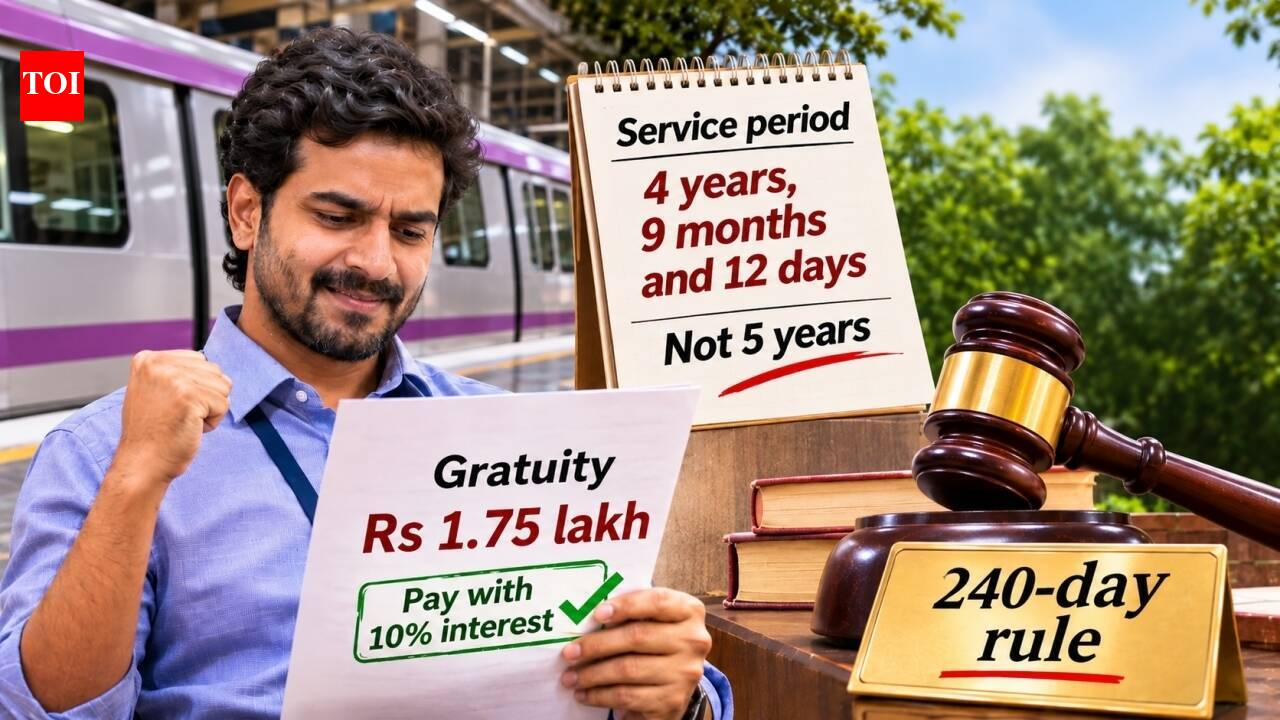
The Karnataka High Court ruled that a former BMRCL employee is entitled to gratuity despite serving less than five years. The court emphasized that the five-year service requirement should not be interpreted as a strict calendar-year mandate.
Karnataka High Court Reinterprets Gratuity Eligibility
A significant legal precedent has emerged from the Karnataka High Court regarding labor rights, specifically concerning the Payment of Gratuity Act, 1972. The case involved an assistant engineer employed by the Bengaluru Metro Rail Corporation (BMRCL), who served for four years, nine months, and 12 days before resigning. Despite falling short of the traditional five-year mark often associated with gratuity eligibility, the court ruled in favor of the employee, ordering the corporation to pay the requested Rs 1.85 lakh along with 10% interest.
The Legal Nuance of 'Five Years'
The core of the dispute rested on the rigid interpretation of the five-year service threshold. The BMRCL had initially denied the claim on the grounds that the employee did not complete five full calendar years of service. However, the High Court observed that such disputes cannot be decided solely by a literal, mechanical check of calendar dates. This ruling signals a shift toward a more equitable interpretation of labor laws, prioritizing the substance of service over rigid bureaucratic timelines.
Implications for Corporate Human Resources
This judgment serves as a wake-up call for Human Resources departments and legal teams within public sector undertakings and private corporations alike. By challenging the strict 'five-year rule,' the court has opened a pathway for employees who have served substantial periods—nearly reaching the milestone—to claim their rightful terminal benefits. Companies may now need to revise their gratuity settlement policies to ensure compliance with this more nuanced judicial interpretation.
Historical Context and Labor Protection
Historically, the Payment of Gratuity Act was designed as a social security measure to reward long-serving employees. Over the decades, litigation has frequently centered on the ambiguity of 'continuous service.' By ruling that the BMRCL must pay the gratuity with 10% interest, the court has reinforced the principle that gratuity is a statutory right rather than a mere discretionary bonus, and that minor shortfalls in service duration should not automatically disqualify a worker.
Future Trends in Labor Litigation
Looking forward, this verdict is likely to encourage more employees who have been denied benefits due to minor service duration gaps to seek legal recourse. It underscores a growing trend in the Indian judiciary of protecting the rights of the workforce against rigid administrative interpretations. As labor laws continue to evolve, the emphasis will likely remain on providing relief based on the spirit of the legislation, ensuring that employees are not unfairly deprived of their hard-earned terminal benefits due to technicalities.