'Liars': Laura Loomer claims Mitch McConnell's hospital photo is AI-generated
Source Entity
Latest News: Today's Latest News Headlines from India & World | Hindustan Times | Hindustan Times
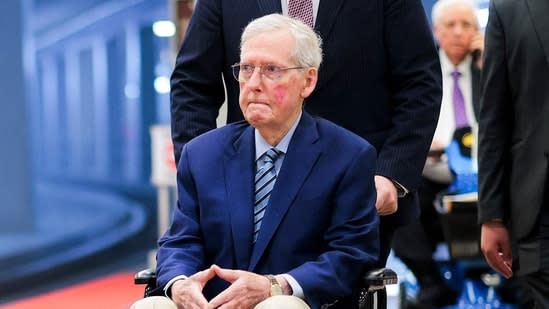
Mitch McConnell revealed a fall led to his hospitalization, but his statement photo has sparked online claims that it looks ‘AI generated.’
The Intersection of Health, Politics, and Digital Skepticism
The recent hospitalization of Senator Mitch McConnell following a fall has transitioned from a health concern to a flashpoint of digital disinformation. While the Senator's team released a photograph to provide transparency and reassure the public of his condition, the image has instead become a catalyst for accusations of deception. The claim, spearheaded by provocative political commentator Laura Loomer, asserts that the photo is not a genuine capture of the Senator in a medical setting but is instead a product of artificial intelligence (AI). This incident underscores a volatile new era in political communication where visual evidence is no longer accepted as primary proof of truth.
The Anatomy of the AI Accusation
Laura Loomer's use of the term 'Liars' to describe the source of the image reflects a growing trend of 'AI-skepticism' within highly polarized political circles. By claiming the photo is AI-generated, Loomer is leveraging the current public anxiety surrounding deepfakes and generative imagery. In the modern digital landscape, any visual anomaly—such as unusual lighting, blurred textures, or atypical anatomical rendering—is often seized upon as 'proof' of AI manipulation. In this specific case, the accusation serves to delegitimize the official narrative surrounding McConnell's health, suggesting that the political establishment is fabricating evidence to mask a more severe reality.
The 'Liar's Dividend' in Political Discourse
This event is a textbook example of what researchers call the 'Liar's Dividend.' This phenomenon occurs when the mere existence of AI-generated content allows individuals to dismiss authentic evidence as fake. Because the public is now aware that hyper-realistic images can be created with a few prompts, political actors can cast doubt on genuine photographs to suit their own narratives. By framing McConnell's hospital photo as a fabrication, the accuser does not necessarily need to prove it is AI; they only need to plant the seed of doubt, thereby eroding the credibility of the official statement and the institution it represents.
Internal Party Friction and Targeted Narratives
To understand the depth of this analysis, one must consider the political dynamics between Laura Loomer and Senator Mitch McConnell. Loomer often positions herself as an outsider fighting against the 'establishment' wings of the Republican Party, a camp that McConnell has long led. Therefore, the claim that the photo is AI-generated is likely less about digital forensics and more about a broader political strategy to paint McConnell and his allies as dishonest. By targeting a moment of physical vulnerability, the narrative shifts from a simple health update to a conspiracy regarding the Senator's actual state and the honesty of his staff.
Broader Implications for Visual Truth
Looking forward, the McConnell incident suggests a precarious future for political transparency. If every photograph released by a public official can be dismissed as AI-generated, the utility of visual communication as a tool for accountability vanishes. We are moving toward a period where 'proof' will require cryptographic verification or third-party authentication (such as C2PA standards) to be believed. The willingness of high-profile commentators to label official imagery as 'AI' without forensic evidence signals a shift where belief is dictated by political alignment rather than empirical observation.
Conclusion: The Erosion of Shared Reality
In summary, the controversy surrounding Senator Mitch McConnell's hospital photo is a symptom of a deeper systemic issue: the collapse of a shared objective reality. When a simple photo of a recovery process is viewed through the lens of generative AI conspiracies, it demonstrates that the technical capability to create fakes has created a psychological environment where nothing is inherently believable. This cycle of accusation and denial not only complicates the public's understanding of a leader's health but also further polarizes the political landscape, making transparency an almost impossible goal.
Verification Required?