Diego Maradona and Lionel Messi: Twin legacies, intertwined yet distinct
Source Entity
NILESH BHATTACHARYA
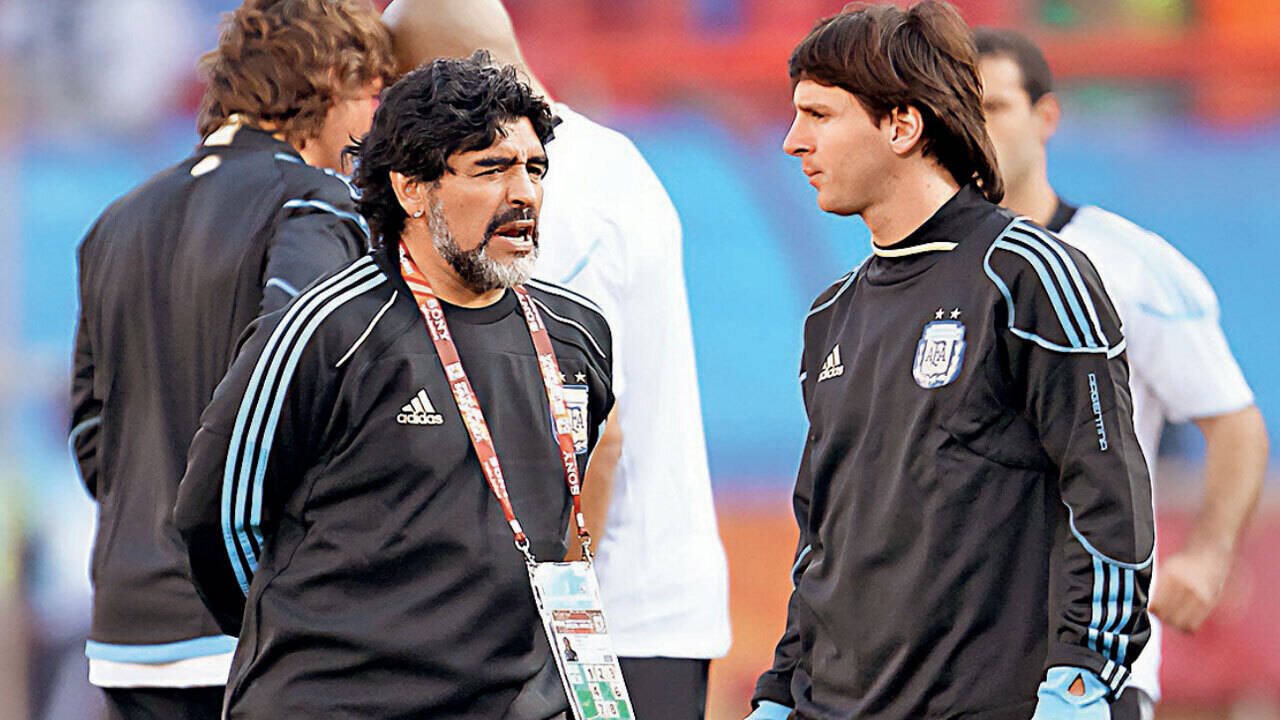
An analysis of the parallel legacies of Lionel Messi and Diego Maradona, highlighting Messi's journey from national team frustration to global glory under the guidance of manager Lionel Scaloni.
The Eternal Dialogue: Messi, Maradona, and the Argentine Soul
For decades, Argentine football has been defined by a singular, towering shadow: that of Diego Maradona. The cultural weight of the 1986 World Cup victory created a benchmark of heroism that seemed almost impossible to replicate. For a significant portion of his career, Lionel Messi existed in a paradoxical state—widely regarded as the greatest player to ever touch a ball at the club level, yet viewed with a sense of incomplete longing regarding his national team contributions. The narrative of Messi's career was long haunted by 'national team lows,' characterized by heartbreaking losses in finals and the crushing pressure of being the sole hope for a nation obsessed with returning to the pinnacle of global football.
The Psychological Weight of Comparison
The intertwining of Messi and Maradona's legacies is not merely a comparison of statistics, but a study in national identity. While Maradona was the rebellious, visceral force of the 1980s, Messi represented a more reserved, technical perfection. However, the frustration Messi faced in his early years with the Albiceleste served as a stark contrast to Maradona's iconic status. To the Argentine public, the lack of a major international trophy was a void that individual brilliance could not fill. This period of struggle added a layer of tragedy to Messi's narrative, making his eventual ascent not just a sporting achievement, but a psychological liberation from the ghost of the past.
The Scaloni Catalyst and Collective Evolution
A pivotal shift in this trajectory occurred under the leadership of manager Lionel Scaloni. Unlike previous regimes that often attempted to build a rigid system around Messi's individual talent, Scaloni implemented a philosophy of collective support. He fostered a team environment where the players did not simply play with Messi, but played for him. By creating a tactical structure that shielded Messi from excessive defensive burdens and provided him with a synergistic support system, Scaloni unlocked a version of Messi that was both more efficient and more emotionally invested in the team's collective success. This shift from individualism to a cohesive unit was the missing piece of the puzzle.
Mirroring the Icon: The Path to Redemption
The eventual securing of major titles—most notably the Copa América and the FIFA World Cup—effectively mirrored the legendary arc of Diego Maradona. Just as Maradona's 1986 triumph cemented him as a national deity, Messi's late-career surge provided a mirror image of redemption. By overcoming years of personal and professional frustration on the international stage, Messi did more than just win trophies; he validated his legacy in the eyes of the most skeptical critics. The parallel is clear: both men carried the hopes of an entire nation on their shoulders and both succeeded in delivering the ultimate glory, though their paths to that peak were vastly different.
Redefining the Modern Legacy
This victory has redefined Messi's legacy for a new generation of fans. He is no longer seen as the 'quiet genius' who excelled in Spain but struggled at home; he is now the complete archetype of the footballing legend. The collective effort of the current Argentine squad has demonstrated that while individual brilliance can win games, a unified cultural and tactical identity wins championships. This evolution marks a transition in Argentine football history, moving from the era of the 'lone savior' exemplified by Maradona to an era of 'supported greatness' exemplified by Messi and Scaloni.
Conclusion: A Unified Heritage
In conclusion, the legacies of Diego Maradona and Lionel Messi are no longer in competition, but are instead intertwined as two pillars of the same temple. Messi's journey from the depths of national frustration to the heights of World Cup glory completes a narrative arc that mirrors the passion and resilience of Argentina itself. By synthesizing individual mastery with a supportive team structure, Messi has not only matched the iconic status of Maradona but has expanded the definition of what it means to be a sporting icon in the modern era. Their twin legacies now stand as a testament to the enduring power of football to define national pride.