Space junk cloud discovered in key satellite orbit raises collision concerns
Source Entity
The Indian Express
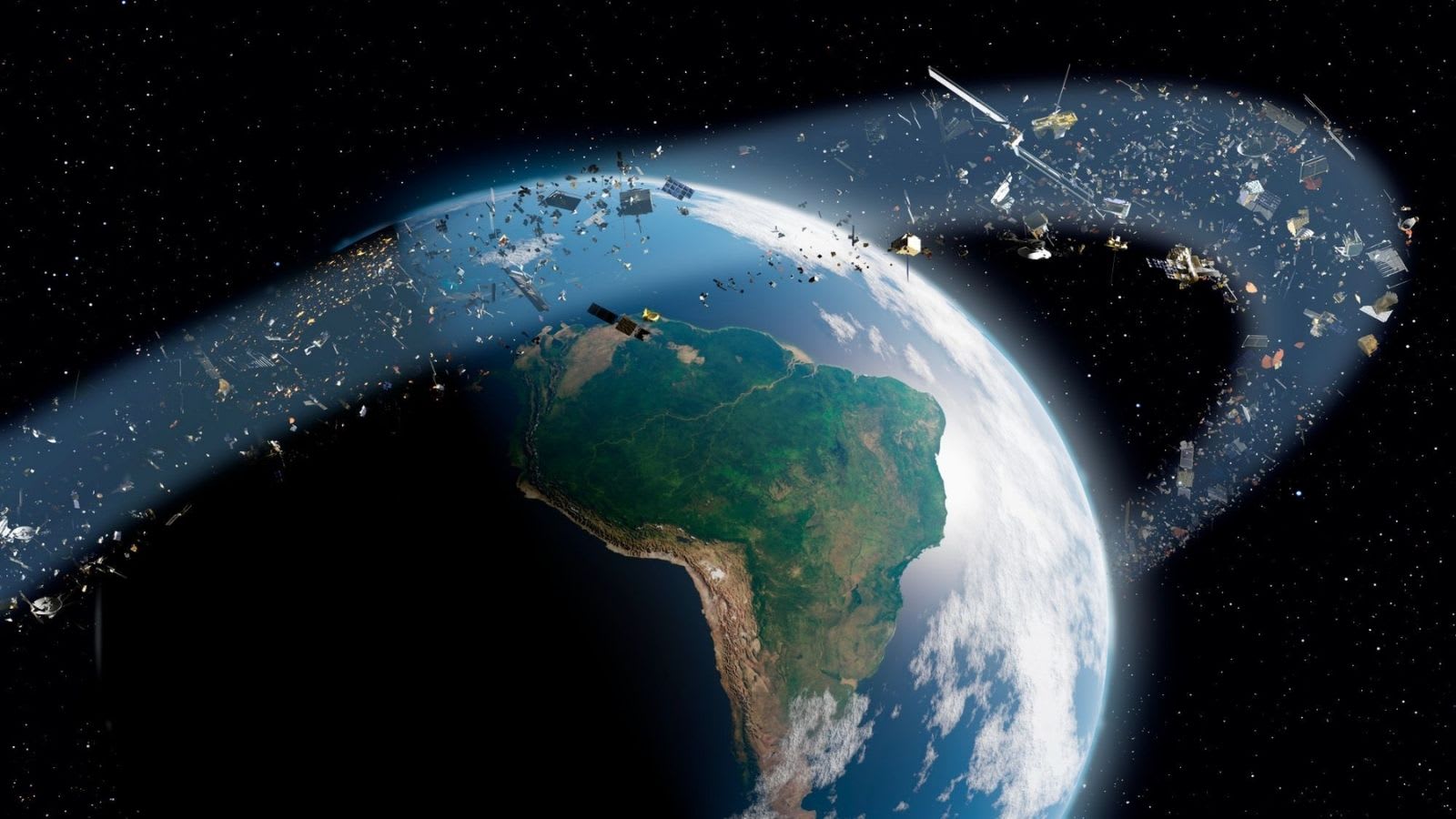
A new scientific study has identified a previously undetected cloud of small space debris within geostationary orbit (GEO), posing a significant collision risk to critical communications, weather, and broadcasting satellites.
The Invisible Threat: Analyzing the Discovery of the Geostationary Debris Cloud
The discovery of a hidden cloud of small space debris in geostationary orbit (GEO) marks a critical turning point in our understanding of orbital sustainability. While the international community has long been aware of the 'space junk' problem in Low Earth Orbit (LEO), the revelation that a concentrated cloud of fragments exists in the higher GEO region introduces a new layer of risk. This discovery underscores the limitations of current tracking technologies, which are often unable to detect smaller fragments that nevertheless possess enough kinetic energy to disable a multi-billion dollar satellite.
The Strategic Importance of Geostationary Orbit
To understand the gravity of this discovery, one must first understand the unique nature of geostationary orbit. Located approximately 35,786 kilometers above Earth's equator, GEO allows satellites to orbit at the same speed as the Earth's rotation, effectively remaining fixed over a single longitudinal point. This makes it the most valuable 'real estate' in space, as it is the primary hub for global telecommunications, satellite television broadcasting, and critical meteorological monitoring. Unlike LEO, where satellites move rapidly across the sky, GEO is a finite resource; there are only so many 'slots' available to prevent interference, making any increase in debris a direct threat to the stability of these essential services.
The Danger of 'Small' Debris and Kinetic Energy
One of the most alarming aspects of this study is the focus on small debris. In the vacuum of space, size is a deceptive metric for danger. Due to the extreme orbital velocities involved, even a fragment the size of a marble or a paint fleck can strike a satellite with the force of a hand grenade. Because these small objects are often below the detection threshold of ground-based radar and optical telescopes, they represent a 'stealth' threat. Satellite operators cannot perform avoidance maneuvers if they cannot see the incoming projectile, leaving our global communication infrastructure vulnerable to unpredictable and catastrophic failures.
Escalation Risk: The Kessler Syndrome in GEO
This discovery brings the theoretical 'Kessler Syndrome' closer to reality in the GEO belt. The Kessler Syndrome describes a scenario where the density of objects in orbit is high enough that a single collision creates a cascade of further collisions, eventually rendering specific orbits unusable for generations. While GEO is less crowded than LEO, the discovery of a concentrated debris cloud suggests that we may already be seeing the early stages of fragmentation events. If a large, active communications satellite were to be struck by a piece of this hidden debris, the resulting cloud of thousands of new fragments could trigger a chain reaction, jeopardizing every other asset in that orbital plane.
Socio-Economic and Global Implications
The implications of losing GEO stability extend far beyond the scientific community. Modern civilization relies on these satellites for real-time weather forecasting—essential for disaster mitigation and agriculture—and for secure military and diplomatic communications. A significant collision event could lead to widespread outages in satellite internet and broadcasting, causing massive economic disruption. Furthermore, the lack of a centralized, global authority to manage 'space traffic' means that the responsibility for mitigation is fragmented among private companies and national space agencies, increasing the likelihood of a coordinated failure in response to this new threat.
Future Trends and Mitigation Strategies
Moving forward, this discovery will likely accelerate the development of Active Debris Removal (ADR) technologies. We can expect a surge in research into 'space tugs' and robotic arms designed to capture and de-orbit defunct satellites before they fragment. Additionally, there will be increased pressure on satellite manufacturers to implement 'end-of-life' protocols, ensuring that satellites are moved to a 'graveyard orbit' once their mission ends. The discovery of this cloud serves as a stark warning: without an international treaty on debris mitigation and a leap in tracking precision, the very orbits that enabled the digital age could become inaccessible barriers to future exploration.